
Japanese Electronics Brands: 25 Leading Companies and What They Do Best
Japanese electronics brands include some of the world’s most recognizable names in cameras, gaming, audio, printing, home appliances, factory automation, sensors and semiconductors. Sony, Panasonic, Canon, Nikon, Fujifilm, Nintendo, Epson, Brother, Casio and Yamaha are familiar to consumers, while Mitsubishi Electric, Omron, Keyence, Murata, TDK, Renesas and ROHM are especially important in industrial and component markets.
The best Japanese electronics brand depends on the product category. Sony may be a strong reference for cameras, gaming and audio, while Canon and Nikon specialize in imaging. Epson and Brother are better known for printing. Mitsubishi Electric, Omron and Keyence serve industrial applications, while Murata, TDK, Renesas and ROHM supply components used inside finished electronic products.
What are the best Japanese electronics brands?
The following list includes both consumer-facing brands and companies that play important roles in industrial electronics, electronic components and semiconductor supply chains.
| Brand | Strongest fields | Best known for |
|---|---|---|
| Sony | Entertainment, imaging, sensors and audio | PlayStation, Alpha cameras, image sensors and headphones |
| Panasonic | Appliances, energy and business solutions | Home appliances, batteries and professional systems |
| Canon | Imaging, printing and industrial equipment | EOS cameras, lenses, printers and imaging systems |
| Nikon | Optics, imaging and precision equipment | Cameras, lenses, microscopes and lithography systems |
| Fujifilm | Imaging, healthcare and electronic materials | Cameras, Instax, medical imaging and semiconductor materials |
| Nintendo | Gaming hardware and software | Switch systems and first-party game franchises |
| Epson | Printing, projection and manufacturing systems | Inkjet printers, projectors and compact robots |
| Brother | Printing, labelling and industrial equipment | Laser printers, label systems and sewing equipment |
| Casio | Portable digital products | G-SHOCK watches, calculators and electronic keyboards |
| Yamaha | Musical instruments and audio | Digital pianos, mixers, speakers and AV equipment |
| Sharp | Displays and appliances | Televisions, displays, air purifiers and kitchen appliances |
| Toshiba | Infrastructure, storage and electronic devices | Hard drives, power systems and semiconductor devices |
| Hitachi | Digital systems, energy and mobility | Industrial systems, rail equipment and digital infrastructure |
| Mitsubishi Electric | Automation, power and building systems | PLCs, servo systems, HVAC and power electronics |
| Fujitsu | Enterprise computing and digital services | Servers, computing systems and business technology |
| NEC | IT, communications and public systems | Network, biometric and enterprise systems |
| Omron | Automation, sensing and healthcare | Controllers, sensors, relays and healthcare devices |
| Keyence | Sensors, machine vision and measurement | Vision systems, laser sensors and industrial metrology |
| Murata | Electronic components and RF modules | Capacitors, filters, sensors and wireless modules |
| TDK | Passive components, sensors and power products | Capacitors, inductors, sensors and power supplies |
| Renesas | Semiconductor devices | Microcontrollers, processors and analogue devices |
| ROHM | Power and analogue semiconductors | Power ICs, SiC devices, LEDs and discrete components |
| Ricoh | Printing, imaging and workplace systems | Multifunction printers and document solutions |
| JVCKenwood | Audio, communications and automotive electronics | Car audio, radios and professional communication equipment |
| Roland | Electronic musical instruments | Synthesizers, digital pianos, electronic drums and effects |
Why are Japanese electronics brands so well known?
Japanese electronics companies became globally known through portable audio, cameras, televisions, video recording, gaming, calculators, printers and semiconductor technology.
Their reputation was built through precise optical and mechanical engineering, consistent manufacturing, long-term product development, compact design, component expertise, reliability testing and deep knowledge in imaging, audio, automation and materials. However, it would be inaccurate to assume that every Japanese product is automatically more durable than every competing product. Quality still differs by product series, price level, factory, component selection and regional distribution.
The industry has also changed. Japan no longer dominates every mass-market consumer electronics category as it once did. Competition from South Korea, China, Taiwan and the United States has reduced its position in televisions, computers, smartphones and other finished products. Many Japanese companies have strengthened their positions in less visible but technically demanding fields such as image sensors, semiconductor materials, passive components, factory automation, power devices and precision systems.
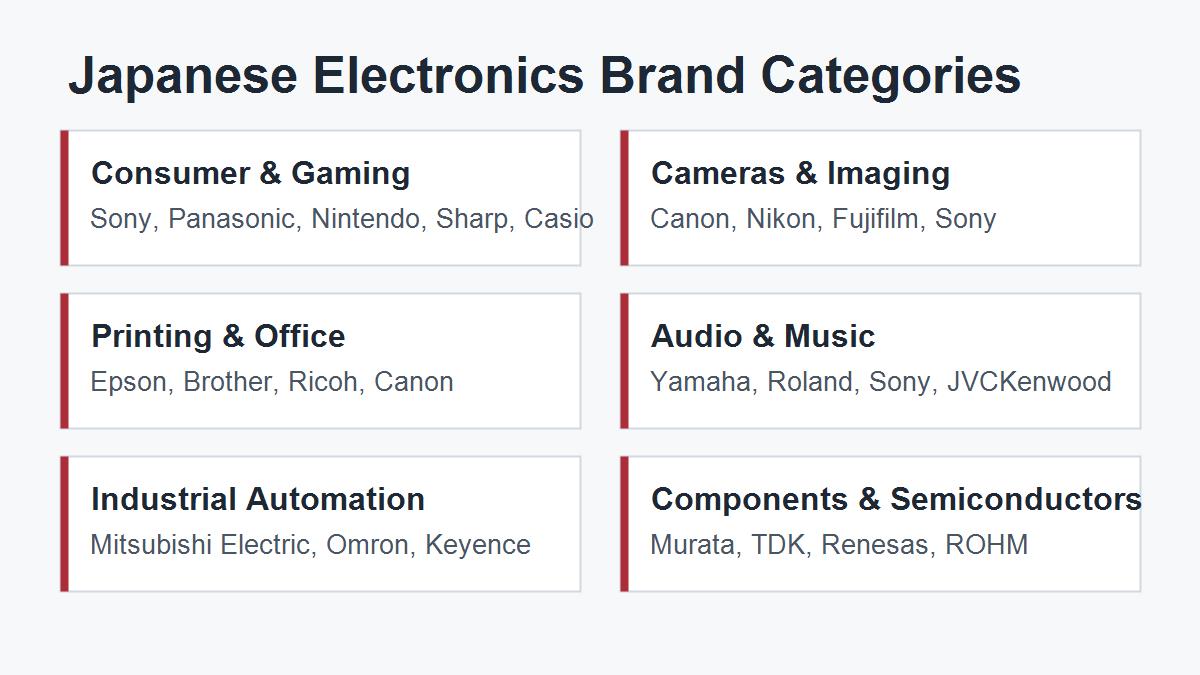
Leading Japanese consumer electronics and gaming brands
Consumer-facing Japanese electronics brands are the names most buyers recognize first. They are strongest in entertainment, appliances, cameras, gaming, audio and portable digital products.
Sony
Sony is one of Japan’s broadest technology groups, with activities in game and network services, music, film, entertainment technology, imaging and sensing. Consumers know Sony for PlayStation gaming systems, Alpha mirrorless cameras, professional video equipment, headphones, televisions and image sensors.
Sony is suitable for buyers who value imaging performance, autofocus capability, gaming content, media integration or premium audio. The main purchasing concern is ecosystem cost. A camera body, for example, should be evaluated together with lenses, batteries, microphones, storage and editing requirements.
Panasonic
Panasonic serves both consumer and business markets. It is recognized for home and kitchen appliances, personal-care devices, heating and cooling products, professional audiovisual equipment, cameras, video products, energy systems and battery technologies.
Panasonic is often a practical option when daily usability and functional engineering matter more than fashionable product styling. Product availability varies by country, so buyers should compare the exact model sold in their region rather than assuming that Japan-market and export models are identical.
Nintendo
Nintendo differs from many electronics brands because its hardware value is closely connected to proprietary software, characters and game ecosystems. The company develops gaming hardware and software built around shared entertainment experiences.
Nintendo is most suitable for family gaming, portable gaming, local multiplayer, exclusive game franchises and users who prefer accessible gameplay. Buyers should review game availability, account region, online-service requirements, storage, accessory compatibility and parental controls.
Sharp
Sharp is associated with displays, televisions, air-treatment products, home appliances and office equipment. The brand has a long connection with LCD technology, calculators, microwave ovens, air purifiers and household products.
Sharp can be a suitable choice when a specific model provides the required appliance functions, display characteristics or local service support. Buyers should examine the exact product rather than relying only on Sharp’s historic reputation in display technology.
Casio
Casio focuses on watches, calculators, electronic musical instruments and selected compact digital products. Its international product categories include G-SHOCK watches, scientific calculators and electronic keyboards.
Casio is strong where buyers need compact design, long battery life, shock resistance, straightforward operation, portable educational tools or affordable electronic instruments. Its narrower specialization is part of its strength.
Leading Japanese camera, imaging and printing brands
Japanese companies have an unusually strong position in cameras, lenses, optical systems, printers and imaging workflows.
Canon
Canon supplies consumer, business and industrial imaging products. Its portfolio includes cameras, lenses, printers, scanners and digital imaging systems. It is suitable for photography, video production, office printing, commercial printing, network imaging and selected industrial or medical imaging uses.
Camera buyers should examine lens availability before comparing camera-body specifications. Printer buyers should calculate ink, toner, printhead, drum and maintenance costs rather than considering only the initial purchase price.
Nikon
Nikon operates across imaging products, precision equipment, healthcare, industrial applications and digital manufacturing. Its strengths include interchangeable-lens cameras, professional lenses, microscopes, measurement equipment and semiconductor lithography systems.
Nikon is especially relevant to photographers who value optical quality, ergonomics, wildlife performance or an established lens system. Industrial buyers may encounter Nikon through microscopes, precision systems and advanced manufacturing equipment.
Fujifilm
Fujifilm has expanded beyond photographic film into healthcare, imaging, electronics and business innovation. Consumers recognize Fujifilm for X Series cameras, GFX medium-format cameras, Fujinon lenses, Instax instant cameras and photographic products.
Fujifilm cameras are often selected for compact systems, physical controls and distinctive image profiles. Buyers should consider lens availability, autofocus needs, video workflow and total system price.
Epson
Epson’s portfolio includes home and office printing, commercial printing, visual communications, manufacturing solutions, wearable products and microdevices. It is a strong candidate for inkjet printing, high-volume ink-tank printing, photo printing, large-format printing, projectors and compact manufacturing robots.
The primary pain point is operating cost. Buyers should calculate ink consumption, expected monthly volume, maintenance requirements and downtime.
Brother
Brother is often a practical choice for monochrome laser printers, office multifunction devices, label printers, warehouse labels, home sewing machines, industrial sewing and selected machine tools.
Print volume is the key selection factor. An inexpensive printer designed for occasional use may become costly or unreliable in a high-volume office.
Ricoh
Ricoh is best known for office imaging, multifunction printers, production printing and digital workplace systems. Business buyers should evaluate device security, document workflow integration, service contracts, toner availability and expected monthly print volume.
For leased or managed print systems, service response and cost per page may matter more than the hardware purchase price.
Leading Japanese audio and music technology brands
Japan also has globally recognized brands in music technology, professional audio and entertainment electronics.
Yamaha
Yamaha operates across musical instruments, audio equipment and related industrial technologies. It supplies digital pianos, keyboards, mixing consoles, professional sound systems, audio interfaces, AV receivers, speakers and music-production equipment.
Home audio, recording equipment and live-performance systems should not be treated as interchangeable. Each uses different inputs, controls, power requirements and acoustic priorities.
Roland
Roland specializes in electronic musical instruments and production equipment. Its portfolio includes synthesizers, digital pianos, electronic drums, wind instruments, guitar products and music-creation tools.
Roland is suitable for electronic musicians, home and studio recording, live performers, guitar effects, electronic drumming and music production. Buyers should check software support, audio and MIDI connectivity, expansion options and long-term driver compatibility.
JVCKenwood
JVCKenwood serves specialized markets including automotive electronics, audio products and professional communication equipment. The brand is relevant for car audio, multimedia systems, professional radios, communication devices and selected consumer audio products.
Availability differs by region, so buyers should check local distribution and service support before purchase.
Leading Japanese industrial and component brands
Many of Japan’s most important electronics companies are rarely visible to ordinary consumers because they sell industrial systems, automation products, sensors, components or semiconductor devices.
Mitsubishi Electric, Omron and Keyence
Mitsubishi Electric supplies factory automation, power electronics, building systems, HVAC products and semiconductor devices. Omron operates in industrial automation, sensing, control equipment, electronic components, social systems and healthcare. Keyence specializes in industrial sensors, machine vision, measurement, inspection and automation equipment.
These brands are commonly evaluated on measurement accuracy, control speed, communication protocols, environmental ratings, safety functions, programming software, replacement-part availability and local engineering support. For industrial equipment, integration time, training, downtime and long-term platform compatibility can cost more than the initial product price.
Hitachi, Toshiba, Fujitsu and NEC
Hitachi, Toshiba, Fujitsu and NEC increasingly focus on enterprise, infrastructure and industrial markets rather than traditional consumer electronics. Hitachi is associated with digital systems, industrial software, power grids, rail and infrastructure. Toshiba remains active in infrastructure, power systems, storage and electronic devices. Fujitsu and NEC concentrate heavily on IT, computing, communications and enterprise systems.
This explains why consumers may see fewer retail products from these brands even though the companies still play important roles in technology markets.
Murata, TDK, Renesas and ROHM
Murata, TDK, Renesas and ROHM supply components used inside other brands’ products. Their product areas include capacitors, inductors, RF filters, wireless modules, sensors, power supplies, microcontrollers, analogue ICs, power semiconductors, SiC devices, LEDs and discrete components.
These companies matter to engineers because component selection affects temperature performance, electromagnetic compatibility, power efficiency, certification, product lifetime and supply continuity.
Which Japanese electronics brand is best for each product category?
There is no single best Japanese electronics brand. A category shortlist is more useful than a general ranking because brands can be strong in one area and ordinary in another.
| Product or application | Brands to consider | Main decision factor |
|---|---|---|
| Mirrorless cameras | Sony, Canon, Nikon, Fujifilm, Panasonic | Lens system, autofocus and video needs |
| Professional photography | Canon, Nikon, Sony, Fujifilm | Lens availability and workflow |
| Gaming | Nintendo, Sony | Exclusive games and ecosystem |
| Headphones and personal audio | Sony, Yamaha | Sound profile, codec and comfort |
| Professional audio | Yamaha, Sony, Roland | Inputs, routing and reliability |
| Electronic musical instruments | Yamaha, Roland, Casio | Keyboard action, sound engine and connectivity |
| Home printers | Epson, Canon, Brother | Monthly volume and consumable cost |
| Office printing | Brother, Canon, Ricoh, Epson | Duty cycle and service cost |
| Projectors | Epson, Panasonic, Sony | Brightness, installation and light source |
| Watches and calculators | Casio | Durability, functions and battery life |
| Home appliances | Panasonic, Sharp, Mitsubishi Electric | Regional support and energy efficiency |
| Factory automation | Mitsubishi Electric, Omron, Keyence | Protocols, software and support |
| Industrial sensing | Keyence, Omron | Accuracy, response time and environment |
| Passive components | Murata, TDK | Electrical rating, size and availability |
| Microcontrollers | Renesas | Architecture, tools and lifecycle |
| Power semiconductors | ROHM, Mitsubishi Electric, Toshiba | Voltage, losses and thermal performance |
Are Japanese electronics brands still made in Japan?
A Japanese brand does not automatically mean that every product is manufactured in Japan. Modern electronics may be designed in Japan and assembled elsewhere, manufactured by a Japanese-owned overseas factory, produced by a contract manufacturer, assembled from global components, or made in Japan only for premium or specialized models.
Overseas manufacturing does not automatically indicate lower quality. Process control, component qualification, testing and supplier management matter more than the country name alone. Buyers should check the country of manufacture, full model number, regional version, importer, warranty provider, regulatory certification, power-input rating, software support and language support.
What should you check before buying electronics from Japan?
Products made for the Japanese domestic market may differ from export versions, so buyers should check technical compatibility before purchase.
Voltage and frequency
Japan uses a 100V electrical system. Eastern Japan generally operates at 50Hz, while western Japan uses 60Hz. Devices marked `INPUT: 100-240V, 50/60Hz` can usually operate internationally with the correct plug adapter. A product labelled only for 100V may require a suitable transformer.
Warranty coverage
A domestic Japanese warranty may not apply in another country. Confirm warranty territory, repair location, parts availability, return process and who pays international freight.
Language and software
Menus, manuals, applications and firmware may be available only in Japanese. Language settings should be checked on the exact model rather than assumed from another product in the same series.
Wireless and broadcasting standards
Smartphones, televisions, radios, wireless devices and connected appliances may use region-specific frequency bands, tuners or regulatory settings. Physical operation does not guarantee network compatibility.
Accessories and consumables
Confirm that batteries, filters, ink, toner, replacement heads, remote controls and proprietary cables are available in the country where the product will be used.
Japanese vs Korean vs Chinese electronics brands
The following comparison describes broad market tendencies rather than fixed rules. Country of origin alone should not determine the purchase.
| Consideration | Japanese brands | Korean brands | Chinese brands |
|---|---|---|---|
| Traditional strengths | Imaging, audio, components and industrial systems | Displays, appliances, memory and mobile devices | Consumer electronics, telecom and rapid product development |
| Product approach | Specialized engineering and long product histories | Integrated ecosystems and strong consumer design | Fast iteration and broad price coverage |
| Price positioning | Mid-range to premium in many categories | Mid-range to premium | Budget to premium |
| Industrial presence | Very strong in automation, sensors and components | Strong in semiconductors and manufacturing | Rapidly expanding in automation, batteries and telecom |
| Main buyer concern | Regional availability and ecosystem cost | Platform compatibility and premium pricing | Model variation, software support and long-term availability |
How to choose the right Japanese electronics brand
Start with the application. A travel camera, studio camera and industrial vision camera require very different specifications even though all three capture images.
Compare product series, not only brands. Large companies sell entry-level, commercial and professional product lines, so one inexpensive model should not be used to judge every product from the manufacturer.
Evaluate the ecosystem. The real cost may include lenses, software subscriptions, batteries, ink, toner, replacement drums, memory cards, programming tools, expansion modules, training and maintenance.
Confirm local support. For business-critical equipment, ask whether local technical support is available, how long replacement parts are supplied, whether calibration is available, and whether the warranty is valid in the destination country.
Check the product lifecycle. Industrial and commercial equipment may remain in use for ten years or longer, so lifecycle notices, replacement models, firmware support and spare parts matter.
FAQs about Japanese electronics brands
What are the most famous Japanese electronics brands?
Sony, Panasonic, Canon, Nikon, Fujifilm, Nintendo, Epson, Brother, Casio, Yamaha, Sharp, Toshiba, Hitachi and Mitsubishi Electric are among the most widely recognized.
What is the best Japanese electronics brand?
There is no universal winner. Sony is strong in entertainment, imaging and audio; Canon and Nikon specialize in cameras and optics; Epson and Brother are strong in printing; Mitsubishi Electric and Omron focus on industrial automation.
Are Japanese electronics still good?
Many Japanese companies remain highly competitive in imaging, audio, factory automation, sensors, electronic components and semiconductors. Quality should still be assessed at the model and product-series level.
Are all Japanese electronics made in Japan?
No. Japanese companies use global manufacturing and supply chains. A product may be designed in Japan and assembled in another country.
Which Japanese brand is best for cameras?
Sony, Canon, Nikon, Fujifilm and Panasonic are major choices. The best option depends on lenses, sensor format, autofocus, video functions, ergonomics and budget.
Which Japanese brands make printers?
Canon, Epson, Brother and Ricoh are the principal Japanese printing brands. Their strengths differ across home, office, photographic, label and commercial printing.
Can Japanese electronics be used in the United States?
Some can, particularly devices marked for 100-240V and 50/60Hz input. Japan uses 100V, while the United States generally uses 120V. Warranty, language and wireless compatibility should also be checked.
Can Japanese appliances be used in Europe?
Products designed only for Japan’s 100V supply should not be connected directly to European 220-240V outlets. A suitable transformer may be required, although buying an export model is usually safer.
Why are fewer Japanese televisions and computers seen today?
Japanese companies face strong competition in mass-market consumer electronics. Many have shifted resources toward entertainment, imaging, industrial systems, components, materials and higher-value technologies.
Which Japanese brands manufacture electronic components?
Murata, TDK, Renesas, ROHM, Toshiba, Mitsubishi Electric and Sony Semiconductor Solutions are prominent examples. Their products include capacitors, sensors, RF modules, microcontrollers, power devices and image sensors.
Conclusion
Japanese electronics brands remain important, but their strengths are more diverse than a simple list of televisions, cameras and home appliances suggests. Sony and Nintendo lead major entertainment ecosystems. Canon, Nikon and Fujifilm remain influential in imaging. Epson, Brother and Ricoh serve printing and workplace applications. Yamaha, Casio and Roland specialize in music technology. Mitsubishi Electric, Omron and Keyence support industrial automation, while Murata, TDK, Renesas and ROHM supply critical components used inside electronic products.
The right brand depends on the product category, regional support, ecosystem cost and intended application. Buyers should compare exact models rather than assuming that every Japanese brand or every product made in Japan provides the same level of quality.
Related PCB Guides
If you are using this guide to prepare a PCB project, these related PCBTRY guides can help you connect the next step instead of reading each topic in isolation.