




If you’re new to hardware, these two terms probably sound like the same thing. They’re not. Getting them confused is one of the most common mistakes people make when ordering their first circuit boards — and it can cost you time, money, and a few frustrating email threads with your supplier.
Here’s the short version: fabrication is making the bare board. Assembly is putting the parts on it. Fabrication gives you an empty circuit board with no components. Assembly takes that board, adds the chips, resistors, and connectors, and turns it into something that actually works.
That’s the one-sentence answer. But the difference matters more than that sentence suggests, because it affects what files you need to prepare, who you order from, how you get quoted, and how long the whole thing takes. Let’s walk through it properly.
The One-Sentence Answer, in a Table
The following table visually illustrates PCB Fabrication vs Assembly:
| PCB Fabrication | PCB Assembly | |
|---|---|---|
| Input | Copper, laminate, raw materials | Bare board + electronic components |
| Process | Etching, drilling, plating | Placing and soldering parts |
| Output | Bare board (no parts) | PCBA — a working, populated board |
If you remember nothing else, remember this: fabrication produces a bare board, assembly produces a PCBA (Printed Circuit Board Assembly). One is the canvas, the other is the finished painting.
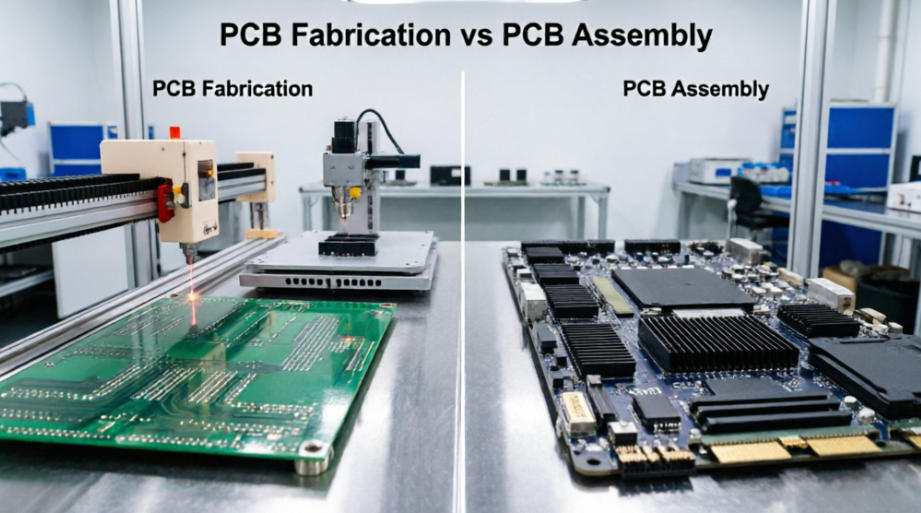
What Is PCB Fabrication?
PCB fabrication is the manufacturing of the bare circuit board itself — the green (or blue, or black) board with copper traces but no components on it yet.
It starts with raw materials: a base laminate, usually FR-4, clad with thin sheets of copper. From there, the board goes through a sequence of steps that gradually turn that blank material into a precisely patterned circuit.
The core stages look roughly like this:
- Imaging and etching transfer your copper trace pattern onto the board and remove the copper you don’t need.
- Layer lamination presses multiple layers together for multilayer boards.
- Drilling creates the holes for vias and through-hole components.
- Plating deposits copper into those holes to connect layers electrically.
- Solder mask applies the colored coating that protects the copper and gives the board its familiar look.
- Silkscreen prints the white labels, reference designators, and logos.
- Surface finish — such as HASL or ENIG — protects the exposed copper pads and prepares them for soldering later.
What comes out the other end is a bare board. It has all the traces and pads it needs, but no chips, no resistors, nothing electronic mounted on it. On its own, it can’t do anything yet.
When you order fabrication, the key specifications your manufacturer cares about are layer count, board thickness, copper weight, minimum trace width and spacing, and the surface finish. And the file that drives the whole process is your Gerber file — the standard format that describes every layer of the board.
What Is PCB Assembly?
PCB assembly is the step that brings the board to life. It takes the bare board from fabrication and mounts all the electronic components onto it, soldering each one into place so the circuit can actually function.
The process depends on the type of components, but it usually involves some combination of these steps:
- Solder paste printing applies paste to the pads where surface-mount parts will sit.
- SMT placement uses pick-and-place machines to position surface-mount components with high precision.
- Reflow soldering melts the paste in a controlled oven to permanently bond those parts.
- Through-hole insertion adds components with legs that go through the board, either by hand or by machine.
- Wave soldering solders those through-hole parts in one pass.
- Inspection and testing — AOI, flying probe, ICT, or functional test — confirm the assembly was done correctly.
The result is a PCBA: a fully populated board with every component in place, ready to be powered on and put to work.
Assembly runs on different documents than fabrication. Instead of just a Gerber file, your assembler needs a BOM (Bill of Materials) listing every component, and a pick-and-place file telling the machines where each part goes. There’s also a decision to make about who supplies the parts: in a turnkey arrangement the assembler buys everything for you, while in a consigned arrangement you ship the components to them.
Fabrication vs Assembly: Side by Side
Here’s the full comparison in one place:
| Dimension | PCB Fabrication | PCB Assembly |
|---|---|---|
| What it does | Manufactures the bare board | Mounts components onto the board |
| Input | Laminate, copper, chemicals | Bare board + components |
| Output | Bare board | Working PCBA |
| Required files | Gerber files | BOM + pick-and-place file |
| Key equipment | Etching, drilling, plating lines | Pick-and-place, reflow oven, wave solder |
| What can go wrong | Trace defects, drill errors, plating issues | Wrong parts, solder defects, misplacement |
| Typical lead time | Days to a couple of weeks | Days to weeks, depends on parts sourcing |
| Comes first? | Always first | Always after fabrication |
The pattern is clear: these are two distinct manufacturing disciplines with different machines, different inputs, different failure modes, and different documentation. They just happen to be neighbors in the same production chain.
How the Two Fit Together
Think of the journey from idea to finished product as a straight line:
Design → Fabrication → Assembly → Testing → Finished Product
You start with a design, captured in your Gerber files and BOM. Fabrication turns the design into a physical bare board. Assembly populates that board with components. Testing confirms it works. And then you have a finished, functional product.
The order never changes. You can’t assemble a board that hasn’t been fabricated yet — there’s nothing to put the parts on. Fabrication always comes first, assembly always follows.
What can change is whether one company handles both steps or whether you split them between two suppliers. That’s the real decision most people face.
Do You Need One Service or Both?
Almost every finished product needs both fabrication and assembly. The question isn’t whether you need them — it’s whether you buy them together or separately.
Ordering them separately makes sense when you have a specific board house you trust for fabrication, or when you want to control component sourcing yourself, or when you’re chasing the best price on each step independently. The tradeoff is that you become the middleman: you coordinate between two vendors, ship bare boards from one to the other, and own any finger-pointing if something goes wrong at the handoff.
Turnkey service — where one company does both fabrication and assembly — is the simpler path for most people. You hand over your Gerber files, BOM, and placement data, and they deliver finished, tested boards. There’s one point of contact, one party responsible for the whole result, and no shipping delay in the middle. For prototypes and small-to-medium runs especially, the convenience usually outweighs any small savings from splitting the work.
If you’re just starting out, turnkey is almost always the less painful choice. As your volume grows and you develop supplier relationships, splitting the process can start to make more financial sense.
Common Questions
Can one company do both fabrication and assembly? Yes. Many manufacturers offer both under one roof as a turnkey service. This is common and often the most convenient option, since it removes the handoff between two separate vendors.
What files do I need for each? Fabrication needs Gerber files (and often a drill file). Assembly additionally needs a BOM and a pick-and-place file. If you’re ordering turnkey, prepare all of these up front.
Which is more expensive, fabrication or assembly? It depends on the board. Simple boards with lots of components can make assembly the larger cost, while complex multilayer boards with few parts can make fabrication dominate. Component prices also swing assembly costs significantly.
How long does each take? Fabrication typically runs from a few days to a couple of weeks depending on complexity. Assembly timing depends heavily on component availability — the actual soldering is fast, but sourcing hard-to-find parts can add weeks.
What does PCBA stand for? Printed Circuit Board Assembly — a bare board that has been populated with components. It’s the output of the assembly stage.
The Bottom Line
Fabrication builds the board. Assembly puts the parts on it. Together they turn a design into a working product, and fabrication always comes first.
If you’re getting ready to place an order, the most useful thing you can do right now is figure out which files you actually have in hand — Gerber files, a BOM, a pick-and-place file. Once you know that, deciding between a turnkey service and splitting the work between two suppliers becomes a lot clearer.
And once your boards come back populated, the next question is how to confirm they actually work — which comes down to choosing the right testing method for your volume and product. But that’s a topic for another guide.
0 Comments