




Breadboard vs PCB for Prototyping
A breadboard is best for quick circuit experiments, jumper-wire changes and early proof-of-concept work. A PCB is better when the circuit must be stable, repeatable, compact, testable and ready for assembly or production. The practical decision is not whether one is always better. It is when the prototype has outgrown temporary wiring and needs a controlled layout.
This breadboard vs PCB guide focuses on that transition point. It explains what a breadboard can prove, what it cannot prove, and when a printed circuit board becomes the safer engineering choice.
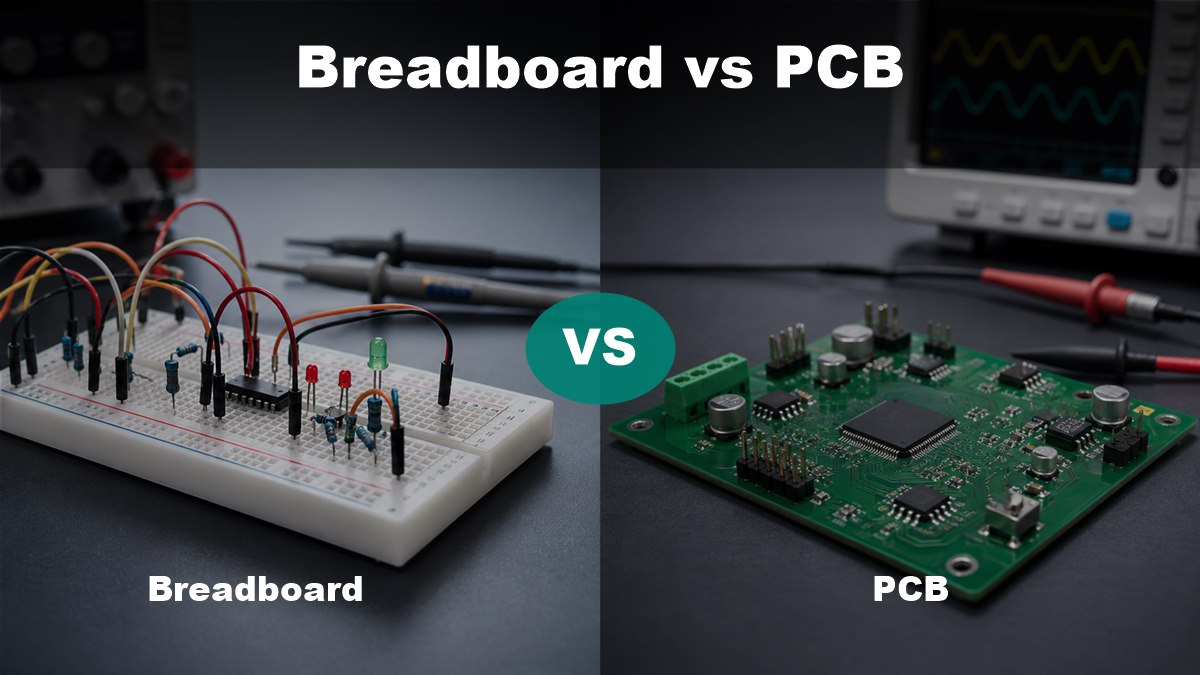
What Is the Main Difference Between a Breadboard and a PCB?
The main difference is permanence and control. A breadboard uses spring contacts and jumper wires, so you can change connections quickly. A PCB uses copper traces, drilled holes, pads, solder mask and fixed component footprints, so the circuit layout is repeatable.
That difference changes almost everything: signal quality, mechanical reliability, testing method, assembly speed and production risk. A breadboard answers the question, 鈥淐an this idea work?鈥?A PCB answers a different question: 鈥淐an this circuit be built, tested and used reliably?鈥?/p>
When Should You Use a Breadboard?
Use a breadboard when the circuit is still changing and the main goal is learning, checking a concept or testing component values. It is fast, low-cost and forgiving when you need to move a resistor, add a sensor or try a different pull-up value.
A breadboard is a good fit for low-frequency digital circuits, simple analog experiments, microcontroller demos, LED tests and early sensor checks. It is also useful when the team is still discussing function and does not yet know connector positions, enclosure size or power architecture.
Do not treat a working breadboard as proof that the final product is ready. The jumper wires, long loops and loose contacts can hide layout problems that only appear after the circuit becomes smaller, faster or more current-heavy.
When Should You Move from Breadboard to PCB?
Move to a PCB when the circuit behavior depends on layout, when the prototype must be handled repeatedly, or when you need more than one reliable sample. A printed circuit board gives you fixed trace routing, stable connectors and a testable assembly.
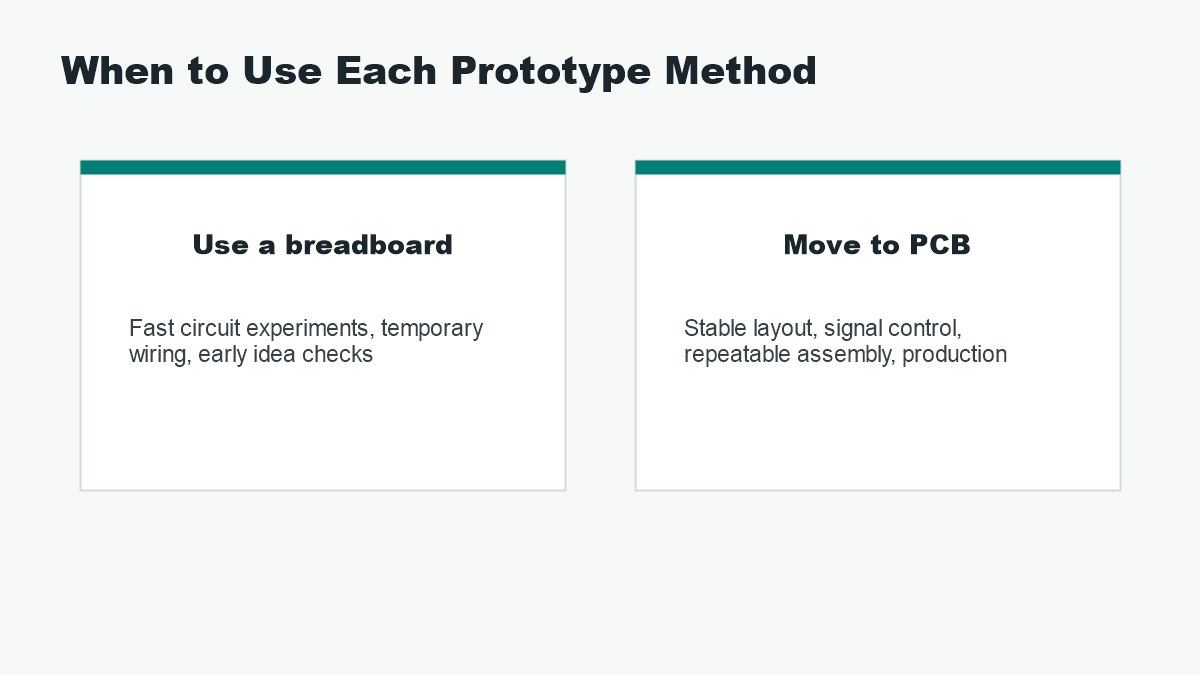
Common signs that it is time to move to PCB include intermittent breadboard behavior, noisy signals, connector movement, current paths that heat up, repeated wiring mistakes, or the need to send the prototype to a customer, investor, lab or factory.
For most commercial electronics, the first PCB prototype should start before the circuit feels perfect. Waiting too long can delay the real learning: enclosure fit, connector placement, thermal behavior, EMI risk, assembly method and test-point access.
Breadboard vs PCB: Practical Comparison
A breadboard gives speed. A PCB gives control. The right choice depends on what risk you are trying to reduce at the current stage.
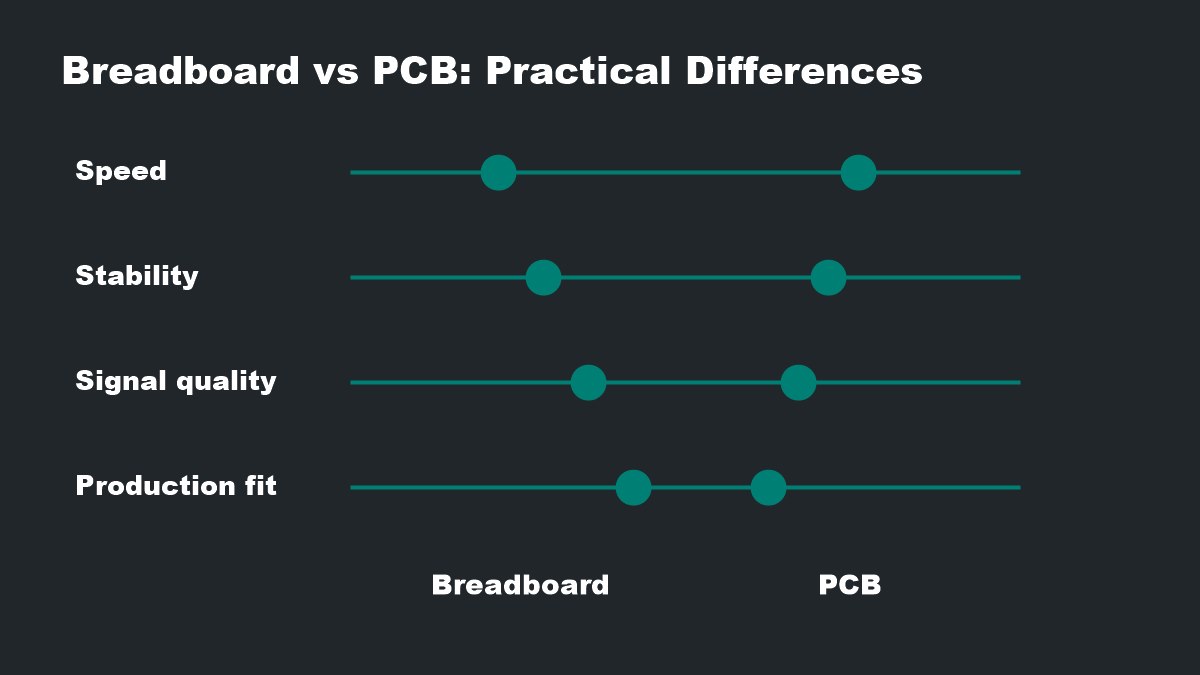
| Factor | Breadboard | PCB |
| Best use | Early experiments and temporary circuits | Reliable prototypes and production-ready designs |
| Change speed | Very fast | Requires design file changes and fabrication |
| Mechanical stability | Weak with movement and handling | Stable when layout and assembly are correct |
| Signal behavior | Affected by jumper length and contact quality | Controlled by trace routing, ground return and stackup |
| Repeatability | Low | High |
| Manufacturing fit | Not suitable for production | Designed for assembly, testing and scaling |
Why Breadboards Can Give Misleading Results
Breadboards can make a circuit look more reliable than it really is, or less reliable than it would be on a PCB. The wiring method adds parasitic resistance, capacitance, inductance and contact uncertainty.
For slow LEDs or simple buttons, that may not matter. For switching regulators, high-speed digital buses, RF circuits, precision analog signals, motor drivers or current-heavy paths, the breadboard can become part of the problem. A regulator that oscillates on a breadboard may work on a good PCB layout. A signal that seems acceptable on loose wires may fail when real ground return paths, connector positions and trace impedance matter.
This is why engineers often breadboard only the simple parts of a design and move sensitive sections to a PCB prototype early.
Cost and Time: Breadboard vs PCB
A breadboard is cheaper and faster for the first experiment. A PCB is usually cheaper and faster once you need repeatable samples, assembly records or design validation.
The hidden cost of staying on a breadboard too long is engineering time. Every jumper wire must be checked, every loose connection can waste debugging hours, and every copied prototype introduces new wiring variation. A PCB prototype has fabrication cost and lead time, but it gives the team a stable reference build.
For buyer or supplier communication, a PCB is also easier to quote and review. Gerber files, BOM, pick-and-place data, assembly drawings and test requirements are the language a PCB factory can work with. A photo of a breadboard is not enough for repeatable manufacturing.
Design Checks Before Turning a Breadboard into a PCB
Before converting a breadboard circuit into a PCB, check the circuit as a design, not just as a wiring copy. The PCB layout should solve real engineering constraints instead of simply freezing the breadboard connections.
- Confirm voltage rails, current paths and connector polarity.
- Separate noisy power paths from sensitive analog or signal paths.
- Place decoupling capacitors close to IC power pins.
- Check component footprints against datasheets before ordering.
- Add test points for power rails, programming pins and important signals.
- Review mounting holes, enclosure space, connector access and cable direction.
- Think about heat, copper width and return current paths.
- Prepare a BOM and assembly notes before sending the design for fabrication.
Which Prototype Should You Show to a Customer or Factory?
Show a breadboard when you are demonstrating early function. Show a PCB prototype when the discussion is about fit, reliability, assembly, quotation, compliance, packaging or production.
A customer can understand a breadboard demo, but they usually cannot judge product readiness from it. A factory also cannot price assembly accurately from a breadboard. Once the project moves toward sourcing, testing or mass production, the practical handoff needs PCB files and build documentation.
If you are not ready for a final PCB, a small engineering prototype is still useful. It can prove connector placement, component spacing, test access and assembly method before you commit to a larger production panel.
FAQ
Is a breadboard the same as a PCB?
No. A breadboard is a temporary prototyping board with spring contacts and jumper wires. A PCB is a manufactured board with fixed copper traces, pads and component footprints.
Can I use a breadboard instead of a PCB?
You can use a breadboard for temporary experiments, but it is not a good replacement for a PCB in a product. It lacks mechanical stability, repeatability and controlled routing.
Why does a circuit work on a breadboard but fail on a PCB?
The PCB may have a layout error, wrong footprint, missing connection, solder defect or grounding issue. The breadboard and PCB also have different parasitic effects, so sensitive circuits may behave differently.
Why does a circuit fail on a breadboard but work on a PCB?
The breadboard may add long jumper wires, loose contacts or noisy return paths. A well-designed PCB can shorten paths, improve grounding and make power distribution more stable.
When should I order the first PCB prototype?
Order the first PCB prototype when the basic circuit is proven and layout-related risks matter. Do not wait until every detail is final if the real questions involve size, connectors, heat, assembly or test access.
Is PCB prototyping expensive compared with breadboarding?
The first PCB costs more than a breadboard experiment, but it can save time when you need repeatable samples, factory review, assembly testing or customer-ready hardware.
Can high-speed circuits be tested on a breadboard?
Only in very limited ways. High-speed, RF, switching power and precision analog circuits often need controlled layout, short return paths and proper grounding, so a PCB prototype is usually safer.
What files are needed to move from breadboard to PCB?
You usually need a schematic, PCB layout, Gerber files, drill files, BOM, component footprints, assembly notes and test requirements. For assembled boards, pick-and-place data is also useful.
Final Thoughts
A breadboard helps you learn quickly. A PCB helps you build reliably. The best workflow is not to choose one forever, but to use the breadboard while the circuit is fluid and move to a PCB when layout, testing and repeatability become the real risks.
If you are ready to turn a breadboard prototype into a manufacturable PCB or PCBA, PCBTRY can support custom PCB fabrication, prototype assembly, OEM/ODM development and production review. Contact the engineering team at [email protected] for technical support and a quote.
Related PCB Guides
If you are using this guide to prepare a PCB project, these related PCBTRY guides can help you connect the next step instead of reading each topic in isolation.
0 Comments