





To find a PCB manufacturer with quick turnaround, do not start with the shortest advertised lead time. Start by checking whether the supplier can review your files quickly, manufacture the board inside its real capability window, separate fabrication and assembly timing, and explain which quality checks are included before shipment.
A quick-turn PCB order fails when speed hides missing data. A strong supplier will ask for Gerber files, drill data, stackup notes, copper weight, surface finish, impedance needs, quantity, delivery country, and assembly files when PCBA is included. If those questions are clear on day one, the schedule is usually more believable.
What Does Quick Turnaround Mean for PCB Manufacturing?
Quick turnaround means the manufacturer can move a board from file review to fabrication, inspection, and shipment inside a compressed schedule without skipping engineering checks. It does not mean every PCB can be built in the same number of days.
For a simple two-layer prototype, the bottleneck may be panel planning and electrical test. For a multilayer impedance board, the bottleneck may be stackup confirmation, laminate availability, lamination, drilling, plating, solder mask, or final inspection. For PCBA, component sourcing and stencil preparation often control the real delivery date.
That is why buyers should ask for two timelines: fabrication lead time and total delivery lead time. A supplier may offer 24 hour quick turn PCB fabrication for certain prototypes, but assembly, testing, shipping, and engineering changes can add time.
Start With Complete Manufacturing Files
A quick-turn quote is only reliable when the supplier receives complete, production-ready manufacturing files. Missing drill files, unclear copper weight, or inconsistent solder mask openings can turn a fast quote into a slow engineering exchange.
For bare PCB fabrication, send Gerber or ODB++ data, drill files, board outline, layer stackup, copper weight, solder mask color, surface finish, impedance requirements, special tolerances, and final quantity. If you are not sure whether the package is complete, compare it with a guide to complete PCB Gerber files before requesting urgent delivery.
For PCB assembly, add the BOM, centroid or pick-and-place file, polarity notes, assembly drawings, test requirements, approved alternates, and component sourcing responsibility. A supplier that accepts only a screenshot or incomplete BOM for a quick-turn assembly job is likely to revise the schedule later.
Check Whether the Supplier’s Capability Fits Your Board
The fastest supplier is the one whose normal process already fits your PCB, not the one that promises to force a difficult board through an unsuitable line. Capability mismatch is one of the most common reasons quick-turn jobs slip.
Ask whether the supplier can support your layer count, board thickness, copper weight, minimum trace and spacing, smallest mechanical drill or laser via, surface finish, impedance tolerance, solder mask bridge, panel size, and material type. If you need HDI, heavy copper, rigid-flex, high-frequency laminate, or controlled impedance, confirm those details before discussing delivery speed.
For a broader view of process choices, review PCB manufacturing techniques and then ask the supplier which of those steps could affect the urgent schedule.
Separate Prototype Speed From Production Readiness
A quick prototype should prove the design and process path, but it should not hide manufacturability problems that will appear during production. Buyers should ask whether the prototype flow uses the same materials, surface finish, testing method, and acceptance rules intended for the next order.
If the board is only for fit checking, a faster simplified build may be acceptable. If the board will validate RF behavior, current carrying, thermal performance, assembly yield, or safety-critical function, shortcuts can create misleading results. In those cases, speed should be balanced with process similarity.
A useful question is: “Will this quick-turn prototype use the same stackup, copper, laminate family, finish, and test criteria we would use for pilot production?” The answer tells you whether the supplier is only moving fast or also protecting the next engineering decision.
Ask Lead-Time Questions That Reveal the Real Schedule
Good quick-turn suppliers separate quote response time, engineering review time, fabrication time, assembly time, testing time, and shipping time. If all of those are merged into one vague promise, the buyer cannot see where the schedule risk sits.
Ask these questions before approving the order:
- When will the DFM review be completed after files are received?
- Is the quoted lead time counted after payment, after file approval, or after engineering questions are closed?
- Which materials and surface finishes are already available?
- Does the schedule include electrical test, AOI, final inspection, and packaging?
- For PCBA, are all components in stock or still being sourced?
- Which shipping method is assumed, and what happens if customs documents are incomplete?
These questions do not slow the order down. They prevent a supplier from giving a fast answer that later becomes a revised delivery date.
Review Quality Controls Before You Approve a Fast Order
Quick turnaround should not remove basic quality gates. At minimum, the supplier should explain file review, in-process checks, electrical testing for bare boards, and outgoing inspection before shipment.
For bare PCBs, ask about DFM review, solder mask registration, copper and hole checks, surface finish inspection, final visual inspection, and electrical test. For assembled boards, ask about paste inspection, AOI, X-ray for hidden joints when needed, functional testing if supplied, and packaging for moisture or ESD-sensitive components.
If the order includes assembly, confirm the PCB assembly process steps that are included in the timeline. Assembly speed is not useful if component polarity, BGA inspection, cleaning, or functional test expectations are unclear.
Compare Suppliers With a Practical Decision Table
A supplier comparison table helps buyers avoid choosing only by the shortest lead time. The better choice is usually the supplier that gives the clearest risk explanation for the specific board.
| Check | Weak answer | Better answer | Buyer action |
| File review | “Send files and we will see.” | Supplier lists required files and review timing. | Send complete files before asking for final lead time. |
| Capability | Generic “we can make all PCBs” claim. | Supplier confirms layer count, copper, drill, finish, and tolerance. | Match board specs to published or confirmed capability. |
| Lead time | One number without assumptions. | Separate fabrication, assembly, test, and shipping dates. | Approve only after assumptions are written. |
| Quality | No detail beyond “QC passed.” | DFM, AOI, electrical test, and inspection steps are named. | Ask which inspection records can be shared. |
| Risk response | Supplier promises no delays. | Supplier explains risks from files, materials, parts, and logistics. | Use the supplier that exposes risk early. |
Watch for Red Flags in Urgent PCB Quotes
Red flags appear when a supplier promises speed before understanding the board. A fast quote is useful only when it is tied to the actual files, materials, quantity, and inspection requirements.
- The supplier gives a firm date before seeing Gerber, drill, stackup, or BOM data.
- The quote does not say when the lead time starts.
- The supplier avoids questions about impedance, copper, finish, testing, or component stock.
- The quoted price is much lower than other suppliers but does not explain process assumptions.
- The supplier cannot explain what happens if DFM issues are found.
- The company claims certifications, capacity, or inspection results without verifiable details.
For urgent orders, transparency matters more than a perfect sales answer. A manufacturer that identifies a risk early may save more time than one that hides the risk until production starts.
How to Send a Quick-Turn PCB RFQ
A strong RFQ should let the manufacturer check manufacturability and schedule without repeated emails. The more complete the RFQ, the faster the supplier can give a useful answer.
Include the board name, revision, quantity, due date, Gerber or ODB++ package, drill files, stackup, material, copper weight, board thickness, solder mask and silkscreen color, surface finish, impedance requirements, panelization preference, inspection needs, and shipping destination. For PCBA, include BOM, pick-and-place file, assembly drawing, component sourcing instructions, test plan, and packaging needs.
If you need a fast first response from a PCB prototype and fabrication manufacturer, state which details are fixed and which can be adjusted. For example, accepting an alternate solder mask color or finish may help schedule only if it does not affect the design requirement.
FAQ
How do I know if a PCB manufacturer can really provide quick turnaround?
Ask for the lead-time assumptions in writing. A credible supplier explains when the clock starts, which files must be approved, whether material is available, which inspections are included, and how shipping is counted.
What files should I send for a quick-turn PCB quote?
Send Gerber or ODB++ files, drill data, board outline, stackup, copper weight, material, surface finish, quantity, and delivery country. For PCBA, also send BOM, pick-and-place file, assembly drawings, and test requirements.
Is the fastest PCB manufacturer always the best choice?
No. The best quick-turn supplier is the one that can meet the schedule while staying inside verified capability and quality controls. A very fast promise can be risky if files, materials, or tests are unclear.
Can a complex multilayer PCB be made with quick turnaround?
Sometimes, but complexity changes the schedule. Layer count, lamination cycles, impedance control, microvias, copper thickness, material availability, and special finishes can all extend lead time.
Does quick-turn PCB fabrication include assembly?
Not always. Fabrication and assembly are separate services. If you need PCBA, confirm component sourcing, stencil preparation, SMT or through-hole assembly, inspection, testing, and packaging dates separately.
What is the biggest cause of quick-turn PCB delays?
Incomplete or inconsistent files are a common cause. Missing drill files, unclear stackup, BOM errors, part shortages, and late DFM approvals can delay an order even when the supplier has fast production capacity.
Should I use a local PCB manufacturer for faster delivery?
Local delivery can reduce shipping time, but it is not the only factor. File review speed, material availability, manufacturing capability, component sourcing, and communication quality often matter more.
How should I compare quick-turn PCB quotes?
Compare more than price and lead time. Check file requirements, capability fit, included inspections, lead-time start point, shipping assumptions, revision policy, and how the supplier handles DFM questions.
Can I speed up a PCB order by simplifying specifications?
Sometimes. Flexible choices such as common material, standard copper weight, common solder mask color, and available surface finish may help. Do not simplify requirements that affect electrical, thermal, safety, or reliability needs.
When should I avoid a quick-turn schedule?
Avoid forcing a quick-turn schedule when the design is not stable, test requirements are unclear, materials are special, or the board validates critical reliability requirements. In those cases, a slightly longer build can reduce project risk.
Final Buyer Checklist
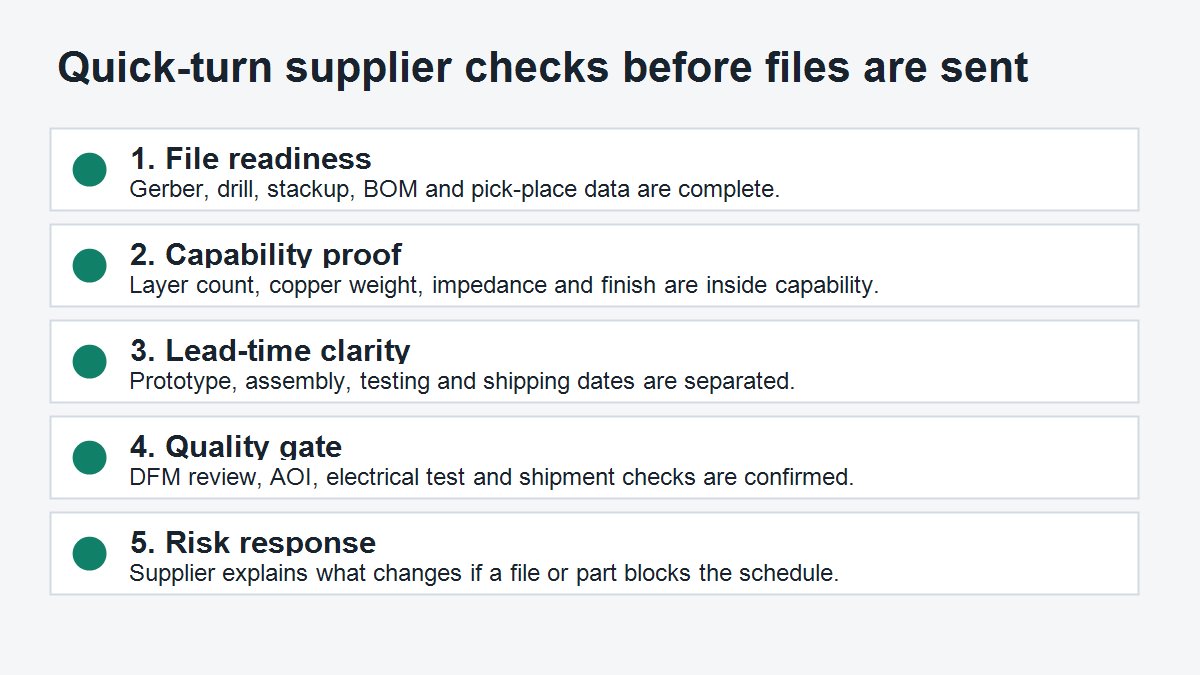
Before choosing a PCB manufacturer with quick turnaround, confirm five items: complete files, real capability fit, written lead-time assumptions, defined quality checks, and a clear response plan for DFM or sourcing problems. If any of these are missing, the shortest promised lead time may not be the safest schedule.
If you’re sourcing reliable PCB/PCBA manufacturing, including OEM, ODM, prototyping, mass production, or custom engineering solutions, reach out to our engineering team for technical support and a quote at [email protected].
Related PCB Guides
If you are using this guide to prepare a PCB project, these related PCBTRY guides can help you connect the next step instead of reading each topic in isolation.



0 Comments