




Among the many causes of electronic equipment failure, moisture and water damage rank near the top of the list. Once moisture penetrates a circuit board, it can lead to corrosion, oxidation, reduced insulation resistance, and in severe cases, direct short circuits or leakage current. What makes this kind of damage particularly tricky is that it rarely happens all at once. It builds up gradually, and by the time a device actually fails, the damage may have already spread across multiple components, making repairs far more costly than if proper protection had been in place from the start.
Before going further, it’s worth separating two concepts that often get mixed up: waterproofing refers to preventing liquid water from directly contacting the board, such as rain, splashing, or submersion. Moisture-proofing refers to preventing airborne humidity and water vapor from penetrating and condensing on the board’s surface. Waterproofing addresses the intrusion of liquid water, while moisture-proofing addresses the gradual penetration and condensation of humidity, and the design approaches for each aren’t always the same.
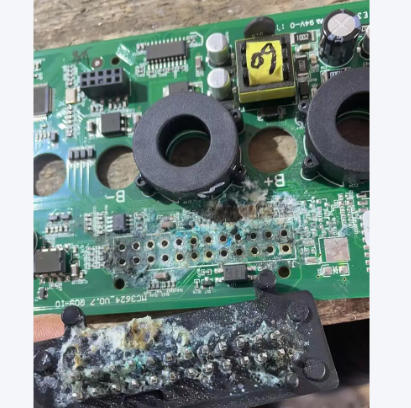
Common Failure Modes from Moisture and Water Damage
When moisture or water gets into a circuit board, the typical failure modes include:
- Corrosion and oxidation: Copper traces, solder joints, and component leads oxidize easily in humid conditions, eventually causing poor contact or open circuits
- Leakage current and short circuits: Moisture or humidity can form conductive paths in densely routed areas, and the risk is higher on boards with high-voltage or high-density routing
- Reduced insulation resistance: Even without a direct short, moisture degrades the insulating properties of the substrate and solder mask, lowering long-term reliability
- Conductive Anode Filament (CAF) growth: Under combined humidity and electric field exposure, metal ions can migrate inside the board material and form conductive paths, a long-term reliability concern for multilayer boards
These failure modes are addressed specifically in industry standards such as IPC-CC-830 (conformal coating standard) and IPC-9691 (CAF testing guideline), which shows this isn’t an isolated issue but a widely recognized concern across the industry.
Conformal Coating
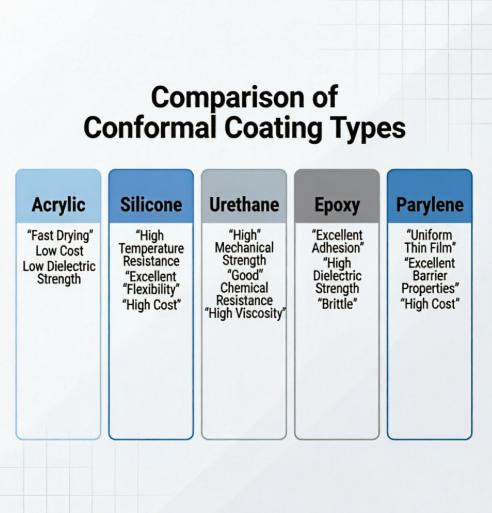
Conformal coating is one of the most common methods for PCB moisture and water protection. It involves applying a protective layer over the board’s surface to block out humidity, dust, and chemical contaminants. Common types include:
- Acrylic: Low cost, easy to apply, and easy to rework, but with moderate chemical and abrasion resistance. Suitable for general consumer electronics and cost-sensitive applications
- Silicone: Good performance across wide temperature ranges with strong flexibility, suitable for environments with significant temperature swings, though it tends to attract dust and is harder to rework
- Urethane: Better chemical and abrasion resistance, commonly used where mechanical strength and chemical protection matter, though rework requires specialized solvents
- Epoxy: The strongest protection of the common coatings, but essentially non-reworkable once applied. Typically used where repair isn’t needed and maximum protection is required
- Parylene: Applied via vapor deposition to form an extremely thin and uniform coating with excellent protective performance, though equipment and process costs are higher. Often used in high-end or medical applications
Common application methods include spraying, dipping, brushing, and selective coating, which uses robotic equipment to precisely control the coated area while avoiding connectors and test points. Selective coating is particularly effective at preventing connectors, buttons, and test points from being unintentionally covered, and this is exactly the kind of detail customers need to specify clearly before placing an order.
On the topic of rework: acrylic coatings are relatively easy to remove locally with solvents; urethane and silicone require specialized solvents or mechanical abrasion; epoxy and parylene are essentially non-reworkable at the local level. If frequent maintenance is expected later in a product’s life, these last two materials usually aren’t the right choice.
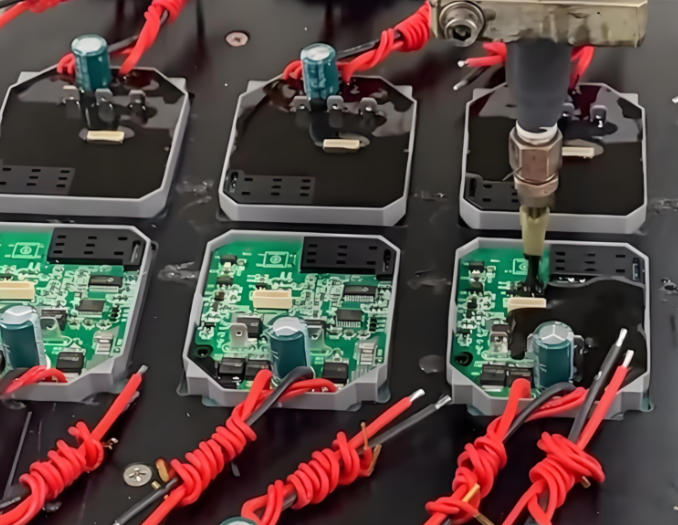
Potting and Encapsulation
Potting is a heavier-duty protection method compared to conformal coating. It involves fully encasing an entire board or a specific region in epoxy or urethane potting compound, forming a solid protective mass. This method offers a much higher level of protection than conformal coating and is particularly suited to:
- High-vibration or high-impact industrial or automotive environments, where potting compound provides both mechanical support and protection
- Equipment that needs to operate long-term underwater or in high-humidity conditions
- Products requiring maximum protection with little to no need for future repair, such as disposable sensor modules
The tradeoffs are significant. Once potting is complete, repairing or replacing internal components becomes nearly impossible. Potting compound also adds weight and bulk, and thermal design needs to be reconsidered, since the potting material affects heat dissipation paths to some degree. For this reason, potting is generally chosen only when protection takes clear priority over repairability.
Enclosure-Level Protection (IP Rating Design)
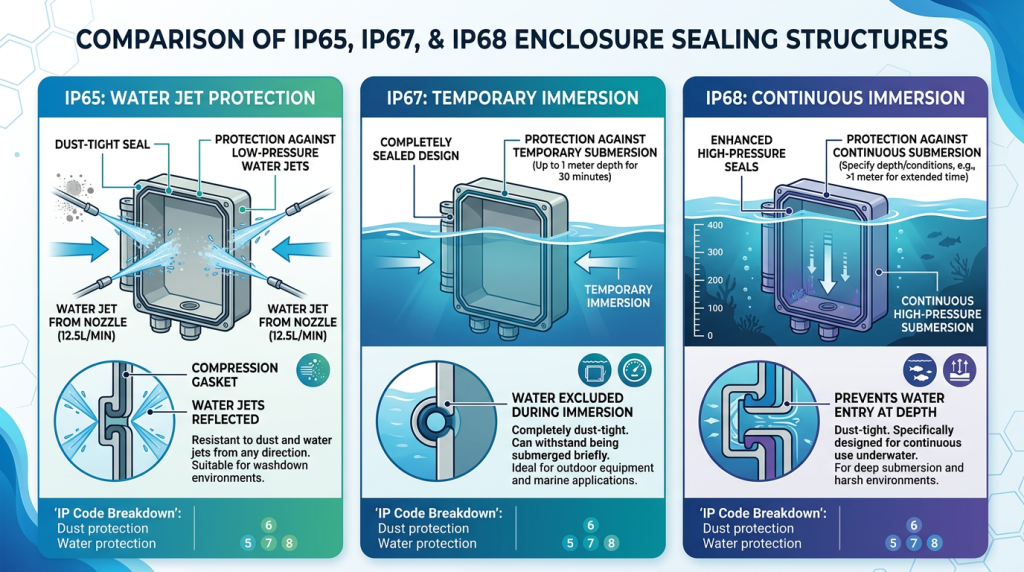
Beyond coating the PCB itself, the sealing design of the overall enclosure is equally important, and the common reference standard here is the IP rating system:
- IP65: Dust-tight and protected against low-pressure water jets, suitable for general outdoor equipment
- IP67: Can withstand brief immersion at a limited depth, suitable for scenarios involving heavy rain or short-term submersion
- IP68: Can withstand prolonged immersion at greater depths, suitable for underwater or persistently humid environments
Achieving a given IP rating for the overall device requires coordinating the PCB’s own protection with the enclosure design. Relying on enclosure sealing alone, without additional protection on the PCB itself, leaves no backup layer of defense if the seal fails, whether from a degraded gasket or an improperly sealed cable gland. A more reliable approach is to let the enclosure block most liquid water and humidity, while conformal coating or potting on the PCB acts as a second line of defense. Together, these two layers actually achieve the intended protection level.
Key details in enclosure design include gasket material and compression ratio, sealing at cable glands and connector openings, and waterproof structural design at enclosure seams. A failure at any one of these points can render the entire enclosure’s IP rating meaningless.
A Commonly Overlooked Issue: Condensation
This is a problem that’s easy to overlook but can have a major impact. An enclosure might be well sealed and meet its rated protection level, but if the device operates in an environment with significant temperature swings, whether from daytime heat and nighttime cooling, or from the device itself heating up and then cooling down after shutdown, the humidity inside the sealed enclosure can condense as temperatures change. This condensation forms directly on the PCB surface, and because the enclosure is sealed, that moisture has no way to evaporate out. Instead, it accumulates inside over time, creating a hazard that can be worse than direct exposure to rain.
Common approaches to address this include:
- Installing a breathable vent that allows water vapor to pass through while blocking liquid water, balancing internal and external pressure and humidity
- Placing desiccant inside the sealed space to absorb residual moisture
- Optimizing overall thermal management and cooling design to reduce sharp internal temperature swings
The key takeaway here is that the better the seal, the more deliberate the pressure and humidity balancing needs to be. A fully sealed enclosure should never be assumed to automatically solve every moisture problem.
Design Considerations for Moisture and Water Protection
Waterproofing and moisture-proofing aren’t just about post-production processing. Several key points deserve attention at the PCB design stage:
- Trace spacing: In humid environments, tightly spaced traces are more prone to leakage or shorting caused by moisture. Widening spacing in critical areas during design can help mitigate this
- Solder mask coverage: The solder mask itself serves as a baseline layer of protection, so design should ensure complete coverage and minimize areas of exposed copper
- Conformal coating keep-out zones: If conformal coating is planned for later production, the design stage should clearly mark which areas must not be coated, such as connectors, test points, and switches, directly in the Gerber files to avoid back-and-forth clarification during manufacturing
- Protection at connectors and test points: These areas are often the weakest link in overall protection. Options include using waterproof connectors or minimizing the number of exposed test points in the design
Accounting for these details at the design stage makes the manufacturing and protection process much smoother later on, and helps avoid rework caused by oversights in the original design.
Typical Industry Scenarios
Requirements for PCB waterproofing and moisture protection vary significantly across industries. Below are a few representative scenarios commonly seen across the industry (note: these describe general, industry-wide patterns rather than any specific project or customer):
- Outdoor communication and renewable energy equipment: These devices are exposed to rain, dew, and temperature swings over long periods. A combination of conformal coating and sealed enclosures is typically used, with particular attention paid to condensation risk, since device self-heating combined with ambient temperature changes increases the likelihood of internal condensation
- Automotive electronics: Components inside an engine bay face high temperatures, high humidity, and potential liquid splashing. Potting and higher-grade conformal coatings, such as urethane or silicone, are common, along with closer attention to CAF-related electrochemical migration, since automotive-grade reliability requirements are especially strict
- Marine and shipboard equipment: In addition to water and moisture protection, salt spray corrosion is a major factor. Coatings with stronger chemical resistance are typically used, and salt spray testing is applied to verify long-term reliability
What these scenarios have in common is that a single protection method usually isn’t sufficient on its own. Coating materials, potting solutions, and enclosure sealing structures need to be combined based on the actual operating environment to achieve the level of protection actually required.
How to Verify Protection Effectiveness
After protective measures have been applied, whether they’re actually effective shouldn’t be judged on experience alone. Common industry verification methods include:
- Damp Heat Test: Simulates high-temperature, high-humidity conditions over an extended period to test the moisture resistance of coatings and substrate materials
- Salt Spray Test: Simulates corrosion in marine or high-salinity environments, commonly used to verify protection effectiveness for outdoor and marine equipment
- HAST (Highly Accelerated Stress Test): Exposes the board to more extreme temperature, humidity, and voltage conditions to accelerate the discovery of potential reliability issues, commonly used to evaluate CAF-related risk
- Insulation resistance testing: Measures changes in insulation resistance before and after humidity exposure to determine whether the protective layer is actually functioning as intended
These test methods are backed by corresponding industry standards, such as IPC-9691 for CAF testing. When planning a protection strategy, it’s worth including verification testing as part of the overall plan, rather than assuming that coating or potting alone guarantees the desired result.
Choosing the Right Protection Strategy
With so many protection methods available, the right choice usually comes down to a few key factors:
- Operating environment: Short-term indoor use versus long-term outdoor, high-humidity, or submersion exposure determines the baseline protection level needed
- Budget: Conformal coating tends to be lower cost, while potting and higher-grade coatings cost more, so a balance needs to be found between protection level and cost
- Repair requirements: If a product will need frequent repairs, epoxy coating and potting, both essentially irreversible, should generally be avoided
- Weight and thermal requirements: Potting adds weight and affects heat dissipation, so it needs careful evaluation for weight-sensitive or high-heat-generating products
A reliable approach is to communicate the operating environment, budget, and repair requirements with your manufacturing partner early in the design stage, so the protection strategy can be finalized alongside the design itself, rather than discovering after prototypes are built that the protection level is insufficient or the cost has exceeded expectations.
Frequently Asked Questions
1. Can a board still be repaired after conformal coating is applied? Does it affect heat dissipation?
It depends on the material. Acrylic coatings are relatively easy to remove locally with solvents; urethane and silicone require specialized solvents or mechanical abrasion; epoxy is essentially non-reworkable at the local level. As for heat dissipation, conformal coating layers are typically thin enough to have minimal impact on most components, though for high-power components generating significant heat, coating thickness and thermal conductivity should still be evaluated.
2. Can potting and conformal coating be used together?
Yes, and this combination is fairly common in applications with high protection requirements. For example, the entire board might receive a conformal coating, while a specific high-risk area, such as near a connector, gets additional potting reinforcement. This provides overall protection while reinforcing the weakest points.
3. What level of protection does a typical consumer electronics product actually need?
For products used primarily indoors without direct exposure to liquid water, a basic conformal coating combined with sound PCB design practices, such as adequate trace spacing and solder mask coverage, is usually sufficient to handle everyday humidity exposure. Potting or IP67-and-above enclosure ratings aren’t necessary in these cases and would only add unnecessary cost.
4. Does conformal coating have a shelf life? How often does it need to be reapplied?
Under normal operating conditions, conformal coating typically lasts the entire product lifecycle without needing reapplication. However, if the product is exposed to extreme conditions over the long term, such as high heat, high humidity, or frequent chemical contact, or if the coating has been locally damaged (for example, after a repair that wasn’t recoated), it’s worth evaluating whether a local touch-up is needed.
5. How much difference is there between IP67 and IP68? Is it worth paying more to upgrade?
The main difference lies in the depth and duration of water immersion each rating can withstand. IP67 generally covers brief immersion at a limited depth, while IP68 covers deeper, longer-duration immersion. If the actual use case never involves deep submersion, pursuing IP68 unnecessarily just adds design complexity and cost. It’s better to base the decision on the actual operating environment rather than assuming higher is always better.
6. Will adding a desiccant solve condensation problems inside a sealed enclosure?
Desiccant does absorb some moisture, but if the device experiences significant temperature swings or continuous moisture generation, desiccant alone may not be enough, and it also has a saturation limit that requires periodic replacement. A more systematic solution combines a breathable vent with thermal management design to reduce condensation at the source, rather than relying solely on passive absorption from a desiccant.

0 Comments