




As smart home products continue to evolve toward greater connectivity, integration, and energy efficiency, PCBs play an increasingly critical role in overall product performance and manufacturing stability. Whether it is a smart door lock, thermostat, lighting controller, security camera, smart plug, or environmental sensor, the core functions of these devices ultimately rely on a well-designed PCB.
For smart home product manufacturers, a PCB is not just an electrical interconnection platform. It is a key foundation that influences product size, power consumption, wireless stability, system reliability, safety performance, and mass production consistency. In today’s consumer electronics and IoT markets, products must meet functional requirements while also supporting cost control, fast time to market, and stable long-term supply. This places higher demands on PCB design and PCB assembly capabilities.
So, what are the main characteristics of PCBs used in smart homes? And what design and manufacturing priorities should be considered across different applications? This article provides a practical overview from both engineering and production perspectives.
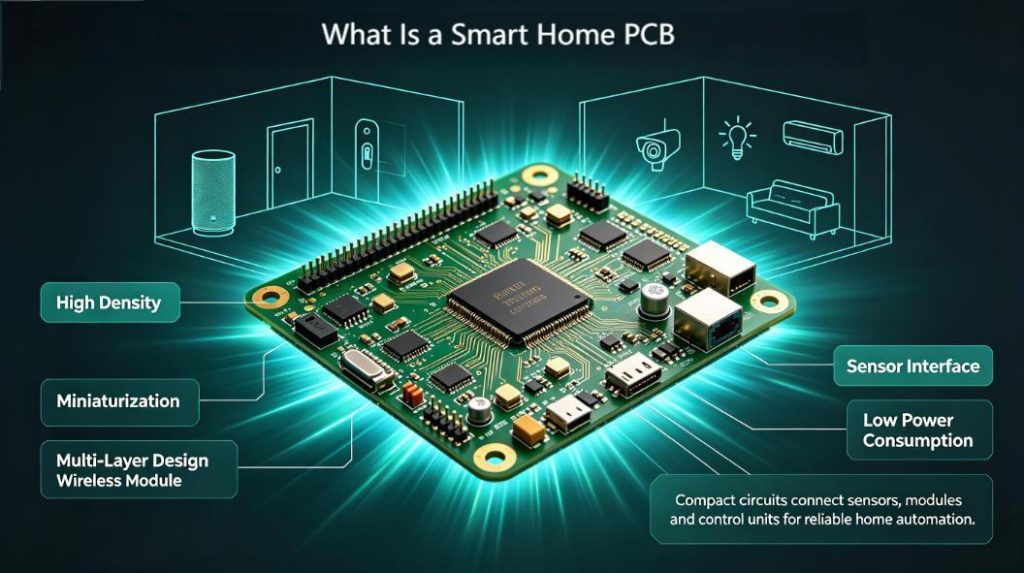
What Is a Smart Home PCB?
A smart home PCB refers to a printed circuit board used in home automation devices, wireless control terminals, and IoT-enabled residential products. It serves as the core platform for mounting and connecting key electronic components, such as:
- Main control MCU or SoC
- Wireless communication modules
- Sensors and signal acquisition units
- Power management circuits
- Memory and interface components
- Driver circuits
- User interface elements such as displays, touch controls, buzzers, and LEDs
In real-world product development, a smart home PCB must do more than simply provide electrical connectivity. It also needs to balance several critical requirements:
- Compact structure compatibility
- Low power operation
- Stable wireless communication
- Long-term reliability
- Electrical and functional safety
- Cost-effective mass production
That is why more smart home brands and hardware developers are paying close attention not only to PCB design, but also to DFM optimization and PCBA manufacturing support early in the development process.
Key Characteristics of Smart Home PCBs
1. Miniaturization and High-Density Integration
Smart home devices are often installed in limited spaces, and many are directly visible to end users. Products such as wall switches, thermostats, and smart locks must integrate multiple functions within a compact enclosure.
As a result, smart home PCBs often require:
- High-density component placement
- Extensive use of small-package components
- Multi-layer board structures
- More complex functional partitioning and routing
- Higher assembly precision and soldering consistency
From a manufacturing perspective, this means PCB suppliers and PCBA partners need stable process capabilities to support fine-pitch components, dense SMT layouts, and repeatable production quality.
2. Low Power Design as a Core Requirement
In products such as smart locks, wireless sensors, remote control panels, and battery-powered control terminals, battery life directly affects the user experience. Low power design is therefore one of the most important requirements.
From the PCB perspective, power efficiency depends on more than chip selection alone. It is also closely related to:
- Whether the power architecture is properly designed
- Whether different modules can be powered independently
- Whether always-on circuits are minimized
- Whether wireless modules can wake up only when needed
- Whether the PCB introduces unnecessary leakage paths or static power loss
For production-ready projects, low power design also involves current consistency across components, standby current testing methods, and long-term power stability after product aging. These are often overlooked during development, but they are highly important when moving toward volume production.
3. Strong Wireless Communication Support
Most smart home devices must connect to a home network or local control ecosystem, so PCBs commonly need to support wireless technologies such as BLE, Wi-Fi, Zigbee, or Thread.
In these projects, designers and manufacturers usually need to control the following factors carefully:
- Antenna keep-out area
- RF routing and impedance control
- Grounding integrity
- EMI and EMC performance
- Interference between modules
- Effects of housing materials on antenna performance
If these details are not handled correctly, even a good chipset choice may still lead to pairing issues, poor range, unstable connections, or unreliable field performance.
4. High Reliability for Long-Term Operation
Many smart home devices are expected to remain active for extended periods, especially smart locks, cameras, gateways, detectors, and central control panels. Intermittent failure or long-term drift can directly affect end-user satisfaction.
Therefore, smart home PCBs typically need to address:
- Stability under temperature and humidity changes
- Long-term solder joint reliability
- Power and signal integrity
- Thermal stability of key components
- Process consistency in mass production
From a supply chain perspective, this also means PCB and PCBA partners should offer not only manufacturing capacity, but also engineering support such as material suggestions, process reviews, testing assistance, and failure analysis.
5. Stricter Safety Requirements
Some smart home devices are connected directly to AC mains, while others are related to access control, alarms, or household safety systems. In such cases, the PCB must support both performance and safety compliance.
Typical design priorities include:
- High-voltage and low-voltage isolation
- Overcurrent, overvoltage, and short-circuit protection
- ESD and surge protection
- Flame-retardant materials
- Creepage distance and electrical clearance control
- Fail-safe behavior under abnormal operating conditions
For example, smart plugs, lighting controllers, smart locks, and alarm devices usually need safety considerations to be built in from the earliest stages of development and manufacturing.
6. Multi-Function Integration
As smart home products become more integrated, single-board functionality becomes more important. Many devices now need one PCB to handle:
- Sensing
- Control
- Communication
- Power management
- Actuation
- User interaction
This means PCB design is no longer just about routing traces. It must also consider system partitioning, heat dissipation paths, EMC risk, testability, and assembly compatibility.
For OEM and ODM customers, a PCB or PCBA supplier with experience in multi-function board integration can often provide more valuable support during new product introduction.
7. Production-Oriented Design
Most smart home products target the consumer market, where cost, lead time, and production consistency are all highly sensitive. A truly practical smart home PCB must therefore be designed with mass production in mind.
This usually includes:
- Design for manufacturability (DFM)
- Design for testability (DFT)
- Material substitution and supply chain assessment
- SMT assembly efficiency optimization
- Yield control in volume production
- Functional testing and aging test alignment
For OEM and ODM projects, addressing these factors early can make the transition from EVT and DVT to pilot runs and full production much smoother.
Overview of Typical Smart Home PCB Applications
Different smart home products have different functional structures, but their PCB requirements often revolve around miniaturization, low power consumption, wireless connectivity, reliability, and safety. The table below summarizes the PCB design focus of several common applications.
| Product Type | Main PCB Functions | Common Integrated Modules | Design Priorities |
|---|---|---|---|
| Smart Thermostat PCB | Temperature sensing, setting control, and HVAC or floor heating coordination | Temperature and humidity sensors, MCU, display or touch circuit, wireless module, power management | Sensing accuracy, long-term stability, thermal design, and user interface integration |
| Smart Lighting Control PCB | Power conversion, switching control, dimming or color tuning, timing, and networked control | LED driver, power module, MCU, wireless module, dimming control circuit | High- and low-voltage isolation, thermal management, EMC, and driver stability |
| Smart Security Camera PCB | Image capture, data processing, encoding transmission, networking, and night vision control | Image sensor, processor or video SoC, memory, network module, power management, infrared control | High-speed signal integrity, heat dissipation, network stability, and continuous operation reliability |
| Smart Plug PCB | AC switching, networked control, load management, and energy monitoring | Relay or electronic switch, power module, MCU, wireless module, metering circuit | High- and low-voltage isolation, overcurrent and overvoltage protection, creepage distance, thermal design, and safety |
| Smart Sensor PCB | Environmental or status detection, data acquisition, and wireless transmission | Sensor, low-power MCU, BLE, Zigbee, or Thread module, battery management | Ultra-low power consumption, compact size, measurement accuracy, long battery life, and anti-interference capability |
Although each product category has different functional priorities, the underlying PCB development logic is highly similar: integrating more functions within limited space, ensuring stable connectivity at a controlled cost, and maintaining reliable quality in volume manufacturing.
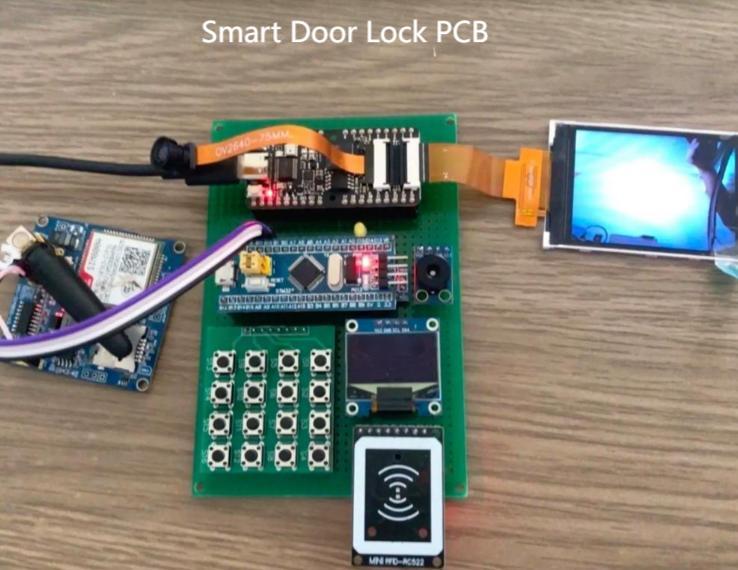
Focus Application: Smart Door Lock PCB
Among smart home devices, smart door locks place particularly high demands on PCB design and integration. A smart door lock PCB typically needs to support:
- Low power operation under battery supply
- Stable wireless communication
- Reliable motor drive control
- Identity verification and security management
- Long standby time together with frequent daily use
- High integration within a compact mechanical structure
As a result, the smart lock PCB is not simply a control board. It is a core part of the product that directly affects battery life, response speed, functional safety, and production consistency.
Why Low Power Design Is Essential for Smart Door Lock PCBs
Unlike mains-powered devices, smart door locks are usually powered by dry batteries or rechargeable lithium batteries. End users are highly sensitive to battery replacement frequency, so low power performance has a direct impact on product competitiveness.
In engineering practice, power optimization for a smart lock cannot be judged by the datasheet current of a single chip alone. It should be evaluated at the system level, including:
- Standby power consumption
- Wake-up strategy
- Wireless connection mode
- Motor action energy usage
- Always-on peripheral losses
- PCB leakage and static current paths
In other words, low power design is fundamentally a system architecture issue rather than a single-component issue.
Key Low Power Design Points for Smart Door Lock PCBs
| Design Area | Main Content | Low Power Design Focus |
|---|---|---|
| 1. Low-Power Main MCU Selection | The main controller manages lock status, logic control, and peripheral scheduling, making it central to overall power consumption. | Select an MCU or SoC with ultra-low sleep current, multiple low-power modes, fast wake-up capability, and support for RTC, GPIO, or interrupt wake-up. Focus on standby current and average power consumption. |
| 2. Low-Power Wireless Communication Design | The wireless module handles Bluetooth unlocking, status synchronization, device pairing, or gateway connection. | Prioritize low-power technologies such as BLE, Zigbee, or Thread. Pay attention to deep sleep current, advertising power, connection maintenance power, and wake-up speed. For remote access, a low-power lock plus always-on gateway architecture can be more efficient. |
| 3. Power Management Architecture Optimization | The power system determines how each function module is supplied and directly affects standby losses. | Use low quiescent current LDOs or high-efficiency DC-DC converters. Divide the system into separate power domains for the MCU, wireless module, motor, and sensors, and use load switches for power-on-demand control. |
| 4. Power Control in the Motor Drive Section | The motor drive is one of the major power-consuming sections during lock and unlock actions. | Use efficient motor drive solutions and low Rds(on) MOSFETs. Add Hall sensing, limit detection, or position feedback to stop the motor in time and avoid idle running, stalling, or unnecessary activation. |
| 5. Selection of Low-Power Peripheral Components | Peripheral devices such as fingerprint modules, touch keys, LEDs, buzzers, door sensors, and tamper detection units also affect battery life. | Choose components with sleep or standby modes and use event-triggered operation whenever possible to avoid unnecessary always-on current consumption. |
| 6. Reducing Leakage Through PCB Design | PCB layout and electrical details directly affect standby current and static losses. | Avoid unnecessary pull-up or pull-down resistors, continuously conducting divider networks, and floating IOs. Optimize always-on circuits and reduce leakage risks caused by contamination, creepage, or humid environments. |
Typical Component Selection Summary for Low-Power Smart Lock PCB Design
In a smart door lock project, low power performance is usually determined by several key component categories working together. Instead of evaluating only the typical operating current shown in a datasheet, a more practical approach is to assess overall behavior during standby, wake-up, communication, and actuation.
| Component Category | Main Function | Low Power Selection Focus | Design Suggestion |
|---|---|---|---|
| Main MCU / SoC | System control, status management, and peripheral scheduling | Ultra-low sleep current, fast wake-up, multiple low-power modes, and high peripheral integration | Focus on standby current and average power consumption. If compact size is important, consider SoCs with integrated BLE or built-in security features. |
| Wireless Communication Module | Bluetooth unlocking, device pairing, status synchronization, or gateway connection | Low deep sleep current, low advertising power, low connection maintenance power, and fast wake-up | BLE is often a strong option for battery-powered locks. For remote functions, consider a low-power lock plus always-on gateway architecture. |
| Power Management Devices | Stable power supply for different system modules | Low quiescent current, high conversion efficiency, strong light-load efficiency, and low shutdown leakage | Use low-Iq LDOs, DC-DC converters, or load switches, and divide power by functional domain. |
| Motor Drive Devices | Drive the lock mechanism during locking and unlocking | Low conduction loss, low standby loss, and complete protection features | Combine low Rds(on) MOSFETs with position detection and overcurrent protection to reduce ineffective energy consumption. |
| Fingerprint / Key / Touch Input Devices | User identification and input | Support for standby or sleep, wake-on-event capability, and short active operation time | Use event-triggered operation whenever possible, and avoid leaving identification modules continuously active. |
| Status Detection Devices | Monitor door position, latch status, tamper events, and related conditions | Low leakage current, low continuous monitoring power, and stable response | Prefer low-leakage Hall sensors, magnetic switches, or micro switches, and optimize sampling and wake-up mechanisms. |
| Protection and Auxiliary Devices | Provide ESD protection, reverse polarity protection, undervoltage detection, and overcurrent protection | Low self-leakage, low voltage drop, and minimal added standby power | Ensure safety protection without allowing the protection circuit itself to become a significant source of standby current. |
What This Means for Smart Home Brands and Device Developers
For smart home brands, OEMs, ODMs, and hardware development teams, the value of a smart home PCB is not limited to making the circuit function. It must also support a smooth transition through:
- Prototype verification
- Engineering builds
- Functional testing
- Reliability validation
- Mass production introduction
- Long-term stable supply
Therefore, when selecting a PCB or PCBA partner, price should not be the only consideration. It is also important to evaluate whether the supplier can offer:
- Understanding of smart home product characteristics
- Experience with high-density and multi-function boards
- Support for low power, wireless, and safety-related requirements
- DFM and DFT optimization suggestions
- Stable material sourcing and volume delivery capability
- Testing, assembly, and quality control support
A manufacturing partner with stronger application knowledge can often help accelerate development and reduce the risks associated with scaling to production.
Conclusion
The characteristics of smart home PCBs go far beyond simple miniaturization or connectivity. In practical product development, the real challenge is to balance size, power consumption, wireless performance, reliability, safety, and production cost within one manufacturable design.
Especially in applications such as smart door locks, sensors, lighting controllers, thermostats, and security devices, PCB quality can directly affect battery life, connection stability, user experience, and large-scale delivery performance. That is why it is important for both development teams and product brands to consider PCB design quality, manufacturability, and PCBA production collaboration from the early stages of a project.
If you are developing a smart home product and looking for a reliable PCB manufacturing and PCBA assembly partner, feel free to contact us. Based on your product type, functional requirements, and production goals, we can support your project with services ranging from PCB fabrication and DFM review to PCBA assembly and mass production cooperation.


0 Comments