




What Does PCB Production in China Include?
PCB production in China can mean bare-board fabrication, PCB assembly, or a coordinated service covering both. Buyers should define the boundary before comparing quotes. A bare PCB order turns Gerber, drill, stackup and fabrication requirements into finished circuit boards. A PCBA order adds component sourcing, solder paste printing, placement, reflow, inspection, programming and functional testing.
The practical advantage is not simply a low unit price. It is access to a dense manufacturing supply chain. The risk is assuming every supplier controls the same processes, materials, tests and subcontractors. A reliable order therefore needs a controlled technical package, approval gates and evidence that the released batch matches the approved design.
Which China PCB Production Model Fits Your Order?
Choose a production model from the board technology, volume and control level. A fast prototype shop can be excellent for design learning but may not be the right owner for a regulated or repeat mass-production program.
| Model | Good fit | Main question |
| Prototype factory | Early samples and design iterations | Can the approved process transfer to repeat production? |
| Volume PCB factory | Stable, repeat bare-board demand | What are the pilot, tooling and change-control rules? |
| Specialist factory | HDI, flex, RF, heavy copper or metal core | Which critical processes are performed and verified in-house? |
| PCB plus assembly partner | One controlled PCB/PCBA handoff | Who owns BOM, substitutions, programming and final test? |
What Files Must Be Frozen Before Production?
A file freeze means everyone is producing the same approved revision. It prevents a common failure: the buyer approves one drawing while purchasing, CAM and production use different attachments.
- Gerber or ODB++ data and NC drill files.
- Dimensioned fabrication drawing with profile, slots and tolerances.
- Approved stackup, material family, copper weight and finished thickness.
- Impedance table and coupon requirement when applicable.
- Surface finish, solder mask, legend and acceptance notes.
- For assembly: controlled BOM, CPL, assembly drawing, firmware and test specification.
Put a revision identifier on the order and file package. Do not rely on an email subject line to control production data. Our PCB order file guide explains the basic handoff.
How Should DFM and Stackup Approval Work?
DFM should convert design intent into a producible construction before material is released. The factory reviews spacing, annular rings, drill aspect ratio, copper distribution, mask clearances, routing, panel use and any special process. The buyer reviews the proposed stackup and every deviation.
A DFM question is not automatically permission to change the design. Classify each item as clarification, recommended change or required change. Record the final answer and attach it to the controlled revision. For multilayer work, compare this with the stackup and lamination checks in our multilayer PCB guide.
Why Should a Pilot Lot Come Before Mass Production?
A pilot lot tests the production package and process at limited exposure. It is not merely a smaller commercial order. The lot should use the intended material, tooling, CAM data and inspection route so the buyer can approve evidence before volume release.
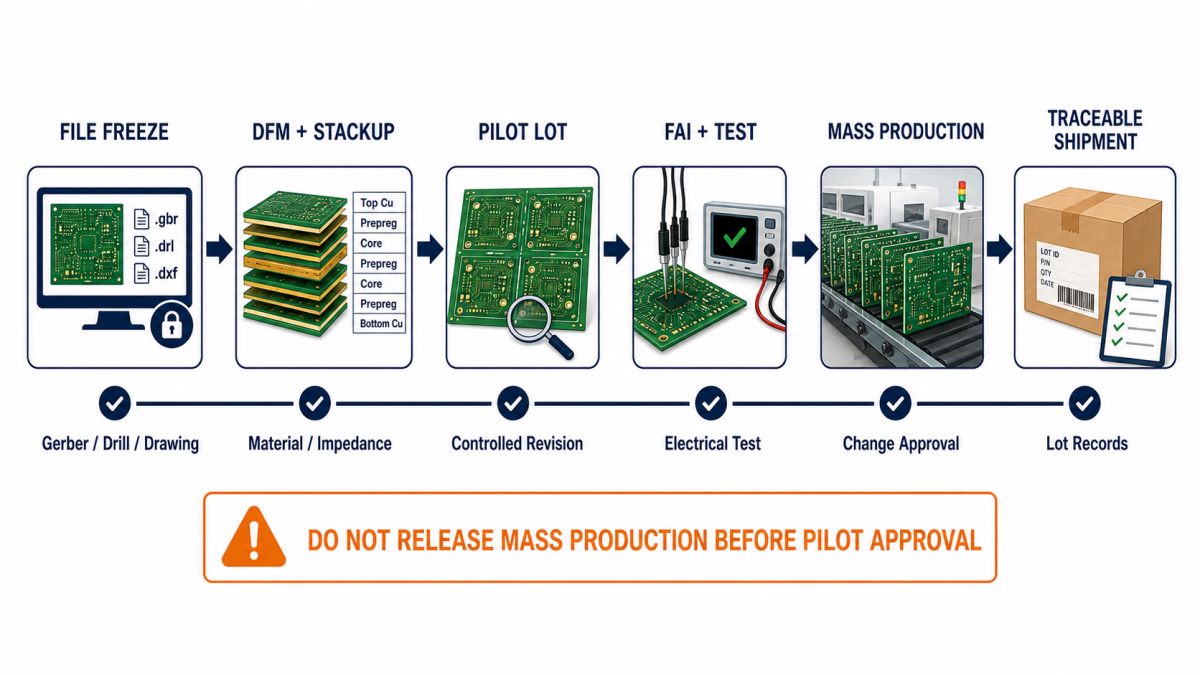
Do not release mass production only because the prototype powers on. Confirm dimensions, finish, workmanship, electrical test, impedance where required, assembly fit and any application-specific checks.
What Should First Article Approval Verify?
First article approval verifies that the supplier built the right product with the agreed process. The exact evidence depends on risk, but the record should answer three questions: Is the construction correct? Does the board meet critical dimensions and electrical requirements? Can the result be repeated?
- Part number and revision match the purchase order.
- Layer count, thickness, copper and material match the approved stackup.
- Profile, holes, slots and controlled dimensions match the drawing.
- Surface finish, solder mask and legend are correct.
- Electrical test passed against the correct netlist.
- Required impedance, microsection or special-process evidence is attached.
Which PCB Production Tests Matter?
Testing should match failure risk. Electrical test checks opens and shorts in the bare board; it does not prove laminate identity, plating quality or assembly function.
| Check | What it detects | Buyer confirmation |
| AOI | Pattern defects and inner/outer-layer anomalies | Which layers and production stages are inspected? |
| Electrical test | Open and short circuits | Flying probe or fixture, and test coverage |
| Microsection | Hole-wall plating and internal construction | Sampling plan and acceptance requirement |
| Impedance test | Controlled-impedance result on coupon or board | Target, tolerance and report format |
| Dimensional inspection | Profile, hole and slot deviations | Critical dimensions and sampling level |
How Should Materials and Special Processes Be Controlled?
Do not specify only “FR-4” when performance depends on a particular material property. State the approved material or required property set, and decide whether equivalents require written approval. Apply the same logic to copper foil, solder mask, surface finish, via filling, sequential lamination and special inspection.
Ask whether critical operations are internal or subcontracted. Outsourcing is not automatically a defect, but the supplier must identify the process owner, acceptance evidence and lot traceability.
How Do You Control Engineering Changes?
Production changes need a written approval path. A material substitution, stackup adjustment, panel change or process relocation can affect impedance, assembly fit, reliability, cost or lead time.
Require the supplier to describe the reason, affected requirement, proposed replacement, validation evidence and effective lot. Emergency email approval should be transferred into the formal revision record before the next order.
What Traceability Records Should a Supplier Keep?
Traceability links shipped boards to the production data and material/process records used to build them. The required depth depends on the application, but repeat orders benefit from a stable minimum set.
- Customer part number, revision and purchase order.
- Factory lot or date code.
- Material and special-process lot references where required.
- CAM and traveler revision.
- Inspection and electrical-test disposition.
- Approved deviations and rework records.
What Changes PCB Production Cost in China?
Cost follows material use, process difficulty, yield risk, tooling and verification. A low quoted unit price can rise when the technical package is incomplete or when required tests appear after order release.
| Driver | Why cost changes | RFQ action |
| Layer count and stackup | More imaging, lamination and control | Send an approved or reviewable stackup |
| Small holes and fine features | Higher process and yield demand | Identify critical minimums |
| Material and finish | Different purchase and process routes | State approved alternatives |
| Panel utilization | Changes material yield | Share annual volume and delivery lot |
| Testing and reports | Adds equipment and review time | Define evidence before quotation |
What Should You Ask During Factory Evaluation?
Ask questions that expose process ownership rather than collecting generic promises.
- Which board technologies and volume ranges are routine here?
- Which critical processes are subcontracted?
- How are DFM questions, deviations and revision changes approved?
- How does a pilot lot transfer into mass production?
- What electrical, dimensional and special-process reports are available?
- How are complaints contained by lot and traced to process records?
For a broader supplier screen, use our China PCB manufacturer checklist.
PCB Production RFQ Checklist
A quote is comparable only when every supplier prices the same scope.
- Gerber/ODB++, drill and fabrication drawing.
- Stackup, material, copper, thickness and finish.
- Critical dimensions, impedance and acceptance notes.
- Prototype, pilot, delivery-lot and annual quantities.
- Required tests, reports, packaging and traceability.
- Approved-equivalent and change-notification rules.
- For PCBA: BOM, CPL, assembly drawing, firmware and functional test.
FAQ About PCB Production in China
Is PCB production the same as PCBA production?
No. PCB production creates the bare board. PCBA production adds components and assembly processes. State whether the quote covers one or both.
Should I start with a prototype or pilot lot?
Use prototypes to learn and verify the design. Use a controlled pilot lot to validate the intended production package and process before volume release.
Can a factory change laminate without approval?
Your order should define whether equivalents are allowed. For performance-sensitive work, require written approval and supporting property data before substitution.
Does electrical test prove PCB quality?
It proves continuity and isolation against a netlist. It does not alone prove material, plating integrity, dimensions or long-term reliability.
What is the most important RFQ file?
No single file is enough. Gerber/drill data define geometry, while the fabrication drawing and stackup define construction and acceptance intent.
How do I compare two China PCB quotes?
Normalize material, stackup, quantity, tooling, testing, reports, shipping terms and allowed substitutions before comparing unit price.
When is microsection evidence useful?
It is useful when plated-hole quality, internal construction or a special process is a critical acceptance risk. Define sampling and reporting before production.
What should happen after a DFM question?
The buyer should approve a documented answer or revised file. Production should not proceed from an informal assumption.
How can I reduce repeat-order variation?
Freeze files, approve the stackup and pilot, control changes, define evidence, and reference the same controlled package on every repeat purchase order.
Should I use one supplier for PCB and assembly?
It can simplify ownership, but verify the boundary for sourcing, substitutions, programming, testing and failures. One invoice does not automatically mean one controlled process.
Request a PCB Production Review
Send Gerber or ODB++, NC drill, fabrication drawing, stackup, quantity, material, copper weight, surface finish, impedance and test requirements to [email protected]. PCBtry can review DFM questions, pilot scope, production controls and quotation assumptions before release. Include BOM, CPL, firmware and functional-test requirements when assembly is also required.

0 Comments