




What Is the Density of FR4 Material?
The density of FR4 material is commonly used to estimate the weight of the insulating laminate in a printed circuit board. In practical PCB quotation, many engineers use an approximate FR4 density around 1.8 to 2.0 g/cm3 for rough calculations, but the exact value can vary with glass content, resin system, grade and manufacturer data.
For most buyers, FR4 density is not needed to design every trace. It becomes useful when estimating board weight, shipping weight, fixture load, enclosure support, panel handling or cost assumptions for larger boards. The estimate should also include copper, solder mask, surface finish, components if assembled, packaging and quantity.
How to Estimate PCB Weight from FR4 Density
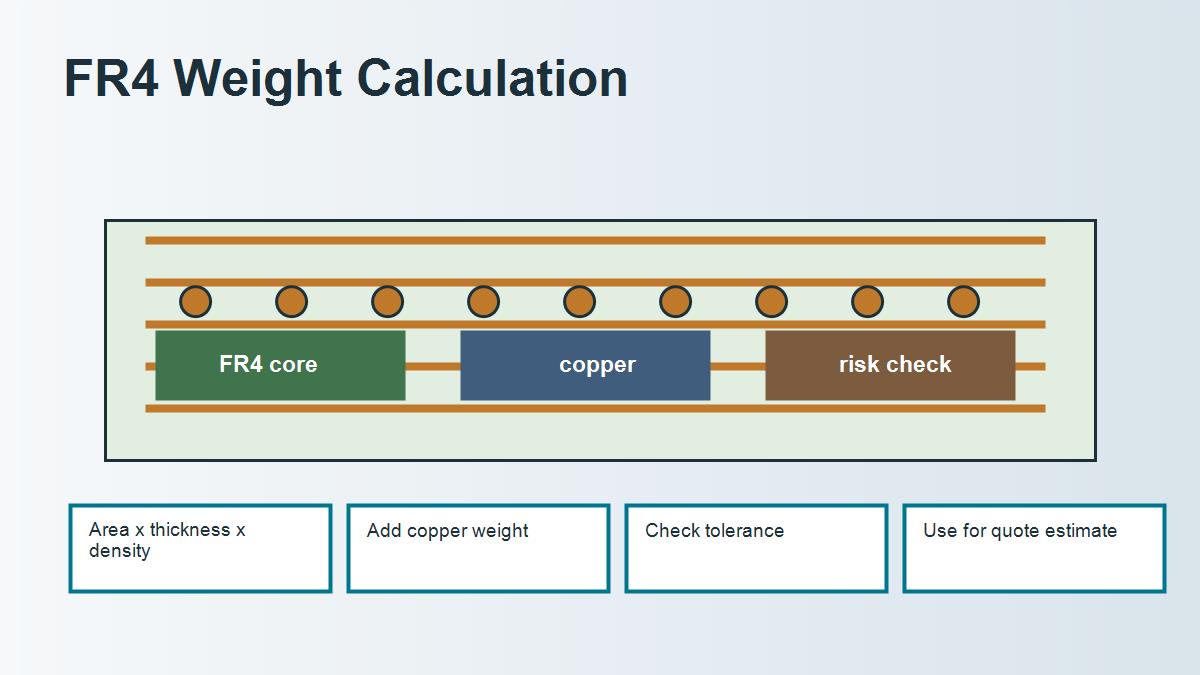
A simple base estimate is board area multiplied by finished thickness and material density. For example, a larger 1.6 mm rigid board will weigh much more than a small 0.8 mm board even if both use FR4. Copper adds additional weight, especially with 2 oz or heavier copper. Components, connectors, shields and packaging can dominate the final shipping weight for assembled boards.
This calculation is useful for early planning, but it is not a replacement for the supplier final weight. Finished thickness tolerance, routing waste, panel rails, copper percentage and assembly materials can change the result.
FR4 Density and PCB Weight Factors
| Factor | Effect on weight | Why buyers check it | Practical action |
|---|---|---|---|
| Board area | Larger area increases laminate mass | Important for shipping and enclosure support | Use final outline dimensions |
| Board thickness | Thicker boards add material volume | Affects weight and mechanical stiffness | Use finished thickness tolerance |
| Copper weight | Heavier copper adds significant mass | Matters for power boards and cost | State copper per layer |
| Panel rails | Increase temporary manufacturing weight | Affects handling and shipping estimates | Ask whether rails remain or are removed |
| Assembly parts | May exceed bare board weight | Important for PCBA logistics | Use BOM and packaging estimate |
Density of FR4 vs Finished PCB Weight
| Item | Included in FR4 density estimate? | Can affect final shipped weight? | Buyer note |
|---|---|---|---|
| FR4 laminate | Yes | Yes | Main base material for bare rigid PCB |
| Copper layers | No | Yes | Important for heavy copper boards |
| Solder mask and silkscreen | No | Slightly | Usually small but still part of finished board |
| Components | No | Yes | Can dominate PCBA weight |
| Packaging | No | Yes | Needed for shipping quote |
When FR4 Density Matters in Real Projects
FR4 density matters most when the board is physically large, thick, heavy-copper, mounted in a weight-sensitive enclosure or shipped in high quantity. It also matters when a customer compares prototype and mass-production logistics. A few grams may not matter for one prototype, but thousands of boards can change shipping cost and packaging planning.
Density also helps avoid mechanical surprises. A large thick FR4 board may need better support points in an enclosure. If the board carries heavy connectors, transformers or heat sinks, the mechanical design should review total PCBA weight, not just bare board material.
Real Quote Case: Weight Estimate Changed the Shipping Plan
A buyer requested 2,000 large FR4 control boards for an industrial cabinet. The electrical design was ordinary, but the board outline was large and the finished thickness was 2.0 mm. The first shipping estimate used only a generic small-board assumption and looked too low. During quote review, the supplier recalculated using board area, thickness, copper weight, panel handling and packaging.
The revised estimate changed the shipping method and packaging plan. It did not change the circuit, but it prevented a logistics surprise after production.
Buyer takeaway: use FR4 density as an early estimate, but ask for final shipment weight when board size, thickness, copper or quantity is significant.
FR4 Density Checklist for Buyers
- Use finished board dimensions, not only schematic size.
- Confirm finished thickness and tolerance.
- Add copper weight for each layer, especially for heavy copper boards.
- Include panel rails if they remain during delivery.
- For PCBA, include components, fixtures and packaging.
- Ask the supplier for final estimated shipment weight before confirming logistics.
Ask PCBTRY for a Weight and Quote Review
If board weight affects shipping, enclosure design or production planning, send PCBTRY the Gerber files, board thickness, copper weight, quantity and assembly BOM. PCBTRY can help estimate bare PCB and PCBA weight more realistically before quotation.
Weight Calculation Boundaries
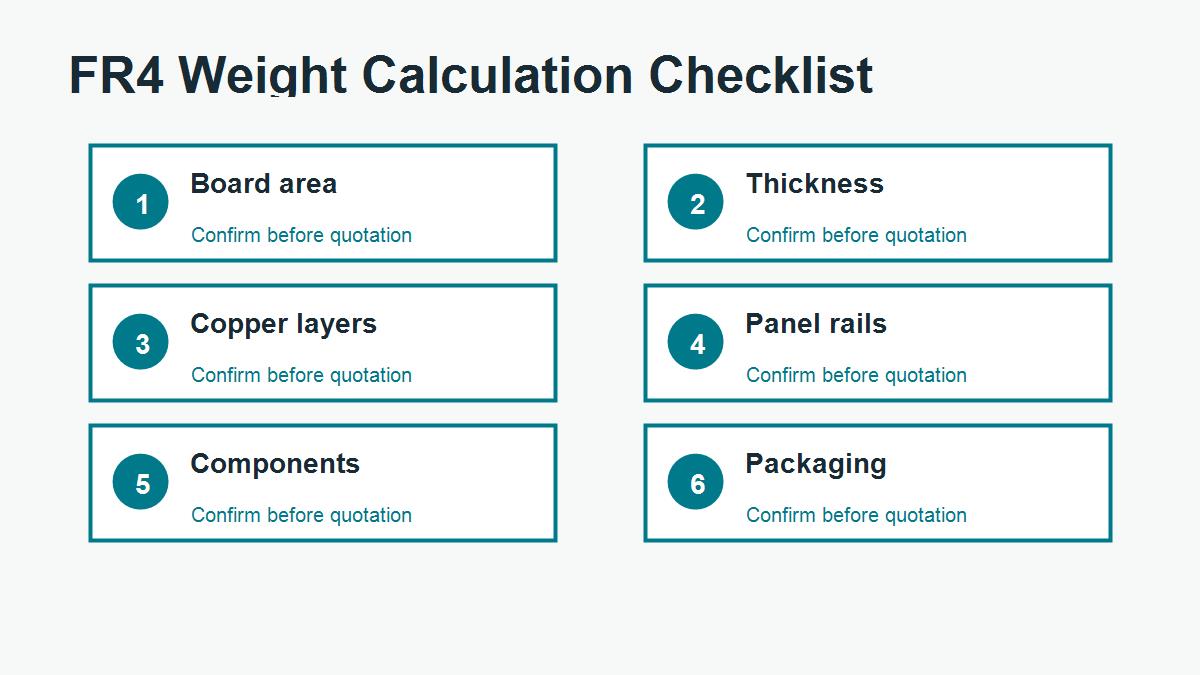
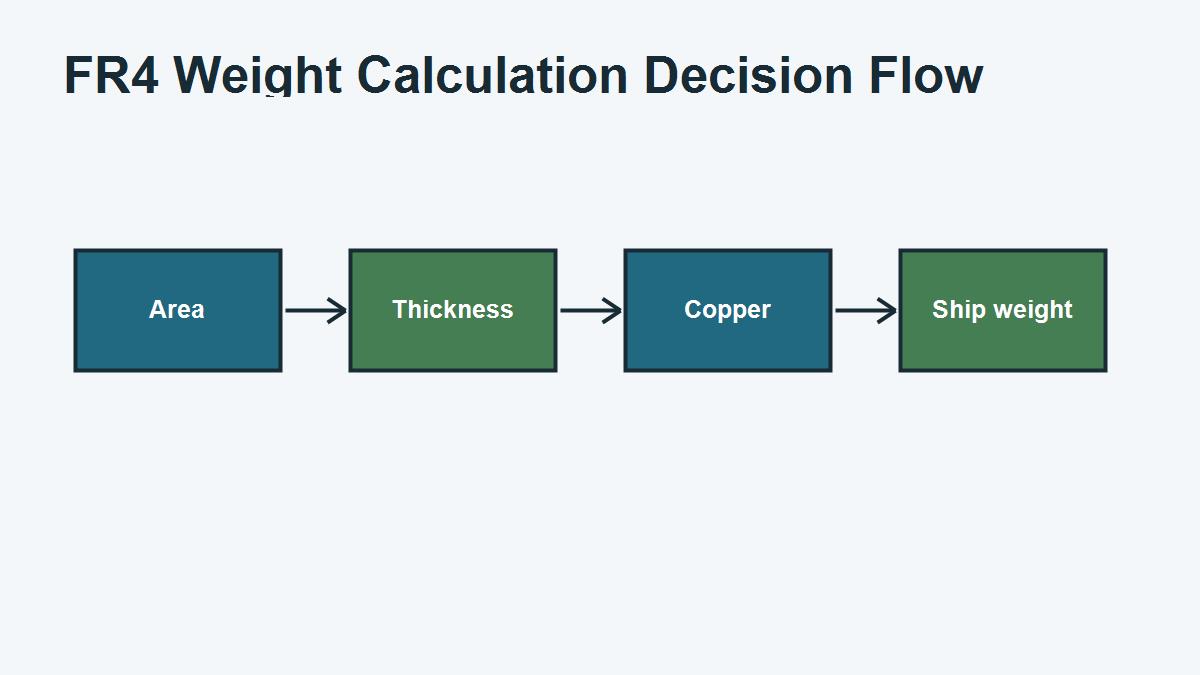
Use FR4 density as an estimate, not as the final shipment promise. The result can change when the supplier adds copper plating, surface finish, solder mask, silkscreen, route tabs, panel rails, labels, bags, cartons and moisture protection. For assembled boards, connectors, transformers, shields, heat sinks and cables may weigh more than the bare FR4 board.
The safest approach is to use density for early planning and ask the PCB supplier for a final logistics estimate before production release. This is especially important for large boards, thick boards, export shipments, air freight, and products with strict enclosure or mounting limits.
Common FR4 Mistakes That Cause Quote or Production Problems
The most common FR4 mistake is treating a short material word as a complete production requirement. A PCB supplier cannot reliably quote every risk from the phrase “FR4” alone. The quote also depends on board thickness, layer count, copper weight, surface finish, hole structure, impedance, assembly process, test requirement and delivery quantity. If those details are missing, the first quote may look fast but the order can still change after engineering review.
A second mistake is comparing suppliers only by unit price. One quote may assume standard FR4, loose tolerance and no special report. Another quote may include high-Tg material, impedance coupon, tighter inspection or a controlled stackup. If the assumptions are different, the prices are not truly comparable. Buyers should ask what is included before deciding that one supplier is more expensive.
A third mistake is using a datasheet value without checking how the finished board will be built. Dk, Df, Tg and CTE values are useful, but they must be connected to the actual stackup, copper construction, press process and assembly exposure. For sensitive designs, the better workflow is to share the real files and let the manufacturer confirm a practical build.
Questions to Send With an FR4 PCB RFQ
| Question | Why it helps | What the supplier can confirm |
|---|---|---|
| Is standard FR4 acceptable for this application? | Prevents over-specifying or under-specifying material | Material family, Tg need and substitution rule |
| Can you propose a manufacturable stackup? | Connects material to real production | Core, prepreg, copper and thickness tolerance |
| Does this board need impedance control? | Protects signal integrity requirements | Trace geometry, Dk assumption and coupon options |
| Are there DFM risks in the files? | Finds issues before production | Drill, spacing, annular ring, solder mask and outline risks |
| What should be changed before mass production? | Turns the quote into a decision tool | Cost, yield, testing and reliability improvements |
FR4 FAQ for PCB Buyers
Can I simply write FR4 on the drawing?
You can do that for many simple boards, but it is not enough for every project. If the board has controlled impedance, high assembly temperature, heavy copper, dense vias, RF signals or strict reliability requirements, add the relevant material and stackup notes.
Does higher Tg always mean better FR4?
Higher Tg can improve thermal margin, but it does not automatically solve signal loss, impedance, current carrying or moisture concerns. Match the material upgrade to the actual risk.
Should prototypes and mass production use the same FR4 grade?
For low-risk prototypes, an equivalent stocked FR4 may be acceptable. For controlled or certified products, keep the material rule consistent and document any approved substitution before production.



0 Comments