




What Is the Dielectric Constant of FR4?
The dielectric constant of FR4, often called Dk or relative permittivity, describes how the PCB dielectric stores electric-field energy compared with air or vacuum. In practical PCB design, Dk affects impedance, propagation delay and wavelength. Designers often use a value around the low-to-mid 4 range for ordinary FR4 estimates, but that should not be treated as one fixed universal number.
FR4 is a family of glass-epoxy materials. Different resin systems, glass styles, resin content, frequency, test method and laminate construction can produce different effective Dk values. The Dk used in an impedance calculation should match the actual material and stackup the factory will build.
Why FR4 Dk Is Not One Exact Number
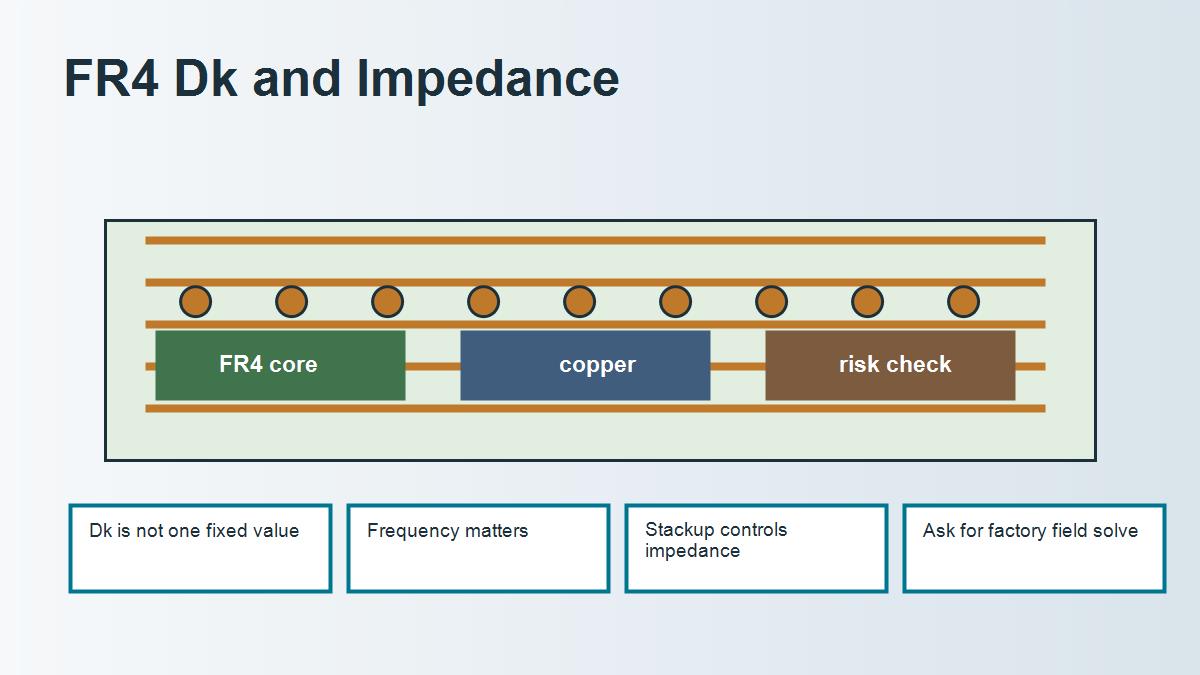
A datasheet Dk value is measured under specific conditions. It may be measured at a stated frequency, using a stated method, on a specific material grade and sample thickness. A PCB trace, however, sees an effective environment: dielectric thickness, copper thickness, solder mask, trace width, nearby planes, glass weave and fabrication tolerances all contribute.
This is why two common mistakes happen. One mistake is copying a random FR4 Dk value into a calculator and locking the trace width before the fabricator has proposed a stackup. The other mistake is assuming a high-Tg FR4 automatically gives better high-frequency loss. Tg and Dk/Df answer different questions.
Typical FR4 Dk Decision Table
| Situation | Dk sensitivity | What to check | Recommended action |
|---|---|---|---|
| Low-speed control board | Low | Basic insulation and manufacturability | Standard FR4 estimate is usually enough |
| Controlled impedance digital board | Medium | Dk, dielectric thickness and trace geometry | Ask supplier for stackup and impedance calculation |
| Long high-speed channel | Medium to high | Dk, Df, copper roughness and via transitions | Review material data and loss budget |
| RF or microwave circuit | High | Dk stability, Df and frequency-specific data | Consider low-loss laminate or hybrid stackup |
How Dk Affects Impedance
For a controlled-impedance trace, Dk is only one part of the result. Trace width, copper thickness, dielectric height, solder mask, reference plane spacing and fabrication tolerance also matter. A higher Dk generally allows a narrower trace for the same impedance, while a lower Dk generally requires different geometry. But the exact answer must be solved from the final stackup.
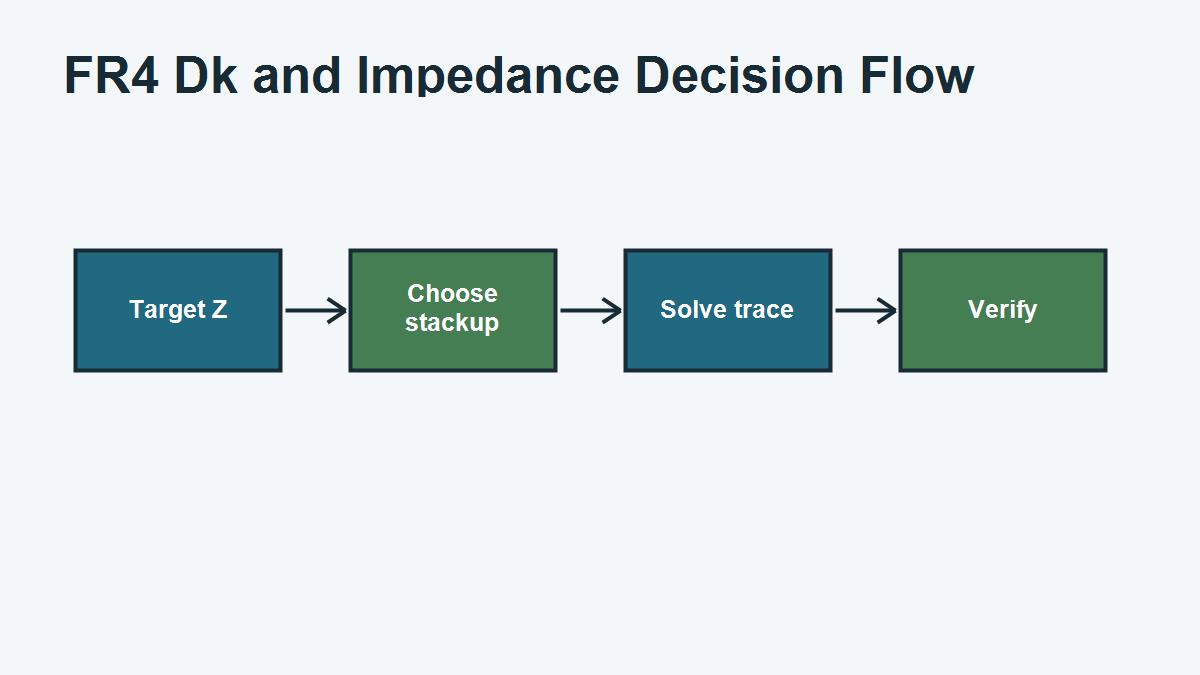
The safest workflow is to give the PCB factory the impedance target, layer assignment, preferred board thickness and any material requirement. The factory can then propose a manufacturable stackup and trace geometry. After approval, the designer can update the routing rules and release a controlled package.
FR4 Dk vs Df: Do Not Mix Them Up
| Term | Meaning | Main design effect | Buyer question |
|---|---|---|---|
| Dk | Dielectric constant | Impedance, delay and wavelength | Which value will be used for stackup solving? |
| Df | Dissipation factor | Dielectric loss | Is standard FR4 loss acceptable at this frequency and length? |
| Tg | Thermal transition behavior | Assembly and temperature reliability | Does the board need high-Tg material? |
A board may need high-Tg FR4 because of assembly stress but still not need a low-loss laminate. Another board may need low-loss material because of RF performance even if the thermal requirement is not extreme. Define the problem before choosing the upgrade.
Real Engineering Case: Impedance Failed Because the Stackup Was Assumed
A design team routed a four-layer board using a generic online impedance calculator and assumed a standard FR4 Dk value. The Gerber files were sent without a controlled stackup. During manufacturing review, the factory proposed a different dielectric thickness because of available materials and press construction. The original trace width no longer matched the target impedance.
The fix was to stop treating Dk as a standalone number. The team approved a factory stackup first, then updated trace width and impedance notes. The job also added an impedance coupon requirement for production verification.
Buyer takeaway: do not specify only “50 ohm on FR4.” Give the supplier the target impedance, layer, tolerance and board thickness, then approve the actual stackup before production.
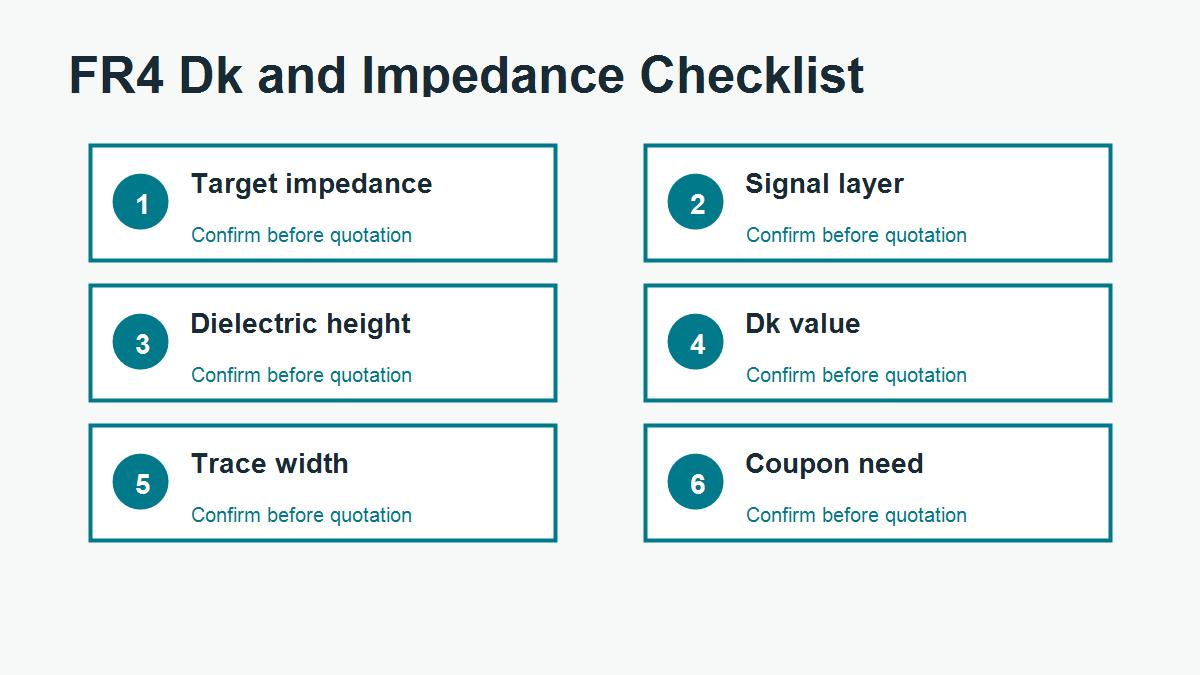
FR4 Dk Checklist Before Quotation
- Is the design low speed, high speed, RF or mixed?
- Which layers carry controlled-impedance traces?
- What impedance target and tolerance are required?
- What finished board thickness is required?
- Does the supplier have a stocked FR4 grade with suitable Dk/Df data?
- Will impedance coupons or reports be required?
- Is standard FR4 acceptable, or should low-loss material be reviewed?
Ask PCBTRY for a Stackup and Dk Review
If Dk affects your board, send PCBTRY the Gerber files, impedance targets, layer assignment, target thickness, frequency range and material notes. PCBTRY can review whether standard FR4 is acceptable and help propose a manufacturable stackup before production.
Common FR4 Mistakes That Cause Quote or Production Problems
The most common FR4 mistake is treating a short material word as a complete production requirement. A PCB supplier cannot reliably quote every risk from the phrase “FR4” alone. The quote also depends on board thickness, layer count, copper weight, surface finish, hole structure, impedance, assembly process, test requirement and delivery quantity. If those details are missing, the first quote may look fast but the order can still change after engineering review.
A second mistake is comparing suppliers only by unit price. One quote may assume standard FR4, loose tolerance and no special report. Another quote may include high-Tg material, impedance coupon, tighter inspection or a controlled stackup. If the assumptions are different, the prices are not truly comparable. Buyers should ask what is included before deciding that one supplier is more expensive.
A third mistake is using a datasheet value without checking how the finished board will be built. Dk, Df, Tg and CTE values are useful, but they must be connected to the actual stackup, copper construction, press process and assembly exposure. For sensitive designs, the better workflow is to share the real files and let the manufacturer confirm a practical build.
Questions to Send With an FR4 PCB RFQ
| Question | Why it helps | What the supplier can confirm |
|---|---|---|
| Is standard FR4 acceptable for this application? | Prevents over-specifying or under-specifying material | Material family, Tg need and substitution rule |
| Can you propose a manufacturable stackup? | Connects material to real production | Core, prepreg, copper and thickness tolerance |
| Does this board need impedance control? | Protects signal integrity requirements | Trace geometry, Dk assumption and coupon options |
| Are there DFM risks in the files? | Finds issues before production | Drill, spacing, annular ring, solder mask and outline risks |
| What should be changed before mass production? | Turns the quote into a decision tool | Cost, yield, testing and reliability improvements |
FR4 FAQ for PCB Buyers
Can I simply write FR4 on the drawing?
You can do that for many simple boards, but it is not enough for every project. If the board has controlled impedance, high assembly temperature, heavy copper, dense vias, RF signals or strict reliability requirements, add the relevant material and stackup notes.
Does higher Tg always mean better FR4?
Higher Tg can improve thermal margin, but it does not automatically solve signal loss, impedance, current carrying or moisture concerns. Match the material upgrade to the actual risk.
Should prototypes and mass production use the same FR4 grade?
For low-risk prototypes, an equivalent stocked FR4 may be acceptable. For controlled or certified products, keep the material rule consistent and document any approved substitution before production.



0 Comments