




Define the Product and Packaging Risks Before Choosing Materials
PCB packaging process control is not simply the choice of a bag or box. It is the controlled transfer of an accepted product from final inspection to the customer without losing cleanliness, solderability, electrical integrity, traceability, or mechanical condition. The correct package therefore depends on what is being shipped: an unassembled bare printed board, a populated printed circuit board assembly (PCBA), or a mixed shipment containing accessories and hardware.
Begin with a product-and-route risk assessment. Bare boards may be vulnerable to surface contamination, oxidation, moisture uptake, scratches, edge damage, and panel distortion. A PCBA adds electrostatic-discharge (ESD) sensitivity, exposed components, connectors, tall parts, batteries, conformal coatings, and solder joints that can be damaged by impact or board flexure. The distribution route adds vibration, drops, compression, humidity, temperature cycling, and handling errors. Packaging controls should be selected against those identified risks, not copied from an unrelated product.
| Risk question | Evidence to review | Typical control category |
|---|---|---|
| Can the product be damaged by static? | ESD control plan, component sensitivity, customer specification | Static-control packaging and an ESD-protected handling process |
| Can moisture affect storage or later assembly? | Laminate, finish, component MSL status, exposure history, customer requirement | Dry release, moisture-barrier system where justified, controlled storage |
| Can surfaces rub or bend? | Board geometry, finish, component height, trial-pack inspection | Separation, restraint, cushioning, rigid support |
| Can lots or revisions be mixed? | Traveler, inspection record, label master, ERP data | Unit-level identification, reconciliation, seal and label verification |
PCB Packaging Control Plan: From Final Release to Receiving
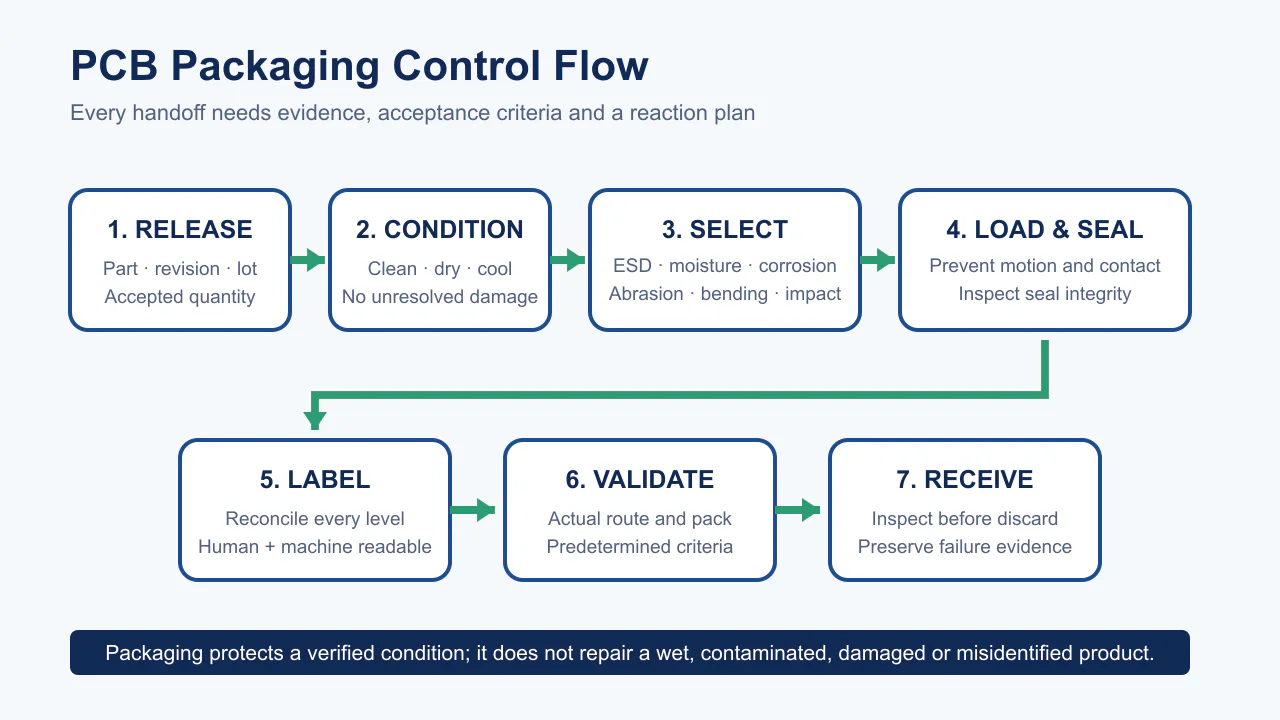
A useful control plan defines the inputs, acceptance criteria, responsible operator, records, and reaction plan at every handoff. The basic flow is: final release, cleanliness and dryness confirmation, packaging-material selection, protected loading, sealing, labeling, pack-out verification, transport validation, shipment, and receiving inspection. A package should not conceal an unresolved manufacturing problem. Boards that are wet, contaminated, damaged, or incorrectly identified must be contained before packaging.
- Release: confirm inspection status, quantity, part number, revision, lot, and any customer-specific packaging instruction.
- Condition: verify that the product is clean, dry, cooled to an appropriate handling condition, and free from loose debris.
- Select: choose ESD, moisture, corrosion, abrasion, and mechanical controls from documented requirements.
- Load: prevent bare-hand contact with critical surfaces and avoid uncontrolled sliding, stacking, or board flexure.
- Seal and label: use a qualified sealing method and reconcile the inner-package label with the outer carton and traveler.
- Verify: inspect seal continuity, cushioning, orientation, carton closure, quantity, and traceability before release.
- Receive: inspect the package before discarding evidence, then verify product condition and record any discrepancy.
Bare PCB vs PCBA Packaging Requirements
Bare PCBs and PCBAs should not automatically share one packaging specification. Bare boards often need surface protection and support that prevents bow, twist, edge chipping, and finish abrasion. Contact with sulfur-bearing paper, uncontrolled foam, dirty separators, or incompatible packaging material can introduce contamination or corrosion risk. Finished boards should be handled by clean edges whenever practical, with critical contact areas protected from touch and rubbing.
A PCBA may contain ESD-sensitive devices even when the board itself appears robust. Its package must also prevent tall components, connector latches, switches, wires, and soldered joints from carrying stack or impact loads. Cavities, dividers, trays, or fixtures should restrain the assembly at mechanically suitable locations. If the assembly includes a battery, magnet, liquid, or other regulated item, transport and labeling obligations must be assessed separately; a standard PCB carton does not resolve those requirements.
Packaging Use Scenarios and Their Control Priorities
The same drawing can need different packaging as quantity, assembly state, route, and storage change. Use scenarios should therefore be named in the packaging specification rather than hidden in an operator’s assumptions.
| Use scenario | Primary concern | Control priority | Release evidence |
|---|---|---|---|
| Prototype or small engineering lot | Mixed revisions, manual handling, repeated access | Individual identification, controlled access and separation of revisions | Quantity and revision reconciliation at every handoff |
| High-volume bare-board shipment | Surface rubbing, panel distortion, lot mixing, storage exposure | Validated pack quantity, clean separation, rigid support and traceability | Pack audit plus representative flatness and surface inspection |
| PCBA with tall parts or connectors | ESD, impact, component preload and solder-joint flexure | ESD control, restrained cavities and load paths that bypass vulnerable parts | Trial-pack inspection and post-distribution mechanical or functional checks |
| Long storage or humid route | Moisture ingress, corrosion and loss of solderability | Verified dry release and a qualified barrier system when required | Seal, material, exposure and indicator records defined by the control plan |
| Return, repair or field-service loop | Unknown exposure, damaged original pack and incomplete identity | Quarantine, status labeling, preserved evidence and fresh approved protection | Receiving condition record and disposition authorization |
For example, a ten-board prototype lot may benefit more from unmistakable revision separation and controlled repeated access than from a high-density production tray. A large production panel shipment needs stable support and a validated stack quantity. A PCBA with an edge connector and tall electrolytic capacitors needs restraint that does not transmit carton compression through those components. A repaired field return must not be placed back into clean stock merely because it fits the original bag; its exposure, ESD status, damage, and identification need fresh assessment.
Clean and Dry Release Before the Bag Is Sealed
Packaging preserves an acceptable condition; it does not create one. The pack-out area should be controlled against dust, liquids, food, fingerprints, and incompatible materials. Cleaning residues must be removed or accepted according to the product specification, and boards must not be sealed while still warm or carrying uncontrolled surface moisture. Condensation can occur when a cold product is exposed to warm humid air, so acclimation and handling conditions matter.
Moisture history requires product-specific judgment. IPC-1601A addresses handling and storage of printed boards, while component moisture-sensitivity controls are covered by other requirements such as J-STD-033. A requirement written for moisture-sensitive components should not be imposed blindly on every bare board. Conversely, an assembly containing moisture-sensitive devices cannot be protected solely by treating it as a bare PCB. Define the applicable standard, exposure limit, drying decision, and release evidence in the drawing, purchase order, control plan, or customer-approved packaging specification.
For practical background on controlling the board’s exposure before pack-out, see PCBTry’s guide to protecting PCBs from moisture.
Choose ESD, Moisture and Corrosion Protection by Evidence
Static-control packaging has two jobs: support the organization’s ESD control plan inside protected operations and protect susceptible items during transport or storage outside those operations. ANSI/ESD S541 defines packaging-material properties and classifications for ESD-sensitive items. The appropriate construction may require shielding as well as dissipative or conductive behavior; an ordinary pink or black bag should not be accepted from color alone. Material qualification, supplier data, incoming verification, and periodic checks should match the risk and specification.
A moisture-barrier bag, desiccant, humidity indicator card, dry-air purge, or vacuum seal can be useful when the product and exposure assessment justify them. They are not universal requirements. If desiccant is specified, its type and quantity should be calculated or defined by an approved method using package permeability, internal volume, storage duration, and environmental assumptions. If a humidity indicator is used, define its acceptance limit and reaction plan. Vacuum should never be so aggressive that it bends boards, crushes components, or turns loose hardware into impact points.
Corrosion control begins by eliminating residues and incompatible materials. Where a volatile corrosion inhibitor or other special protection is considered, compatibility with surface finish, solderability, coatings, plastics, optics, and customer processes must be established. Do not add chemical protection simply to mask a cleanliness or storage-control failure. Operators who handle susceptible assemblies should also follow the controlled practices described in the ESD protection and PCB handling guide.
Prevent Scratches, Flexing, Connector Damage and Mixed Lots
Mechanical protection should control relative motion. Boards sliding against each other can abrade solder mask, legends, pads, or surface finishes. Interleaves, slots, trays, or individual cavities can separate products, but their materials must be clean, non-shedding, compatible, and strong enough for the expected load. Finished surfaces should not rest against staples, carton seams, loose desiccant, or sharp tray features.
Cushioning is effective only when the packaged product cannot migrate into an unprotected position. Avoid loading a component, connector, or unsupported board area as the primary restraint point. Set maximum quantity, stacking direction, divider pattern, and allowable void space. For panels or large thin boards, evaluate rigid support and flatness after a representative storage and distribution cycle. For PCBAs, check that the closing bag or lid does not preload tall parts.
Lot integrity is another physical control. Do not combine revisions, date codes, or inspection statuses merely because they fit in one carton. Inner packages should have defined quantities, and the final reconciliation should connect the packaged quantity to the accepted quantity and shipment record.
Seal, Label and Trace Every Packaging Unit
A seal is a process output, not a cosmetic feature. Define the sealer settings or approved operating window, seal location, minimum acceptable appearance, and checks for wrinkles, contamination, channels, burns, incomplete fusion, or punctures. When the packaging system depends on barrier performance, validate the complete bag-and-seal combination rather than relying only on the film supplier’s data.
Labels should remain readable and attached for the intended storage and route. At minimum, the controlled label master commonly includes part number, revision, quantity, lot or batch identifier, manufacturer or supplier identity, inspection status where applicable, and any required handling symbol. Date and shelf-life fields should appear only when governed by a real requirement. Barcode data must match human-readable text and the shipping record. Put labels where they do not damage the barrier or cover critical seal evidence.
Validate the Package Against Real Distribution Hazards
A package that looks tidy on a bench may fail in a parcel network or pallet load. Validation should reflect the actual distribution mode, product mass, carton geometry, stacking, route, climate, and handling. ISTA procedures and other recognized test methods can help build a test plan, but the correct procedure must be selected for the shipment system. Passing an unrelated test is not proof of fitness.
Representative validation can include conditioned storage, vibration, shock or drop, compression, package integrity, label legibility, and post-test product inspection. Establish acceptance criteria before testing: no puncture or seal failure, no unacceptable board deformation, no component or connector damage, no product migration, maintained identification, and any required electrical or solderability result. Record the product configuration, packaging revision, material lots, test setup, deviations, and disposition. A packaging change in film, tray, carton, supplier, quantity, or layout should trigger a documented review of whether revalidation is required.
Packaging Failures: Evidence, Containment and Root-Cause Response
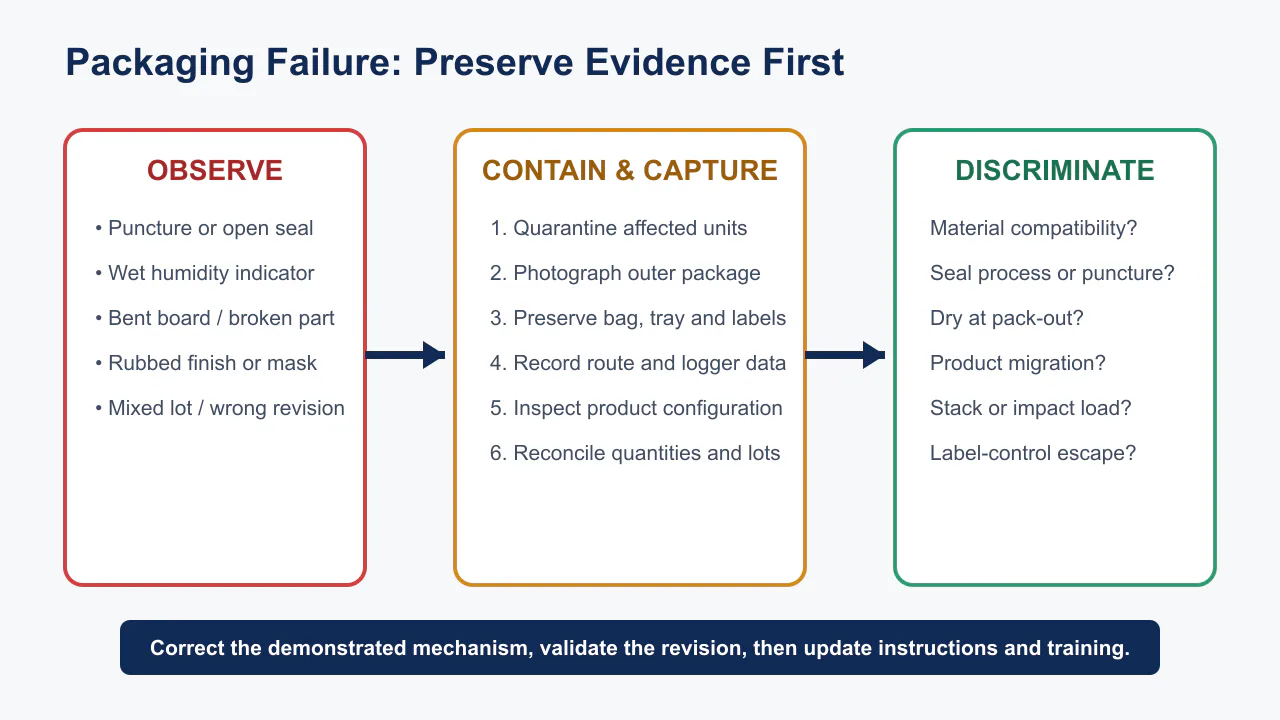
When damage is reported, first preserve evidence. Photograph every side of the outer carton, closure, labels, inner protection, orientation, and damaged product before repacking. Retain the packaging materials, shipment records, environmental logger data if used, and representative affected units. Record where the package was found, not just what the board looks like.
| Observed condition | Immediate containment | Questions for investigation |
|---|---|---|
| Punctured or open barrier bag | Quarantine affected units and preserve the bag | Was the puncture caused by product geometry, loose hardware, carton damage, or sealing? |
| Unexpected humidity indication | Do not assume product acceptability; follow the defined reaction plan | Was the product dry at pack-out? Were barrier, desiccant, seal, storage time, and indicator valid? |
| Bent board or broken component | Stop use of the affected pack configuration | Did the product migrate, bottom out, carry stack load, or contact a hard feature? |
| Mixed lot or wrong revision | Contain the shipment and reconcile all package levels | Where did traveler, label generation, count, or final verification lose control? |
Corrective action should address the causal mechanism, not just add more packaging. A stronger carton will not fix an unsupported connector, and extra desiccant will not fix an open seal. Recreate the failure where possible, change one controlled element with a documented rationale, validate the revised pack, update instructions and training, and monitor subsequent shipments.
Published Moisture-Control Case for Printed Boards
An IPC-hosted technical paper, Controlling Moisture in Printed Circuit Boards, describes the industry problem of moisture absorbed by printed boards and the risk that rapid heating during assembly can cause damage. Its practical lesson for packaging control is that a board’s moisture condition must be managed before and during storage; simply sealing an uncontrolled board does not prove that it is dry.
The published work supports a sequence of assessing moisture exposure, applying an appropriate drying or handling method when required, and using suitable protective packaging for the intended storage condition. It does not establish one universal bake schedule, desiccant quantity, or shelf life for every PCB. Those values depend on construction, prior exposure, applicable standards, and customer requirements. For a pack-out team, the reusable lesson is to require objective dry-release evidence and a defined packaging system instead of relying on the appearance of a sealed bag.
What to Put in a PCB Packaging Specification or RFQ
A packaging specification should be testable. State the product scope and revision, cleanliness and release condition, ESD classification, moisture-control basis, approved packaging materials, maximum pack quantity, orientation, separation and cushioning, sealing method, labeling data, carton limits, storage environment and duration, transport mode, validation requirement, inspection sampling, records, and reaction plan. Separate mandatory customer requirements from supplier proposals.
For higher-volume programs, package design should be reviewed together with line output, material replenishment, traceability, and inspection capacity. PCBTry’s high-volume PCB assembly readiness checklist provides a broader framework for that production handoff.
PCB Packaging Process Control Checklist
- Confirm whether the shipment is bare PCB, PCBA, panel, or mixed hardware.
- Verify accepted quantity, part number, revision, lot, and customer instruction.
- Confirm cleanliness, dryness, temperature condition, and damage-free release.
- Identify ESD, moisture, corrosion, abrasion, bending, and impact risks.
- Use qualified, compatible packaging materials with controlled specifications.
- Protect critical surfaces and prevent board-to-board or component contact.
- Restrain the product without loading connectors, tall components, or unsupported areas.
- Apply moisture-barrier components only where the requirement and calculation support them.
- Inspect seal continuity, bag condition, orientation, cushioning, and carton closure.
- Reconcile inner and outer labels with the traveler and shipping record.
- Validate the complete pack against the actual storage and distribution hazards.
- Preserve evidence, quarantine affected units, and follow a documented reaction plan after a failure.
Frequently Asked Questions
What is PCB packaging process control?
It is the documented control of product release, protective-material selection, loading, sealing, labeling, verification, transport validation, and receiving so a PCB or PCBA reaches its next user without unacceptable deterioration or damage.
Does every PCB need a moisture-barrier bag?
No. The decision depends on product construction, exposure history, storage and shipping environment, assembly process, applicable standard, and customer requirement. Ordinary bags should not be upgraded or downgraded by assumption.
Should every PCB package contain desiccant and a humidity indicator card?
No. Use them when a defined moisture-control system requires them. The desiccant amount, indicator limit, package permeability, and reaction plan must be specified rather than improvised.
Is vacuum sealing always better for PCB packaging?
No. Vacuum can reduce package volume and movement, but excessive pressure may bend boards, stress components, or drive sharp features into the film. The complete configuration must be evaluated.
What is the difference between ESD shielding and antistatic packaging?
They describe different protective properties. A material that reduces charge generation is not automatically capable of shielding an ESD-sensitive item from an external discharge. Select packaging using the required electrical properties and qualification data, not color.
Can bare PCBs and PCBAs use the same packaging?
Sometimes, but only after risk review. PCBAs usually add component-level ESD sensitivity, protruding parts, connectors, and solder joints, while bare boards place greater emphasis on finish, cleanliness, flatness, and edge protection.
How should PCBs be stacked for shipping?
Define a validated maximum quantity, orientation, separator or tray system, and support pattern. Do not allow critical finishes or components to rub, and do not let the stack transmit damaging loads through unsupported board areas.
What information should be on a PCB package label?
Common controlled fields include part number, revision, quantity, lot or batch, supplier identity, and required handling symbols. Add dates, shelf-life, serial numbers, or compliance data only when the product specification requires them.
How is PCB shipping packaging validated?
Use representative products and a test plan matched to the actual route. Predefine criteria for package integrity, movement, deformation, component damage, labels, and any required functional or solderability checks after conditioning, vibration, shock, compression, or other applicable hazards.
What should a receiver do when a PCB package arrives damaged?
Quarantine the affected material, photograph the unopened condition where possible, preserve packaging and labels, record shipment details, and follow the agreed inspection and disposition process. Do not discard evidence or assume the inner product is acceptable.
Build a Packaging Plan That Can Be Audited
The strongest PCB packaging plan links each material and check to a known risk, measurable acceptance criterion, and reaction plan. If you are preparing a PCB or PCBA RFQ, provide the product type, board dimensions, finish, assembly features, ESD and moisture requirements, pack quantity, storage duration, destination, and transport mode. PCBTry can then review manufacturability and packaging requirements against the actual product rather than applying a generic pack-out recipe.



0 Comments