




A breadboard is best for quick, temporary circuit testing, while a PCB is designed for stable, repeatable, and production-ready electronics. If you are still experimenting with a circuit, a breadboard gives you speed and flexibility. If the design needs reliability, compact size, better signal performance, or mass production, a PCB is the better choice.
Many electronics projects begin on a breadboard, but very few finished products stay there. The real question is not simply which one is cheaper. It is about when your project should move from temporary testing to a professional printed circuit board.
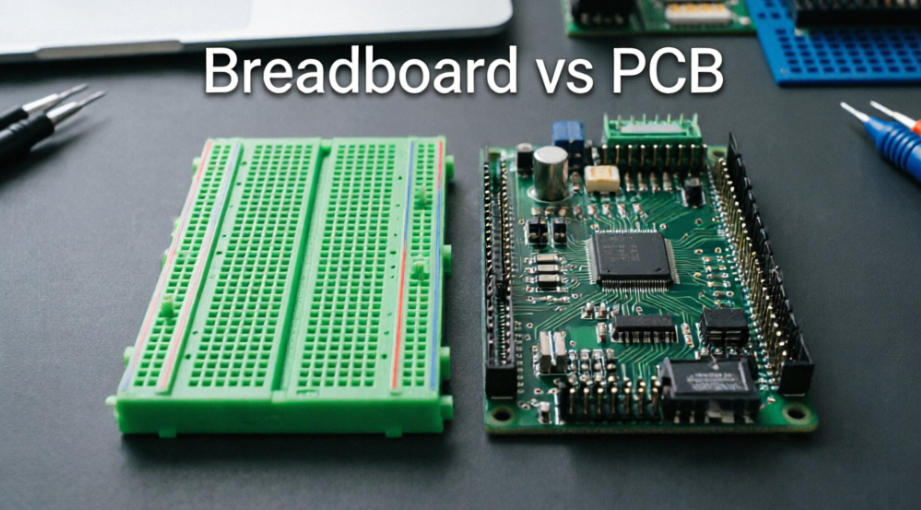
What Is a Breadboard?
A breadboard is a reusable solderless board used to build and test electronic circuits without permanent connections. Components and jumper wires are inserted into holes that are internally connected by metal clips.
Breadboards are widely used by students, hobbyists, engineers, and product developers during the early stage of circuit design. They are useful when you need to test a sensor, microcontroller, LED circuit, power module, or simple analog design quickly.
The main advantage of a breadboard is flexibility. You can change components, move wires, and adjust the circuit without soldering. However, the connections are not mechanically strong, and the electrical performance is limited by loose contacts, jumper wire length, and uncontrolled parasitic effects.
What Is a PCB?
A PCB, or printed circuit board, is a manufactured board that uses copper traces to connect electronic components in a fixed and reliable layout. Components are soldered onto pads or through holes, making the circuit much more stable than a breadboard assembly.
PCBs can be simple single-layer boards or advanced multilayer boards used in automotive electronics, communication equipment, medical devices, industrial control systems, AI servers, consumer electronics, and power electronics.
A PCB is not only a physical carrier for components. It controls routing, grounding, current capacity, thermal behavior, signal integrity, mechanical strength, and manufacturability. This is why PCBs are essential for real electronic products.
Breadboard vs PCB: Core Differences
The biggest difference between a breadboard and a PCB is that a breadboard is temporary, while a PCB is permanent and production-oriented. Breadboards are built for fast testing; PCBs are built for stable performance.
| Factor | Breadboard | PCB |
|---|---|---|
| Main Purpose | Temporary testing and learning | Final product, prototype, or production |
| Connection Method | Spring contacts and jumper wires | Copper traces and soldered joints |
| Reliability | Low to medium | High when properly designed and manufactured |
| Design Changes | Very easy | Requires layout update or board revision |
| Signal Integrity | Limited | Can be controlled through layout and stack-up |
| Mechanical Strength | Weak | Strong and suitable for enclosures |
| Production Use | Not suitable | Suitable for prototype and mass production |
When Should You Use a Breadboard?
You should use a breadboard when the circuit is still changing and you need a fast way to test basic functionality. It is ideal for early experiments, education, proof-of-concept work, and simple low-speed circuits.
A breadboard is a good choice when you are testing component values, checking a microcontroller pinout, validating a sensor module, or learning how a circuit behaves. It helps you find obvious design mistakes before spending time and money on PCB fabrication.
However, breadboards should not be used for high-current circuits, high-frequency signals, vibration environments, compact products, customer demos that require stability, or any device intended for long-term use.
When Should You Use a PCB?
You should use a PCB when the circuit needs to be reliable, compact, repeatable, and suitable for real-world operation. Once a design has passed basic functional testing, moving to a PCB is usually the next engineering step.
A PCB is necessary when your project requires stable power delivery, accurate signal routing, reduced noise, better heat dissipation, connector strength, enclosure fitting, compliance testing, or scalable production.
If your product will be shipped, sold, installed, certified, or used by customers, a breadboard is no longer enough. A custom PCB gives the design a professional structure and reduces many risks that are common in loose-wired prototypes.
Reliability Differences Between Breadboard and PCB
PCBs are far more reliable than breadboards because soldered joints and fixed copper traces provide stable electrical and mechanical connections. Breadboards rely on friction-based contacts, which can loosen over time.
In a breadboard circuit, a small movement of a jumper wire can create an intermittent fault. Contact oxidation, weak spring tension, and poor wire insertion can also cause unstable behavior. These problems are difficult to diagnose because the schematic may look correct while the physical connection is unreliable.
In a PCB, components are fixed in place. The electrical path is defined by the layout, and the board can be inspected, tested, assembled, and repeated consistently. For automotive, medical, industrial, communication, and power applications, this level of reliability is essential.
Signal Integrity and Electrical Performance
A PCB provides much better signal integrity than a breadboard because trace length, impedance, grounding, and return paths can be controlled during layout. Breadboards do not provide controlled routing.
For simple LED or button circuits, this may not matter. But for high-speed digital interfaces, RF circuits, switching power supplies, precision analog signals, and low-noise sensors, breadboard wiring can introduce serious problems.
Long jumper wires create extra inductance and capacitance. Poor grounding can cause noise, ringing, unstable readings, and communication errors. A PCB allows the designer to use ground planes, shorter traces, proper decoupling, impedance control, and optimized component placement.
Cost Comparison: Breadboard vs PCB
A breadboard is cheaper at the very beginning, but a PCB is usually more cost-effective once the design becomes stable or needs to be repeated. The right choice depends on the stage of the project.
For one-time learning or quick testing, a breadboard has almost no setup cost. You can reuse it many times and make changes instantly. This makes it attractive for early development.
For production, the situation changes. Breadboard wiring takes too much labor, creates too many quality risks, and cannot be scaled. A PCB has upfront design and fabrication cost, but it reduces assembly time, improves quality control, and supports repeatable manufacturing.
Prototype PCB vs Breadboard
A prototype PCB is the bridge between a breadboard experiment and a final production board. It allows engineers to test the real layout, soldered components, connector placement, thermal behavior, and mechanical fit.
Many teams first prove the circuit on a breadboard, then order a small batch of prototype PCBs. This step helps identify layout issues before mass production. Common prototype checks include power stability, signal quality, component spacing, mounting holes, enclosure fit, and assembly process suitability.
Prototype PCBs are especially important when the design includes fine-pitch ICs, high-speed signals, power conversion, wireless modules, automotive requirements, or industrial environments.
Common Mistakes When Moving from Breadboard to PCB
The most common mistake is assuming that a working breadboard circuit will automatically work as a PCB. A correct schematic is only part of a successful PCB design.
Engineers should pay attention to grounding, decoupling capacitors, trace width, current paths, thermal relief, connector orientation, component footprints, mounting holes, and manufacturing tolerances. These details are often not obvious during breadboard testing.
Another common problem is poor component placement. A PCB should not simply copy the visual arrangement of a breadboard. It should be optimized for electrical performance, assembly, inspection, and mechanical installation.
PCB Materials and Manufacturing Options
PCB material selection depends on electrical performance, thermal demand, mechanical structure, and application environment. The most common material is FR-4, but advanced designs may require high-frequency laminates, metal core boards, flexible materials, or high-Tg substrates.
Consumer electronics may use HDI, FPC, rigid-flex, or compact multilayer PCBs. Automotive electronics often require high reliability, thermal performance, and stable operation over wide temperature ranges. Communication equipment may need high-frequency and high-speed materials. Power electronics often use heavy copper or metal core PCBs for better heat dissipation.
The right manufacturing option should be selected according to current, voltage, frequency, layer count, board size, operating environment, and assembly requirements.
Quality Standards and Testing
PCB quality depends on controlled manufacturing, inspection, and testing. Reliable PCB suppliers follow recognized quality systems and provide process control from fabrication to assembly.
Common quality requirements may include ISO 9001 quality management, ISO 13485 for medical-related production, IATF 16949 for automotive applications, UL recognition, and RoHS compliance. The exact requirement depends on the target industry and product application.
Testing may include electrical testing, automated optical inspection, solder paste inspection, X-ray inspection, impedance testing, functional testing, and reliability checks. These processes are not available with ordinary breadboard circuits, which is another reason PCBs are required for professional products.
Industry Applications of PCBs
PCBs are used across almost every modern electronics industry because they provide stable, compact, and scalable circuit implementation. Different industries require different PCB structures and quality priorities.
Consumer electronics often focus on thin, compact, and cost-effective boards such as HDI, FPC, and rigid-flex PCBs. Automotive electronics require high reliability, vibration resistance, thermal performance, and long service life. Communication systems need high-speed, high-frequency, and multilayer PCB solutions.
Industrial control, medical electronics, AI servers, new energy systems, LED lighting, IoT devices, AR/VR products, and semiconductor-related applications all depend on specialized PCB design and manufacturing choices.
How to Choose Between Breadboard and PCB
Choose a breadboard if your goal is learning, testing, or changing a simple circuit quickly. Choose a PCB if your goal is reliability, miniaturization, repeatability, product testing, or production.
| Project Situation | Recommended Choice | Reason |
|---|---|---|
| Learning basic electronics | Breadboard | Easy to modify and reuse |
| Testing a simple concept | Breadboard | Fast and low-cost validation |
| Preparing a customer demo | PCB | More stable and professional |
| High-speed or RF circuit | PCB | Requires controlled layout |
| Power electronics | PCB | Needs proper copper width and heat control |
| Mass production | PCB | Supports repeatable manufacturing |
How a PCB Manufacturer Helps After Breadboard Testing
A PCB manufacturer helps turn a tested circuit idea into a manufacturable board by reviewing layout, materials, stack-up, fabrication limits, assembly process, and quality requirements.
At Thindry, we support PCB design, PCB prototyping, PCB manufacturing, component sourcing, and PCBA assembly for customers moving from concept validation to production. Our engineering and manufacturing services cover rigid PCB, flexible PCB, rigid-flex PCB, HDI PCB, high-frequency PCB, metal core PCB, heavy copper PCB, and multilayer PCB solutions.
For customers developing consumer electronics, automotive systems, communication equipment, industrial control devices, medical electronics, new energy systems, and IoT products, early DFM review can reduce redesign cost and prevent production delays.
FAQ
Is a breadboard better than a PCB?
A breadboard is better for quick experiments, learning, and early circuit testing. A PCB is better for reliability, compact size, stable performance, and production. The better option depends on whether your project is still changing or ready for real-world use.
Can I use a breadboard instead of a PCB?
You can use a breadboard for temporary testing, but it should not replace a PCB in a finished product. Breadboards are not designed for vibration, long-term reliability, high-current circuits, or professional assembly.
When should I move from breadboard to PCB?
You should move to a PCB when the circuit function is mostly confirmed and you need stable performance, smaller size, better signal integrity, enclosure fitting, testing, or production. Moving too late can create reliability and debugging problems.
Why does my circuit work on a breadboard but fail on a PCB?
This can happen because PCB layout introduces different grounding, trace length, component placement, soldering, and parasitic behavior. Footprint errors, missing decoupling capacitors, wrong pin mapping, and poor power routing are also common causes.
Are PCBs more expensive than breadboards?
PCBs cost more at the beginning because they require design, fabrication, and assembly. However, they become more cost-effective when the design must be repeated, tested, shipped, or produced in quantity.
Can high-speed circuits be tested on a breadboard?
Breadboards are generally not suitable for high-speed circuits because jumper wires and internal contacts create uncontrolled capacitance, inductance, and noise. High-speed digital, RF, and precision analog designs should be tested on properly designed PCBs.
Is a prototype PCB necessary before mass production?
Yes, a prototype PCB is strongly recommended before mass production. It helps verify layout, component footprints, assembly quality, thermal behavior, signal performance, and mechanical fit before larger production investment.
What PCB type should I choose after breadboard testing?
The right PCB type depends on your application. Simple devices may use FR-4 rigid PCBs, while compact electronics may need HDI or flexible PCBs. Power products may require heavy copper or metal core PCBs, and RF products may need high-frequency materials.
Can a PCB manufacturer help improve my breadboard design?
Yes. A PCB manufacturer can help review the schematic, optimize layout, check manufacturability, recommend materials, verify spacing rules, and plan assembly. This support reduces the risk of board revision and production failure.
What files are needed to make a PCB?
Common files include Gerber files, drill files, BOM, pick-and-place files, assembly drawings, and special manufacturing notes. For PCBA projects, component specifications and approved substitutions may also be required.
Is PCB assembly different from PCB manufacturing?
Yes. PCB manufacturing creates the bare printed circuit board, while PCB assembly mounts and solders components onto the board. A complete PCBA service includes bare board fabrication, component sourcing, SMT assembly, THT assembly, inspection, and testing.
How can I reduce risk before ordering PCBs?
Check the schematic, footprints, board dimensions, connector direction, current capacity, thermal areas, mounting holes, and BOM availability. A DFM review from the manufacturer can help catch practical issues before fabrication.
Conclusion
Breadboards and PCBs serve different stages of electronics development. A breadboard is the right tool for fast experiments and early validation. A PCB is the right solution when the design needs reliability, controlled performance, professional assembly, and scalable manufacturing.
If your project is moving beyond simple testing, a custom PCB can reduce wiring errors, improve electrical stability, support compact product design, and prepare your circuit for real-world use. For serious electronics development, the best path is often simple: test the idea on a breadboard, verify the design with a prototype PCB, then optimize it for production.
If you’re sourcing reliable PCB/PCBA manufacturing — OEM, ODM, prototyping, mass production, or custom engineering solutions — reach out to our engineering team for technical support and a quote at [email protected].
0 Comments