




What Is a PCB Surface Finish?
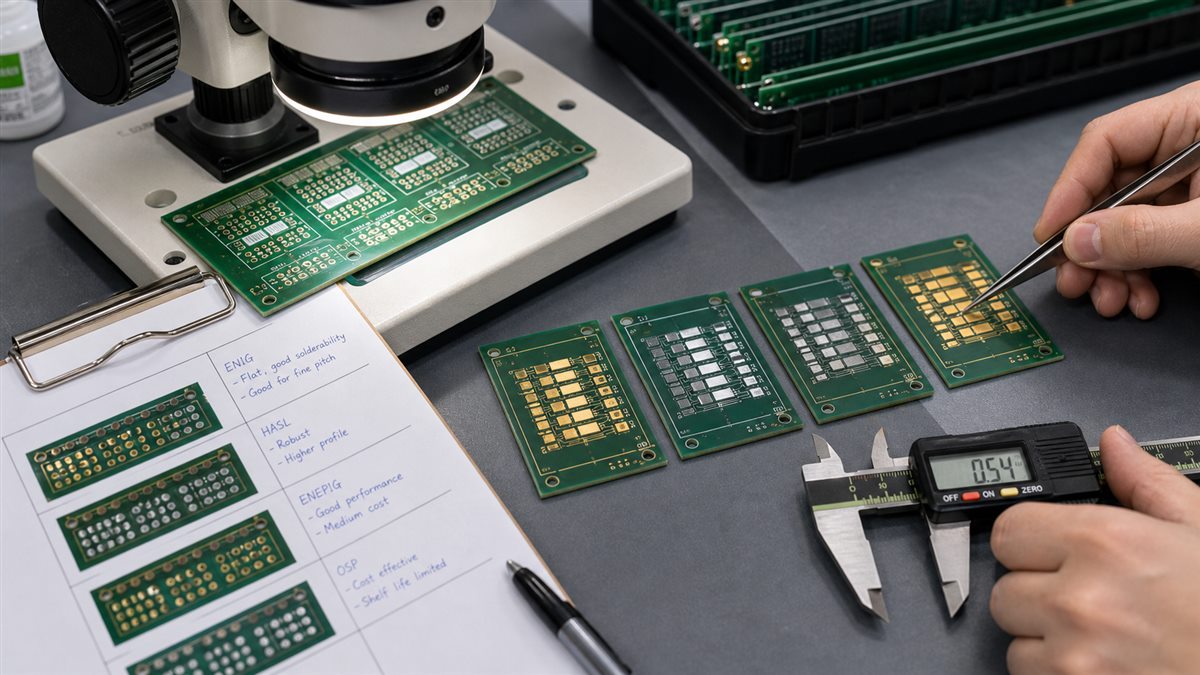
A PCB surface finish is the coating applied to exposed copper pads before assembly. Copper oxidizes easily, so the finish protects the pads and keeps them solderable. It also affects flatness, shelf life, cost, wire bonding, fine-pitch assembly and reliability.
The most common PCB surface finish types include HASL, lead-free HASL, ENIG, OSP, immersion silver and immersion tin. There is no single best finish for every board. The right choice depends on assembly method, component package, shelf life, budget and product environment.
PCB Surface Finish Types Compared
| Finish | Main advantage | Main limitation | Common use |
|---|---|---|---|
| HASL | Low cost and familiar process | Less flat than other finishes | General through-hole and less dense boards |
| Lead-free HASL | RoHS-friendly and economical | Thermal stress and flatness limits | General lead-free products |
| ENIG | Flat surface and good shelf life | Higher cost and process control needed | Fine pitch, BGA, premium boards |
| OSP | Low cost and very flat | Shorter shelf life and handling sensitivity | High-volume SMT with fast assembly |
| Immersion silver | Flat surface and good conductivity | Tarnish and handling concerns | RF or high-speed applications |
| Immersion tin | Flat and lead-free | Whisker and handling concerns | Selected lead-free applications |
HASL and Lead-Free HASL
HASL means hot air solder leveling. The board is coated with solder and leveled with hot air. It is economical and widely understood, but the surface may not be perfectly flat.
For large pads and through-hole boards, HASL can be practical. For fine-pitch components, BGA, small QFN or very flat pad requirements, ENIG or OSP may be better.
ENIG Surface Finish
ENIG means electroless nickel immersion gold. It creates a flat surface with nickel under a thin gold layer. ENIG is popular for fine-pitch SMT, BGA, keypads, longer shelf life and higher-end boards.
The trade-off is cost and process control. ENIG should be fabricated by a supplier with good plating control because poor process control can create reliability concerns.
OSP Surface Finish
OSP is an organic solderability preservative. It is thin, flat and economical. It works well in controlled assembly environments where boards are soldered soon after fabrication.
OSP is more sensitive to handling and storage. It may not be ideal if boards will sit for a long time, face repeated thermal cycles before assembly or need multiple soldering operations.
Immersion Silver and Immersion Tin
Immersion silver provides a flat conductive finish and can be useful for some RF or high-speed designs. It must be handled and stored carefully because tarnish can affect solderability.
Immersion tin is also flat and lead-free, but it has its own storage and reliability considerations. Use it only when it fits the assembly and product requirements.
How to Choose a PCB Surface Finish
| Design need | Finish to consider | Reason |
|---|---|---|
| Lowest cost general board | HASL or lead-free HASL | Economical and common |
| BGA or fine pitch | ENIG or OSP | Flat pads support assembly |
| Longer storage before assembly | ENIG | Better shelf life than OSP |
| Fast high-volume SMT | OSP | Flat and cost-effective when controlled |
| RF or special conductivity need | Immersion silver | Can support selected high-frequency needs |
Surface Finish and Assembly Risk
Surface finish affects solder wetting, pad flatness and storage sensitivity. If the finish is not matched to component type and assembly timing, solder defects can increase.
For BGA and QFN packages, pad flatness matters. For prototype boards that may sit before assembly, shelf life matters. For cost-sensitive general products, HASL may still be acceptable.
What to Tell the PCB Manufacturer
- Required surface finish.
- RoHS or lead-free requirement.
- Component package types, especially BGA, QFN and fine pitch.
- Expected storage time before assembly.
- Assembly method and reflow cycles.
- Any RF, keypad, wire bonding or special contact requirement.
Common Surface Finish Mistakes
| Mistake | Why it matters | Better choice |
|---|---|---|
| Choosing only by price | Assembly yield may suffer | Match finish to package and process |
| Using HASL for very fine pitch | Pad flatness may be insufficient | Consider ENIG or OSP |
| Storing OSP boards too long | Solderability can decline | Control storage and assembly timing |
| Ignoring handling of silver finish | Tarnish risk increases | Use proper packaging and storage |
FAQ
What is the most common PCB surface finish?
HASL, lead-free HASL, ENIG and OSP are all common. The best choice depends on cost, pad flatness, assembly timing and component type.
Is ENIG better than HASL?
ENIG is flatter and has better shelf life, but it costs more. HASL can still be suitable for general boards without fine-pitch flatness needs.
Is OSP good for prototypes?
OSP can work, but storage and handling matter. If prototypes may sit for a long time before assembly, ENIG may be safer.
Which finish is best for BGA?
ENIG is commonly chosen for BGA because of pad flatness and shelf life. OSP may also be used in controlled high-volume SMT processes.
Confirm Surface Finish Before Fabrication
The surface finish should be chosen before PCB fabrication starts because it affects cost, lead time, solderability and assembly yield.
PCBtry can review your PCB fabrication files, component package types and assembly timing to help confirm whether HASL, ENIG, OSP or another finish is suitable. Send your requirements through the contact page before production.
0 Comments