




How do you waterproof a PCB?
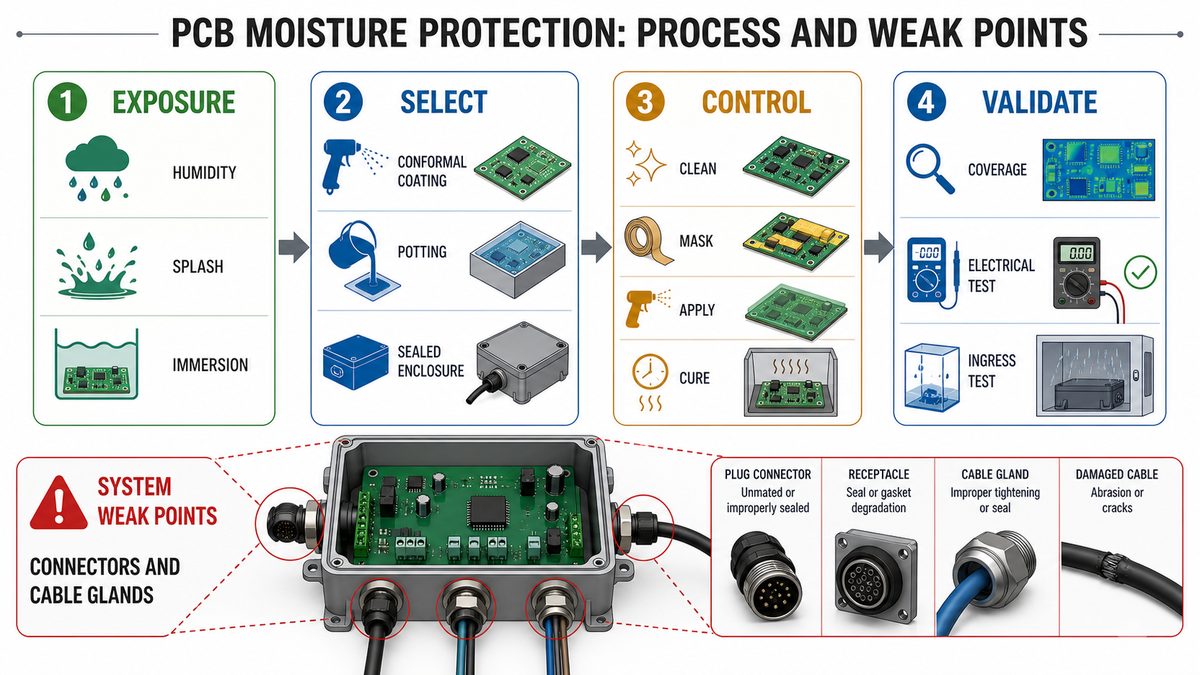
Protect a PCB by first defining the liquid exposure, then combining suitable board coating or encapsulation with a sealed enclosure, protected connectors and a validation test. A conformal coating can resist humidity and occasional splash, but it does not automatically make an assembled product waterproof. Open connectors, cable entries, switches and enclosure joints often determine the real result.
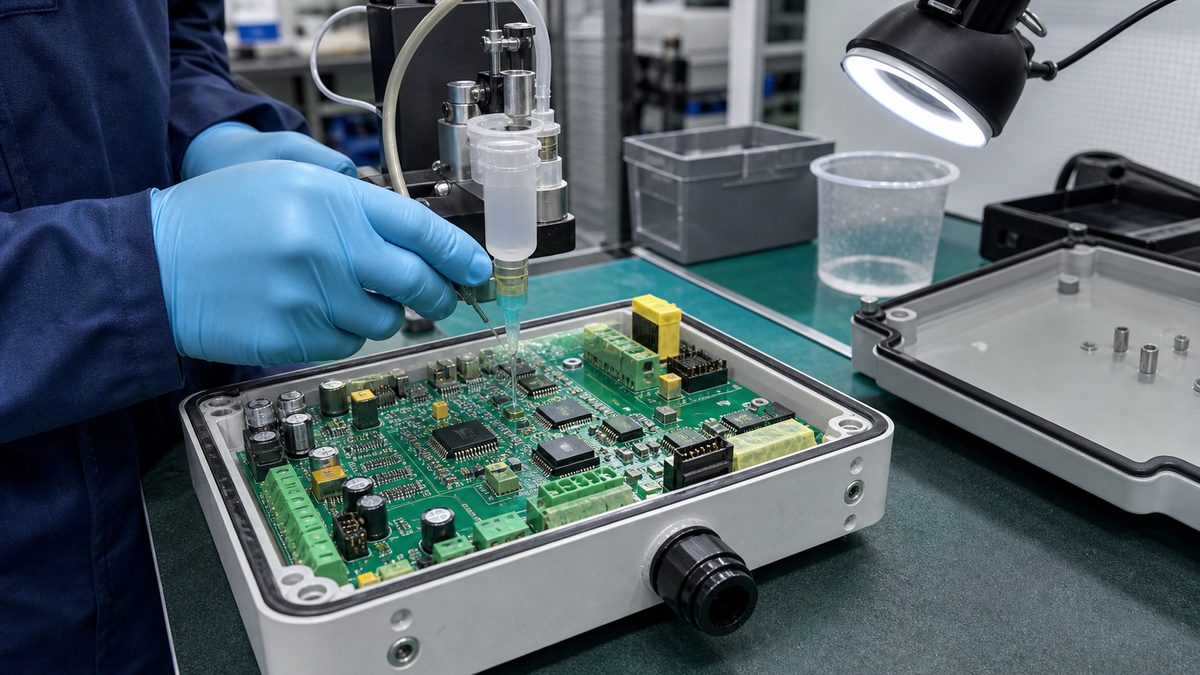
Define the exposure before choosing a material
Write down whether the product faces humidity, condensation, occasional splash, washdown, temporary immersion or continuous immersion. Add temperature range, pressure or depth, exposure time, chemicals, salt, dust and service life. “Outdoor” is not a test condition; a sheltered sensor and a submerged controller need different protection.
| Exposure | Likely protection system | Validation focus |
|---|---|---|
| Humidity or condensation | Clean assembly, conformal coating, condensation-aware enclosure | Coverage, insulation resistance, thermal cycling |
| Occasional splash | Coating plus gasketed enclosure and protected interfaces | Splash direction, duration, powered function |
| Washdown | Robust enclosure, glands/connectors, selective encapsulation | Jet pressure, detergent and seal durability |
| Temporary immersion | Qualified enclosure system, sealed interfaces, possibly potting | Depth, time, pressure and post-test leakage |
| Long immersion | Application-specific encapsulation and enclosure engineering | Pressure cycles, water absorption, thermal and long-duration tests |
Choose conformal coating for light environmental protection
Conformal coating is a thin protective film over selected board surfaces. It can reduce moisture, contamination and corrosion risk while preserving lower weight and better serviceability than full potting. Select acrylic, silicone, urethane or another chemistry from the coating supplier’s data for operating temperature, chemical exposure, dielectric needs, cure process and rework plan.
Use potting when encapsulation is justified
Potting surrounds part or all of the assembly with resin. It can improve resistance to liquid, vibration and tampering, but adds mass, traps heat, complicates repair and can stress components during cure or temperature cycling. Check viscosity, cure exotherm, adhesion, bubbles, coefficient mismatch and the thermal path before specifying it.
Treat the enclosure as part of the protection system
Gaskets, joint geometry, screw spacing, housing stiffness, membrane vents and drainage paths affect ingress. An enclosure can also breathe as temperature and pressure change, pulling humid air through weak seals. Design the housing and board protection together instead of expecting coating to rescue an unsuitable enclosure.
Protect connectors, cables and controls
Connectors, cable glands, switches, displays and programming ports are common entry points. Select interfaces with ratings and materials appropriate to the use condition, preserve gasket compression and provide strain relief. A sealed connector rating applies only when its mating half, seal, mounting and cable termination are used as specified.
Clean and dry the assembly before protection
Coating over ionic residue, oils or moisture can trap contamination and create leakage or corrosion paths. Define a compatible cleaning process, verify cleanliness when risk requires it and dry the assembly thoroughly. Confirm that cleaning does not damage labels, plastics, sensors or components with special handling limits.
Mask keep-out areas deliberately
- Electrical contacts and mating connector surfaces
- Test points and programming pads that must remain accessible
- Heat sinks, thermal interfaces and defined grounding contacts
- Pressure, humidity, gas or optical sensor openings
- Adjustable components, switches and moving mechanisms
- Mounting surfaces or bonding areas that require bare material
Show these keep-outs on a controlled drawing. Verbal instructions are easy to interpret differently between prototypes and production.
Apply coating with a controlled process
- Approve the material, storage condition and shelf life.
- Clean, dry and inspect the assembly.
- Install masking and protect keep-outs.
- Apply by brush, spray, dip or selective equipment using qualified settings.
- Measure or verify coverage and thickness by the approved method.
- Cure for the specified time and environment.
- Remove masking and inspect edges, shadows, bubbles and bridging.
- Complete electrical and environmental checks.
Control thickness, coverage and cure
Too little material leaves exposed areas; too much can bridge contacts, crack, retain solvent or stress parts. Complex components create shadow regions under leads and package edges. Use the material and process specification for target thickness and cure, then define inspection samples and acceptance limits. UV tracer can help reveal coverage when the selected coating supports it, but it does not prove correct thickness or cure by itself.
Account for heat and repair access
Coating and resin alter heat transfer and access. Potting may move heat toward the enclosure or trap it around power parts depending on material and geometry. Identify hot components, model or measure temperature and define whether field repair is required. Masking, removable coatings or partial encapsulation may preserve access when service matters.
Validate against the actual product requirement
Turn the requirement into repeatable conditions: water source, direction, pressure or depth, duration, temperature, powered or unpowered state, cycles and pass/fail criteria. Inspect for leakage, corrosion, insulation change and functional failure immediately and after recovery. An IP code concerns a tested enclosure configuration; it should not be assigned to a bare coated PCB without an applicable test and product context.
Build a production inspection plan
| Control | Evidence | Typical failure signal |
|---|---|---|
| Incoming material | Lot, expiry, storage and mix record | Wrong viscosity or incomplete cure |
| Pre-clean | Process record and cleanliness check | Residue, poor adhesion or leakage |
| Masking | Approved drawing and first-piece check | Blocked connector or exposed sensitive area |
| Application | Equipment recipe and operator/lot traceability | Thin spots, bubbles or shadowing |
| Cure | Time/temperature/humidity record | Tacky, soft or cracked material |
| Final test | Visual, electrical and environmental results | Leakage, corrosion or intermittent operation |
Prepare complete files for a protection quote
Provide assembly drawings, BOM, 3D/enclosure data, keep-out drawing, coating or resin specification, target coverage/thickness, masking requirements, exposure conditions, test method, acceptance criteria, annual volume and repair expectations. State any component supplier restrictions on cleaning, coating or vacuum/pressure.
Common waterproofing mistakes to avoid
- Calling a product waterproof without defining exposure or test conditions
- Coating a contaminated or damp assembly
- Ignoring connector and cable entry leakage
- Covering sensors, contacts, test points or thermal interfaces
- Using potting without checking temperature, stress and repair needs
- Treating visual coverage as proof of cure and long-term reliability
- Changing material or process without revalidation
PCB waterproofing FAQ
Does conformal coating make a PCB waterproof?
It can improve moisture and splash resistance, but complete protection depends on coverage, material, interfaces, enclosure and validated exposure conditions.
Is potting better than conformal coating?
Potting provides stronger encapsulation in some applications, while coating is lighter and more repairable. The better method follows the exposure, heat and service requirements.
Can silicone be used to waterproof a PCB?
Some qualified silicone coatings and encapsulants are suitable. Do not substitute unverified household sealant; confirm cure chemistry, adhesion, corrosion compatibility and electrical properties.
Should a PCB be powered during water testing?
The test plan should reflect real use and safety. Powered testing can reveal leakage-related functional faults but requires controlled equipment, current limits and risk review.
What areas should not be coated?
Contacts, selected test/programming pads, sensor openings, thermal interfaces, grounding points and moving parts commonly require masking.
Can coating be repaired?
Many coatings can be locally removed and restored using the supplier-approved process. Document the rework material, cleaning, overlap and reinspection requirements.
Why does a coated PCB still corrode?
Contamination, incomplete coverage, damaged coating, trapped moisture, unsuitable chemistry or leakage through interfaces can still create a corrosion path.
How do I specify waterproofing to a PCBA supplier?
Supply the exposure profile, material/process specification, keep-outs, drawings, thickness or coverage targets, cure requirements and acceptance tests.
Does an IP rating apply to the PCB?
IP testing normally evaluates an enclosure configuration. The complete product, interfaces and test conditions must be defined before making a rating claim.
Request a protection and manufacturability review
Send the exposure requirement, PCB/PCBA files, enclosure data and acceptance plan through the PCBTRY contact page. The engineering review can identify material compatibility, masking, thermal and test questions before production.


0 Comments