




A PCB washing process removes flux residues, ionic contamination, particles, and handling soils from an assembled circuit board after soldering. The correct process is not simply “wash with water”: it matches the cleaning chemistry and mechanical action to the flux, component set, board geometry, and reliability requirement, then rinses, dries, and verifies the result. This matters most for dense assemblies, fine-pitch devices, conformal-coating preparation, high-impedance circuits, and products exposed to humidity.
PCBTRY can review the assembly drawing, BOM, flux and solder-paste data, component cleaning restrictions, coating requirements, and cleanliness acceptance plan before production. Send your Gerber files, BOM, assembly drawings, flux information, and applicable test requirements through our contact page for an engineering review and quotation.
What Is the PCB Washing Process?
The PCB washing process is a controlled manufacturing operation used to remove contamination after reflow, wave, selective, or hand soldering. It can use an aqueous cleaner, deionized water, a semi-aqueous chemistry, a compatible solvent, or a qualified localized method. The choice depends on what must be removed and what the assembled board can safely tolerate.
Visible flux is only one concern. Ionic residues may attract moisture and contribute to leakage, corrosion, or electrochemical migration under voltage. Non-ionic soils can interfere with coating adhesion or inspection. A board can therefore look clean while still failing the acceptance method selected for its application.
When Should a PCB Assembly Be Washed?
Wash when the approved assembly process, customer specification, coating process, or product-risk assessment requires it. Water-soluble flux normally needs a compatible wash and thorough rinse. A no-clean flux may remain only when the complete process has been qualified for the intended environment; “no-clean” does not mean that every residue is harmless in every geometry.
- Specify cleaning when residue could affect high-impedance or fine-pitch circuitry.
- Review cleaning before conformal coating, bonding, encapsulation, or optical inspection.
- Assess low-standoff parts where wash fluid and residue can become trapped.
- Consider humidity, condensation, voltage bias, service life, and field-access limitations.
- Do not clean solely for appearance without confirming component and chemistry compatibility.
How Does the PCB Washing Process Work?
A reliable washing line moves through review, method selection, wash, rinse, drying, inspection, and cleanliness verification. Each stage has a defined input and acceptance check; skipping the rinse or drying controls can simply replace flux contamination with cleaner residue or trapped moisture.
1. Review the assembly and contamination sources. Engineering identifies the flux family, soldering processes, rework materials, fingerprints, dust, labels, adhesives, and any prior wash. The BOM is checked for microphones, MEMS devices, switches, relays, displays, unsealed connectors, coils, and other parts with restrictions. If the input is incomplete, a cleaner may dissolve the flux yet damage a component or marking.
2. Define the cleanliness requirement and verification method. The drawing or quality plan should state what constitutes an acceptable board and which test supports that decision. Visual inspection detects remaining films and particles but does not measure every ionic species. Process-monitoring tests, ion chromatography, surface-insulation-resistance evaluation, or application-specific testing may be selected according to product risk. Buyers should ask for the agreed method and records, not a generic “boards are clean” statement.
3. Select and qualify the cleaning chemistry. The cleaner must match the flux residue while remaining compatible with solder mask, markings, metals, plastics, elastomers, and components. An aqueous process may use deionized water alone for a compatible organic-acid residue or an engineered cleaning agent for harder soils. Qualification uses representative assemblies because coupons cannot reproduce every low-standoff trap.
4. Control the wash stage. Inline spray, batch spray, immersion, or localized cleaning supplies chemical action, time, temperature, and mechanical energy. Operators monitor concentration and bath condition where applicable, nozzle coverage, board orientation, loading, and exposure. Weak action leaves residue under packages; excessive or incompatible action can attack labels, markings, finishes, or sensitive parts.
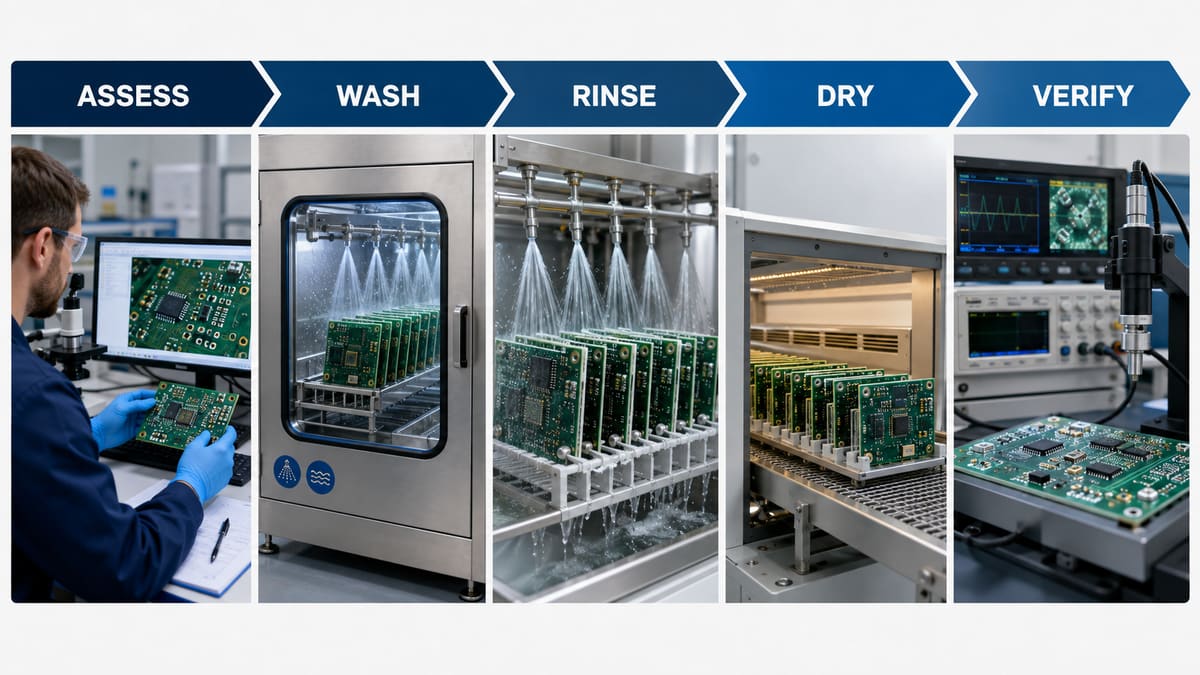
5. Rinse without redepositing contamination. Rinsing carries dissolved residue and cleaner away from the board. Water quality, rinse staging, flow, and loading matter because dirty or poorly maintained rinse water can redeposit ions. Low-standoff components and connector cavities need particular attention. A supplier should control the rinse as a manufacturing input, not treat it as an unlimited clean resource.
6. Remove bulk liquid. Drain orientation and controlled air knives or other approved methods remove water from surfaces and shadow areas. Excessive air pressure can drive liquid farther into unsealed parts or spread contamination. The process must be validated on actual board geometry rather than judged by a dry-looking top surface.
7. Complete controlled drying. Time, temperature, airflow, vacuum, or a combined method must suit the PCB materials and components. Trapped moisture beneath bottom-terminated components, shields, or connectors can remain after the exposed laminate looks dry. Premature electrical test, coating, or packaging can lock in the risk.
8. Inspect the finished assembly. Inspectors look for white residue, tacky films, particles, water spots, corrosion, damaged labels, lifted markings, and liquid retained in cavities. Magnification and angled lighting improve detection around leads and package edges. Inspection findings should trigger a defined rewash, rework, or reject path rather than informal touch-up.
9. Verify and release the process. The agreed cleanliness test confirms process control or product qualification. Results are reviewed alongside visual condition, drying confirmation, and electrical test. A passing bulk ionic result does not identify every local residue, so high-risk products may require a more specific method. Release evidence should be traceable to the lot, process window, and acceptance plan.
Which PCB Cleaning Method Fits the Assembly?
Choose the method by residue chemistry, component compatibility, access beneath parts, production volume, environmental controls, and verification needs. There is no universal “best” cleaner.
| Method | Best fit | Main control | Important limitation |
|---|---|---|---|
| Inline aqueous spray | Repeatable medium- or higher-volume cleaning with compatible assemblies | Chemistry, spray coverage, rinse water, loading, drying | Shadow areas and liquid-sensitive parts require qualification |
| Batch aqueous spray | Flexible mix and smaller production lots | Recipe selection, board spacing, bath and rinse condition | Loading variation can change coverage |
| Semi-aqueous or solvent process | Residues not effectively removed by the selected water process | Material compatibility, exposure, ventilation and recovery | Chemical, safety, environmental, and component restrictions |
| Localized manual cleaning | Controlled rework areas and small accessible residues | Fresh solvent, clean applicator, extraction of dissolved soil | Can spread residue or miss contamination under components |
| Ultrasonic cleaning | Only assemblies specifically assessed and qualified for it | Component restrictions, frequency, power, time, chemistry | Risk to MEMS, crystals, wire bonds, coils, and unsealed parts |
How Do Flux Chemistry and Board Geometry Change the Recipe?
The cleaning recipe begins with the actual flux data, not the marketing category printed on a purchase order. Water-soluble, rosin, resin, and no-clean residues respond differently to water and cleaning agents. Rework flux must also be included because a small manual addition can create a different residue from the main reflow process.
Geometry sets the access problem. A tall open component is easier to rinse than a bottom-terminated device with a narrow standoff. Dense connectors, shields, via fields, and fixtures can create wash and dry shadows. Engineers should use representative worst-case boards during qualification and requalify after material, component, process, or equipment changes that affect cleaning.
Why Is Deionized-Water Rinsing a Separate Control Point?
The rinse determines whether dissolved contamination leaves the assembly. A powerful wash followed by a weak rinse can leave cleaner and flux constituents behind. Deionized-water quality, final-rinse condition, spray access, and carryover between stages therefore need monitoring.
Do not assume tap water or a single static bath is adequate for a production acceptance requirement. The supplier should explain how final-rinse quality is controlled, how exhausted media or contaminated baths are detected, and how hidden areas receive enough exchange to prevent redeposition.
What Can Go Wrong During Drying?
Drying can fail when the process removes surface water but leaves moisture under packages, inside connectors, beneath shields, or in porous and unsealed structures. The risk is not limited to immediate shorts: retained moisture can interact with residues during later humidity and voltage exposure.
- Confirm that component temperature limits support the drying recipe.
- Use board orientation that allows drainage rather than forming pockets.
- Validate the worst thermal mass and the tightest fluid traps.
- Prevent recontamination from unfiltered air, dirty racks, gloves, or packaging.
- Complete required drying before conformal coating or sealed packaging.
What PCB Washing Defects Should Buyers Watch For?
Defects should be tied to likely causes and evidence. A cosmetic photo alone cannot show whether the process removed ionic contamination.
| Observed issue | Likely process cause | Why it matters | Useful evidence |
|---|---|---|---|
| White residue | Incomplete wash, weak rinse, or incompatible chemistry | May signal remaining or redeposited material | Visual record plus process and cleanliness results |
| Tacky film | Dissolved flux was spread but not removed | Attracts particles and can interfere with coating | Localized inspection and reviewed wash method |
| Water spots | Rinse-water or drying control problem | Can mask contamination and harm appearance | Final-rinse monitoring and drying record |
| Residue under low-standoff parts | Insufficient access, exchange, or rinse | Local leakage or corrosion risk may remain hidden | Representative qualification and targeted analysis |
| Damaged marking or component | Incompatible chemistry or excessive exposure | Traceability or functional reliability may be lost | Compatibility approval and post-clean inspection |
| Moisture in connectors or shields | Drain and dry recipe did not reach trapped areas | Delayed electrical or corrosion failures | Drying validation and functional test |
How Is PCB Cleanliness Verified?
Verification should match the risk being controlled. Visual inspection is necessary but does not replace chemical or electrical evidence when the product specification requires it. ROSE-type bulk extraction can monitor a stable process, ion chromatography can identify and quantify particular ionic species, and surface insulation resistance testing can support process qualification under defined conditions.
The acceptance limit and sampling plan must come from the contract, product standard, customer requirement, or qualified internal process. Do not copy a number from an unrelated board. Ask which method is used, whether it is for process control or product acceptance, what area is tested, and how out-of-control results are handled.
Can No-Clean Flux Be Washed?
Some no-clean residues can be removed, but the process must be developed for the specific flux, thermal history, and assembly. Partially dissolving a residue can spread it into low-clearance areas and create a worse condition than leaving a qualified residue undisturbed.
If coating follows, verify both cleanliness and coating adhesion. If no cleaning is planned, confirm that the flux deposition, activation, rework practice, board geometry, operating environment, and qualification evidence support that decision. The PCB soldering process determines much of the residue load that the wash must handle.
Is Ultrasonic Cleaning Safe for Every PCB?
No. Ultrasonic energy can affect parts such as MEMS devices, microphones, crystals, wire-bonded devices, coils, and unsealed components. Compatibility depends on the component construction and the validated cleaning setup, so a generic ultrasonic cycle should not be applied to a populated assembly.
Review every restricted part and supplier datasheet before selecting ultrasonics. If data is unavailable, use a lower-risk qualified method or obtain written component guidance. Also control cleaning chemistry and fire safety; an improvised bath containing a flammable solvent is not a production cleaning process.
How Does Washing Affect Conformal Coating Reliability?
Coating adheres to the surface that the wash and dry process leave behind. Residue, moisture, or cleaner carryover can cause dewetting, bubbles, poor adhesion, ionic activity beneath the film, or inconsistent cure. A visually smooth coating does not prove that the underlying assembly was clean and dry.
Define the time and handling controls between washing and coating, keep masked areas and contact surfaces protected, and include cleanliness evidence in the coating qualification. The same logic applies before underfill; our PCB underfill process guide explains why surface condition affects flow and adhesion.
What Files and Data Should Be Included in an RFQ?
A useful RFQ lets the manufacturer decide whether the board can be washed safely and how the result will be accepted. Include the following information before the first build:
- Gerber or ODB++ data, fabrication drawing, assembly drawing, and revision.
- BOM with complete manufacturer part numbers and component cleaning restrictions.
- Solder paste, liquid flux, wire flux, and rework-material product information.
- Required coating, bonding, underfill, encapsulation, or final surface condition.
- Applicable workmanship class, customer specification, cleanliness test, limit, and sampling plan.
- Known liquid-sensitive, unsealed, optically sensitive, or ultrasonic-sensitive components.
- Operating environment, voltage concerns, humidity exposure, and reliability expectations.
- Packaging and maximum allowable time between cleaning and the next process.
How Should You Evaluate a PCB Washing Supplier?
A capable supplier should connect chemistry, equipment, assembly design, inspection, and verification. Ask for a process explanation tied to your board, not a generic equipment list.
- How is the cleaner selected against the exact flux and component set?
- Which parts are flagged as wash-sensitive, and who approves exceptions?
- How are concentration, bath condition, rinse water, loading, and drying monitored?
- How is the process challenged for low-standoff and shadowed areas?
- Which cleanliness tests are available, and what does each result prove?
- What triggers requalification after a material or equipment change?
- How are rewash, rework, failure review, and lot traceability controlled?
Cleaning should also fit the wider PCB assembly process, including soldering, inspection, electrical test, coating, and packaging. A disconnected wash step can pass cosmetically while creating downstream risk.
PCB Washing Process FAQ
Does every PCB need washing after soldering?
No. The decision depends on the flux system, residue location, product environment, customer specification, and qualified manufacturing process. Water-soluble flux generally requires removal, while a controlled no-clean process may not.
Can ordinary water wash a populated PCB?
Do not assume it can. Water quality, flux solubility, component restrictions, rinsing, and drying all matter. Production processes normally use qualified chemistry and controlled rinsing rather than an uncontrolled tap-water wash.
Is isopropyl alcohol enough to remove flux?
It can help with compatible, accessible residues, but dissolving residue is not the same as removing it. A dirty applicator or evaporating solvent can spread contamination, and low-standoff areas may remain untreated.
What is the difference between washing and rinsing?
Washing loosens or dissolves the soil. Rinsing transports the dissolved material and cleaning agent away from the assembly. Both stages need control.
How do you know a PCB is completely dry?
A dry-looking surface is insufficient for assemblies with trapped areas. Validate the drying recipe on the worst-case geometry and use the agreed time, temperature, airflow, weight, moisture, or functional evidence appropriate to the product.
What causes white residue after PCB washing?
Common causes include incomplete flux removal, cleaner carryover, weak rinsing, hard-water deposits, exhausted baths, or residue redeposition. The team should review both wash chemistry and final rinse rather than simply repeat the same cycle.
Does ROSE testing identify every contaminant?
No. It reports a bulk ionic cleanliness result for its test conditions but does not identify every species or pinpoint every local deposit. More specific analysis or reliability testing may be needed for high-risk assemblies.
What should I send for a PCB washing quotation?
Send manufacturing data, assembly drawings, BOM, flux and solder-paste information, cleaning restrictions, downstream coating requirements, and the required cleanliness test and acceptance criteria.
Request a PCB Washing Process Review
A cleaning plan should be decided before production materials and process routes are locked. PCBTRY can review residue sources, wash-sensitive components, cleaning access, rinse and dry risks, verification needs, and downstream coating or underfill requirements as part of your PCB assembly quotation. Submit your files and specifications for an engineering review.
0 Comments