




Every bare copper pad on a PCB starts oxidizing the moment it is exposed to air. A surface finish is the layer that sits between that copper and the outside world. It keeps the copper solderable during storage and assembly, and it defines the metallurgy of every solder joint on the board. Two of the most widely used finishes are Lead-Free HASL and ENIG, and choosing between them is rarely about cost alone. The finish you select shapes how the board assembles, how the joints behave over time, and where the board is likely to fail.
This article compares Lead-Free HASL and ENIG specifically from a reliability standpoint. Rather than listing generic pros and cons, it looks at flatness, solderability, failure modes, storage behavior, and thermal-mechanical performance, so the trade-offs are clear when you are making a real selection decision.
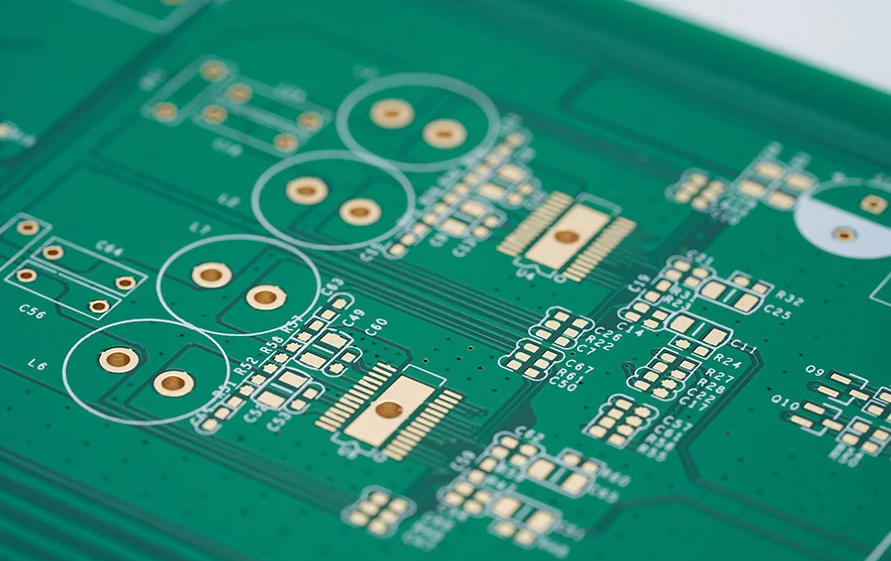
A Quick Overview of Both Finishes
Lead-Free HASL, or Hot Air Solder Leveling, coats exposed copper with a layer of molten solder. The board is dipped into a solder bath, then hot air knives blow off the excess and level the surface. The finish is the solder itself, typically a tin-based lead-free alloy. It is a mature, low-cost process that produces a directly solderable surface.
ENIG, or Electroless Nickel Immersion Gold, is a two-layer metallic coating. A layer of electroless nickel is deposited onto the copper, followed by a thin layer of immersion gold on top of the nickel. The nickel acts as a barrier and the functional soldering surface, while the gold protects the nickel from oxidation until assembly. This is a chemical deposition process with no electrical current involved, which is why it plates uniformly across the board.
These two constructions behave very differently, and the differences show up most clearly under reliability scrutiny.
Surface Flatness and Coplanarity
The most immediate difference between the two finishes is surface flatness. Because HASL is applied as molten solder and leveled by air, the resulting surface is uneven. Pads can end up with a slightly domed or irregular profile, and larger pads may hold more solder than smaller ones. On boards with fine-pitch components, this uneven thickness becomes a real problem. Insufficient coplanarity under a BGA, QFN, or fine-pitch QFP can cause open joints, inconsistent solder volume, and bridging.
ENIG produces a flat, planar surface across all pads regardless of size. This coplanarity is one of the main reasons ENIG is preferred for dense boards with fine-pitch and area-array packages. When your design includes tight pitch components, flatness is not a convenience, it directly affects assembly yield and joint reliability.
Example 1: Injection Molding Machine Controller Board
Consider the main controller board of a hydraulic injection molding machine, which controls the barrel heaters, screw motor, hydraulic valves, mold-clamping mechanism, and temperature sensors. The board uses primarily through-hole terminal blocks and relays, standard 1206 and 0805 resistors and capacitors, SOIC gate drivers and op-amps, and a few TO-252 or DPAK MOSFETs for heater control. The smallest pitch on the board is 0.65 mm on several TSSOP digital isolators.
Recommended finish: Lead-Free HASL
For this design, the uneven surface of HASL does not present a problem. The component pitch is forgiving, solder volume variation across pads falls within standard reflow and wave soldering tolerances, and there are no area-array packages where coplanarity matters. The board operates in an industrial environment where cost control is important and assembly yield with standard components is predictable. HASL provides reliable solderability, withstands multiple thermal cycles during operation, and costs significantly less than ENIG. The slight doming of solder on larger power pads does not interfere with assembly or long-term reliability in this application.
Example 2: Six-Axis Industrial Robot Servo Control Board
Now consider the servo control board of a six-axis industrial robot, which processes encoder feedback and generates real-time control signals for the servo drives of the robot’s six joints. The board is built around a 0.8 mm pitch BGA motion controller, multiple 0.5 mm pitch QFN gate drivers and current sense amplifiers, 01005 decoupling capacitors placed densely around the BGA, and a 10-layer HDI stackup with microvias. Several QFN packages have exposed thermal pads, and the tightest pitch on the board is 0.4 mm.
Recommended finish: ENIG
This design demands coplanarity. The BGA motion controller has over 300 solder balls, and even a small variation in pad height can result in open or cold joints after reflow. Rework on a BGA in a production environment is expensive and time-consuming. The QFN gate drivers have the same requirement: perimeter pads and the central thermal pad must be coplanar, or solder joint integrity suffers and thermal performance degrades. Lead-Free HASL would introduce too much surface variation and create unacceptable risk of assembly defects, especially given the high component density and the precision required for real-time motion control. ENIG provides the planar surface these components require and enables reliable assembly at tight pitch. In this case, the higher cost of ENIG is not optional, it is the only practical choice given the component selection, density, and performance requirements of the system.
When Flatness Matters Less
For designs dominated by through-hole parts, larger SMD footprints with pitch above 1.0 mm, and components that are not coplanarity-sensitive, the flatness advantage of ENIG matters far less, and HASL performs perfectly well. The decision then shifts to other factors such as shelf life, wire bonding requirements, or cost constraints rather than assembly yield.
Solderability and Wetting Behavior
Lead-Free HASL is solder sitting on copper, so wetting during reflow or wave soldering is straightforward. The finish and the joint share the same metallurgical family, and there is no intermediate barrier layer to manage. This gives HASL robust, forgiving solderability.
ENIG works differently. During soldering, the thin gold layer dissolves into the molten solder almost immediately, exposing the nickel underneath. The solder then wets to the nickel, and the intermetallic compound (IMC) that forms the mechanical bond is a nickel-tin compound rather than the copper-tin compound seen with HASL. The gold does not remain in the joint as a structural element; its job is only to protect the nickel until soldering happens. When the electroless nickel layer is deposited correctly, this produces a strong, reliable joint. When the nickel chemistry goes wrong, it produces the failure mode ENIG is best known for.
Failure Modes: Where Reliability Is Won or Lost
This is where the two finishes diverge most sharply, and it is the part of surface finish selection that deserves the most attention.
ENIG Black Pad
Black pad, sometimes called black nickel, is the failure mode most associated with ENIG. It occurs when the electroless nickel surface is excessively corroded during the immersion gold step. The immersion gold process is a displacement reaction: gold deposits as nickel is oxidized. If this reaction is too aggressive or poorly controlled, it corrodes the nickel grain boundaries and leaves behind a brittle, phosphorus-rich, oxidized nickel surface.
A board affected by black pad may look and even test fine at first. The failure shows up as brittle joint fracture, where the solder separates cleanly from the nickel surface under mechanical or thermal stress. Because the joints can pass initial inspection and fail later in the field, black pad is a particularly dangerous failure mode.
Black pad is a process control issue, not an inherent flaw of ENIG. It is driven by the immersion gold bath chemistry, nickel phosphorus content, and process parameters. A supplier with a well-controlled ENIG line and proper process monitoring can consistently avoid it, which is why process maturity matters when specifying ENIG.
Gold Embrittlement
Gold embrittlement is a different concern, and it relates to how much gold ends up in the solder joint. Gold dissolves readily into tin-based solder and forms brittle gold-tin intermetallic compounds. In small quantities this is not a problem, but if too much gold enters the joint, these brittle intermetallics can weaken it and lead to cracking under stress.
For standard ENIG, the immersion gold layer is thin by design, precisely to keep the gold contribution to the joint low. The risk of embrittlement rises when gold thickness is excessive, or when multiple gold-finished surfaces contribute gold to the same joint. This is why immersion gold thickness is a controlled parameter and not something to maximize. More gold is not better; it is a reliability liability past a certain point.
Intermetallic Compound Differences
Both finishes form an IMC layer at the solder joint interface, but the composition differs. HASL joints form copper-tin intermetallics, while ENIG joints form nickel-tin intermetallics with the nickel acting as a barrier that slows further copper diffusion. The nickel barrier can be an advantage in high-temperature or long-life applications because it limits continued IMC growth into the copper. The trade-off is the added complexity and the black pad risk that comes with the nickel-gold system.
The Limits of Lead-Free HASL
HASL has its own reliability limitations, though they are more about process capability than hidden failure modes. The uneven surface makes it unsuitable for fine-pitch and area-array assembly. Solder bridging is more likely on tightly spaced pads. The thermal shock of the hot solder dip also subjects the board to stress during finishing, which can matter for thin or sensitive boards. And HASL is not suitable for applications requiring a flat gold surface, such as wire bonding or press-fit connectors with tight tolerances.
Shelf Life and Storage Stability
Storage behavior is an often-overlooked reliability factor. The immersion gold layer in ENIG protects the underlying nickel from oxidation, giving ENIG boards a long and stable shelf life. Boards can typically be stored for extended periods and still solder well, which is valuable when inventory turns slowly or when boards sit between fabrication and assembly.
Lead-Free HASL has good storage stability as well, since the solder surface resists oxidation reasonably, but it does not match ENIG for very long storage periods. For products with long inventory cycles or infrequent build schedules, ENIG has an edge in maintaining solderability over time.
Thermal Cycling and Mechanical Reliability
Under thermal cycling, the two joint metallurgies age differently. The nickel barrier in ENIG joints slows intermetallic growth, which can benefit long-term reliability in applications that run hot or cycle frequently. However, ENIG joints can be more sensitive to brittle fracture under mechanical shock and drop conditions, particularly if any black pad or excessive gold embrittlement is present, because the failure tends to be brittle rather than ductile.
HASL joints, forming copper-tin intermetallics without a nickel barrier, tend to fail in a more ductile manner and are often more forgiving under mechanical shock. For applications where drop and vibration resistance is the dominant concern, this behavior can favor HASL, though the fine-pitch limitations still apply.
There is no universal winner here. The right choice depends on whether your dominant stress is thermal cycling, mechanical shock, or both, and on the component packages your design requires.
When to Choose Which
Rather than declaring one finish more reliable overall, it helps to match the finish to the application:
| Consideration | Lead-Free HASL | ENIG |
|---|---|---|
| Fine-pitch / BGA / QFN | Not recommended | Preferred |
| Surface flatness | Uneven | Flat and planar |
| Solderability | Robust, direct | Good, depends on process control |
| Cost | Lower | Higher |
| Shelf life | Good | Excellent |
| Wire bonding / flat gold needs | Not suitable | Suitable |
| Main failure risk | Bridging, uneven volume | Black pad, gold embrittlement |
| Mechanical shock behavior | More ductile | More sensitive to brittle fracture |
| Process control sensitivity | Lower | Higher |
In practice, boards dominated by through-hole and larger SMD parts, on a tight budget, often do well with Lead-Free HASL. Dense boards with fine-pitch and area-array packages, long storage requirements, or wire bonding needs point toward ENIG. High-reliability applications that also see significant mechanical shock require a closer look at the specific failure modes rather than a default choice.
FAQ
Is ENIG more reliable than lead-free HASL?
Neither is universally more reliable. ENIG offers superior flatness and shelf life and is better suited to fine-pitch designs, but it carries the risk of black pad and gold embrittlement if the process is not well controlled. Lead-Free HASL is robust and forgiving but is limited by its uneven surface. Reliability depends on matching the finish to the application and controlling the process.
What is black pad and why does it matter?
Black pad is a corrosion of the electroless nickel layer that occurs during the immersion gold step when the process is poorly controlled. It leaves a brittle, oxidized nickel surface that causes solder joints to fracture cleanly under stress. It is dangerous because affected joints can pass initial inspection and fail later in the field. It is a process control problem, not an inherent defect of ENIG.
Why is immersion gold kept thin in ENIG?
Gold dissolves into tin-based solder and forms brittle gold-tin intermetallic compounds. A thin gold layer contributes little gold to the joint and only serves to protect the nickel until soldering. If the gold is too thick, excessive gold enters the joint and can cause gold embrittlement, weakening the joint. More gold is a reliability liability, not a benefit.
Can I use lead-free HASL for BGA or fine-pitch components?
It is not recommended. HASL produces an uneven surface, and the lack of coplanarity across pads can cause open joints, inconsistent solder volume, and bridging under fine-pitch and area-array packages. ENIG provides the flat, planar surface these components require.
Which finish has a longer shelf life?
ENIG has excellent shelf life because the immersion gold layer protects the underlying nickel from oxidation, keeping the board solderable over long storage periods. Lead-Free HASL also has good storage stability but does not match ENIG for very long inventory cycles.
Do HASL and ENIG form the same type of solder joint?
No. HASL joints form copper-tin intermetallic compounds, while ENIG joints form nickel-tin intermetallics, with the nickel acting as a barrier that slows further diffusion into the copper. This difference affects long-term aging behavior and mechanical performance.
Which finish is better for mechanical shock and drop reliability?
HASL joints tend to fail in a more ductile manner and are often more forgiving under mechanical shock. ENIG joints can be more sensitive to brittle fracture, especially if black pad or excessive gold embrittlement is present. For shock-dominated applications, this can favor HASL, though the fine-pitch limitations still apply.
Is ENIG worth the higher cost?
It depends on the design. For dense boards with fine-pitch and area-array packages, long storage needs, or wire bonding requirements, the flatness and stability of ENIG justify the cost. For boards dominated by through-hole and larger SMD parts on a tight budget, Lead-Free HASL is often the more sensible choice.
What should I look for in a supplier when specifying ENIG?
Because ENIG reliability depends heavily on process control, look for a fabricator with a well-monitored ENIG line, control over immersion gold bath chemistry and nickel phosphorus content, and a track record of avoiding black pad. Process maturity is what separates reliable ENIG from problematic ENIG.

0 Comments