




How much is a PCB?
There is no reliable universal PCB price. A small standard bare-board prototype and a tested assembled production board are different products. To estimate cost, first define whether you need a bare PCB or PCBA, then specify size, layer count, material, thickness, copper, features, finish, quantity, test scope and delivery. Comparable files and specifications produce a useful quote; a headline price without scope does not.

Separate bare PCB, PCBA and replacement-board prices
| Item being priced | Included scope | Typical missing costs to check |
|---|---|---|
| Bare PCB | Fabricated board without components | Tooling, electrical test, shipping and import charges |
| PCBA | Bare board plus components and assembly | Component sourcing, stencil, setup, programming and functional test |
| Prototype/perfboard | Generic stocked board | Not a custom manufactured PCB |
| Replacement control board | Finished branded spare part | Distribution, warranty and product-specific markup |
Quantity changes unit price and total commitment
PCB production includes engineering review, imaging, tooling, machine setup, test preparation and handling that do not scale one-for-one with board count. A larger order can lower unit cost by spreading fixed work, but it also increases inventory and revision risk. Compare prototype, pilot and production quantities separately instead of multiplying a prototype unit price.
Board dimensions and panel utilization affect material cost
Factories manufacture panels, not isolated rectangles. Board length, width, outline shape, routing clearance, tooling rails and array arrangement determine how many units fit on a panel. A small dimensional change can improve or worsen utilization. Provide the finished outline and ask whether the quotation assumes single pieces or a production panel.
Layer count and stackup drive process complexity
More layers require additional copper-clad material, imaging, lamination, registration control and verification. A controlled-impedance stackup also requires defined dielectric thicknesses, copper weights and trace geometry. Do not request “four layers” without indicating whether the supplier may use a standard stackup or must follow a specified construction.
Materials change both price and manufacturability
| Specification choice | Why it changes cost | Question for the quote |
|---|---|---|
| Standard FR-4 versus special laminate | Material price, availability and dedicated processing | Is the exact grade required or is an approved equivalent allowed? |
| Thicker copper | More copper and tighter etching/plating control | Is copper stated as finished or base copper? |
| Unusual board thickness | Material availability and process setup | What finished-thickness tolerance applies? |
| High-Tg/RF/metal-core material | Special handling and supplier qualification | Which datasheet and construction are quoted? |
Fine features, microvias and special drilling add cost
Small holes, tight trace/space, blind or buried vias, laser-drilled microvias, via filling and sequential lamination add equipment steps and yield risk. Use advanced features only where the design requires them. A DFM review can identify whether a routing or escape problem can be solved with a simpler stackup.
Surface finish and special processes must match the application
HASL, ENIG and other finishes differ in flatness, solderability, shelf-life expectations and process cost. Edge plating, hard gold fingers, controlled-depth milling, countersinks, castellations and peelable mask are additional operations. State the functional need and acceptance requirement instead of choosing a premium process by habit.
Testing, inspection and documentation are part of the quote
Electrical test, impedance coupons, microsection reports, dimensional inspection, material certificates and special traceability require preparation and records. They may reduce downstream risk but must be quoted consistently. Define what evidence is required with the shipment and whether it applies to prototypes, every lot or selected builds.
Prototype tooling and engineering charges are not recurring unit cost
Separate one-time engineering, tooling, test-fixture or stencil charges from recurring board price. Ask whether those charges apply again after a quantity change, file revision or reorder. This makes supplier comparisons clearer and prevents a low unit figure from hiding setup fees.
Shipping, duties and delivery method change landed cost
A quote can be factory price, shipped price or delivered price. Record freight method, package weight basis, duties/taxes responsibility, payment fees and delivery destination. For urgent prototypes, freight can outweigh the boards themselves; for production, packaging and split shipments may change the total.
Use one RFQ worksheet for every supplier
- Gerber or ODB++ fabrication data and drill files
- Finished dimensions, quantity and delivery destination
- Layer count and approved stackup
- Material grade, board thickness and copper weights
- Minimum trace/space, minimum holes and special vias
- Solder mask, legend and surface finish
- Impedance, testing, reports and acceptance criteria
- Panelization, tooling rails, routing/V-score requirements
- Prototype, pilot and production quantity breaks
- Requested lead time and shipping terms
A complete worksheet turns “How much is a PCB?” into a quote that engineering and purchasing can actually compare.
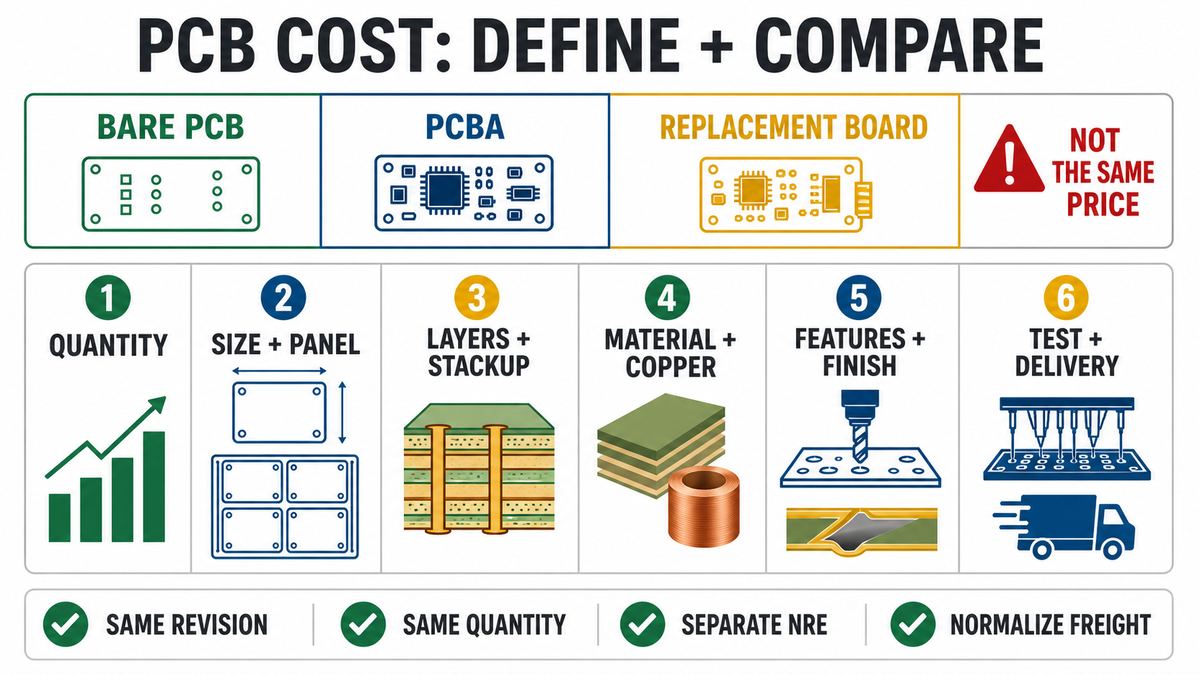
Compare PCB quotes like for like
- Confirm every quote uses the same revision and quantity.
- Compare material, stackup, copper, finish and tolerances line by line.
- Separate tooling/NRE from recurring unit cost.
- Confirm electrical test, reports, scrap allowance and panel quantity.
- Normalize freight, payment and delivery terms.
- Flag substitutions or exclusions for engineering approval.
- Compare total landed cost and risk, not only the lowest unit figure.
Reduce cost without weakening the design
Start with DFM rather than removing requirements blindly. Common opportunities include using a standard material/stackup, improving panel utilization, avoiding unnecessary fine features, consolidating drill sizes, selecting an appropriate finish and ordering a pilot before committing production quantity. Any change affecting electrical, thermal, mechanical or reliability requirements needs engineering approval.
PCB cost FAQ
Is PCB price quoted per board or per panel?
It may be either. Confirm the unit, panel quantity and whether tooling rails or coupons are included before comparing totals.
Why is a prototype PCB expensive per unit?
Engineering, setup, imaging, tooling, testing and handling are spread across very few boards. The production unit price may be lower, but only after a separate quantity quote.
Does a larger PCB always cost more?
Material use usually rises with area, but panel utilization can create non-linear changes. Two similar outlines may fit different quantities on a manufacturing panel.
How much more does a multilayer PCB cost?
There is no fixed multiplier. Layer construction, material, copper, via structure, registration and test requirements determine the actual difference.
Is the cheapest surface finish always the lowest total cost?
No. A finish must suit component pitch, assembly process, storage and reliability. Rework or yield loss can outweigh the fabrication saving.
Why did my PCB quote change after DFM review?
The review may reveal smaller features, special vias, tolerance conflicts, panel constraints or missing requirements that were not included in the initial estimate.
Does a bare-board quote include components?
No. Components, sourcing, assembly, programming and functional testing belong to PCBA scope unless explicitly included.
What files are needed for an accurate PCB quote?
Provide fabrication data, drill files, board drawing, stackup/material requirements, quantity, test requirements and delivery destination. Add BOM and assembly data only when requesting PCBA.
Should I compare only unit price?
No. Compare tooling, reports, test, yield assumptions, freight, payment terms, lead time and revision risk as part of total landed cost.
Request a comparable PCB quotation
Prepare the same fabrication package and quantity breaks for every supplier. For a DFM review and itemized quotation, send your Gerbers, drill files, stackup, drawing, quantities and test requirements through the PCBTRY contact page. Clearly state whether the request is for bare PCB or assembled PCBA.


0 Comments