




What Should You Confirm Before Placing a China PCB Order?
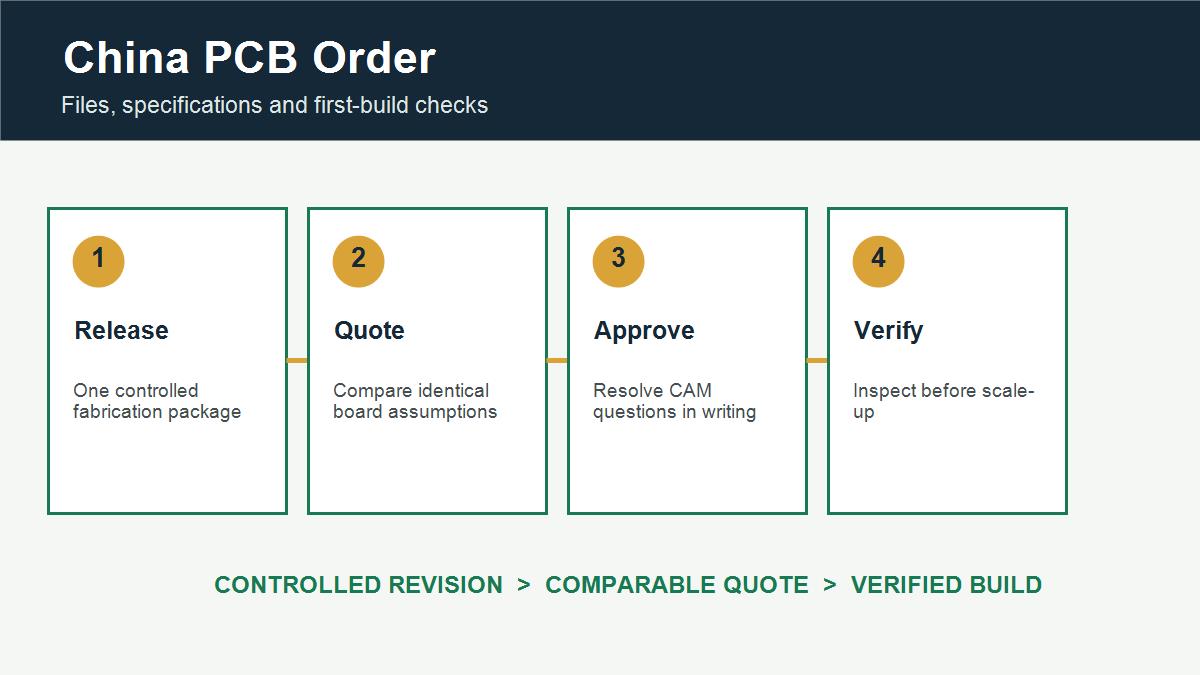
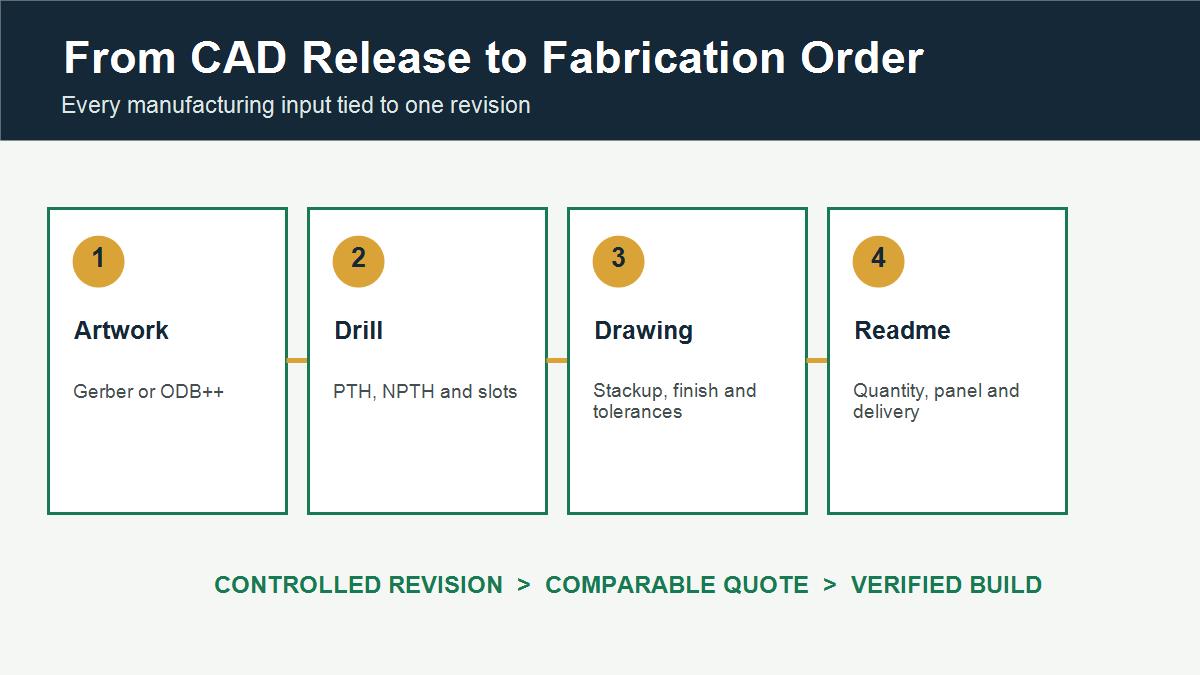
Before placing a China PCB order, release one controlled fabrication package, define the finished-board specifications, and ask every supplier to quote the same assumptions. The minimum package normally includes Gerber or ODB++, NC drill data, a fabrication drawing, stackup information when controlled, board quantity, panel requirements, and the required delivery date.
The goal is not merely to obtain a low price. It is to make sure the quoted board is the board you designed, that CAM questions are approved before production, and that the first shipment provides enough evidence for a repeat order.
Is This a Bare PCB Order or a PCB Assembly Order?
A bare PCB order produces the unpopulated circuit board. A PCB assembly order adds component sourcing, solder paste, placement, reflow, inspection and testing. This guide focuses on bare-board fabrication, so a BOM and component placement list are not the main inputs.
If you need assembled boards, prepare Gerber data plus a BOM and CPL and use an assembly-specific workflow. Keeping the two scopes separate prevents a supplier from quoting fabrication only when you expected complete PCBA.
Which Files Are Needed for a PCB Fabrication Order?
Send a complete, revision-controlled manufacturing package. Do not send several folders named “final” and ask the factory to guess which one is current.
| File | What it controls | Buyer check |
| Gerber or ODB++ | Copper, solder mask, legend and profile artwork | Layer names and polarity are unambiguous |
| NC drill files | Plated and non-plated holes, slots and tooling | PTH and NPTH are separated or clearly identified |
| Fabrication drawing | Dimensions, tolerances, finish, thickness and notes | Notes agree with the artwork and purchase order |
| Stackup | Layer order, dielectric construction and impedance intent | Controlled-impedance values and reference layers are stated |
| Readme or RFQ sheet | Quantity, panel, test, report and delivery requirements | Part number and revision match every file |
Review the PCB Gerber manufacturing-data guide if you are unsure how artwork and fabrication notes work together.
Which Board Specifications Must Be Frozen Before Quotation?
Freeze the specifications that change materials, tooling, process route or inspection. If a quote leaves one of these fields blank, ask what assumption the supplier used.
- Finished dimensions, board thickness and outline tolerance.
- Layer count, copper weight and stackup constraints.
- Base material family, performance requirement and any approved alternatives.
- Minimum trace/space, finished hole sizes and annular-ring constraints.
- Solder-mask color, legend requirements and surface finish.
- Controlled impedance, via filling, edge plating, countersinks or other special processes.
- Electrical test, coupon, report, marking, packing and panel requirements.
For multilayer work, the multilayer PCB capability page provides a useful starting point, but project acceptance must still be written in the order package.
How Do You Make PCB Quotes Comparable?
Compare quotes only after normalizing quantity, finished specifications, panel scope, tooling, test, reports, shipping basis and delivery date. Two prices are not comparable if one includes electrical test and freight while the other excludes them.
| Quote field | Question to ask | Common hidden difference |
| Board construction | Which material, copper and thickness were assumed? | Substitute material or different copper |
| Quantity | Is this delivered boards or production panels? | Panel waste counted differently |
| Engineering/tooling | Which charges recur on repeat orders? | One-time items mixed into unit price |
| Test and reports | What test coverage and evidence are included? | Electrical test or reports excluded |
| Logistics | Which Incoterm, carrier and tax basis apply? | Freight and import costs omitted |
What Happens During DFM and CAM Review?
The factory checks whether your released data can be manufactured on its process. CAM engineers may ask about conflicting dimensions, drill classification, copper-to-edge clearance, solder-mask openings, impedance adjustment or panelization. A question is not automatically a defect in your design; it is a decision point that must be resolved without losing revision control.
Ask the supplier to provide a numbered engineering question with a screenshot, proposed change, reason and affected characteristic. Approve or reject it in writing. If the change alters functional intent, update the source design and release a new revision instead of allowing an undocumented factory-only edit. The PCB DFM and DFA guide explains the wider review purpose.
How Should You Handle Stackup and Controlled Impedance?
State the target impedance, tolerance, reference layer, trace geometry and relevant net class. The fabricator may propose adjusted trace width or dielectric thickness based on available materials and actual process data. Review that proposal before production.
Do not approve a stackup by looking only at total thickness. Check layer order, copper weights, dielectric relationships, resin needs, final trace geometry and the planned verification method. Save the approved stackup with the purchase order revision.
Should You Order a Prototype Before Production Quantity?
Use a prototype or first article when design risk, new technology, mechanical fit, finish, stackup or supplier experience makes early verification valuable. A small order does not eliminate the need for a controlled file package; it gives you a cheaper point at which to find mistakes.
Define what the prototype must prove. Examples include connector fit, hole position, impedance, solder-mask registration, surface finish, assembly compatibility and functional performance after the board is populated.
Which Supplier Questions Matter More Than Marketing Claims?
Ask questions that produce verifiable answers tied to your board: What construction will be used? Which characteristics need engineering approval? How is electrical test performed? What first-article evidence can be supplied? How are nonconformities and repeat-order revisions controlled?
Certifications and equipment lists can provide context, but they do not replace a project-specific manufacturing review. Ask for the report format or sample evidence before the order if documentation is important.
How Do You Approve Engineering Questions Without Creating Errors?
- Confirm the question references the correct part number and revision.
- Identify the affected feature and functional requirement.
- Review the proposed change in the source CAD context.
- Record a clear approve, reject or replace-files decision.
- If files change, issue a new revision and withdraw the old package.
- Ask the supplier to confirm which revision entered production.
This sequence prevents a casual email answer from becoming an uncontrolled design change.
What Should You Inspect on the First PCB Build?
Verify identity and critical characteristics before authorizing a larger repeat order. The inspection plan should reflect the risks of your design rather than checking appearance alone.
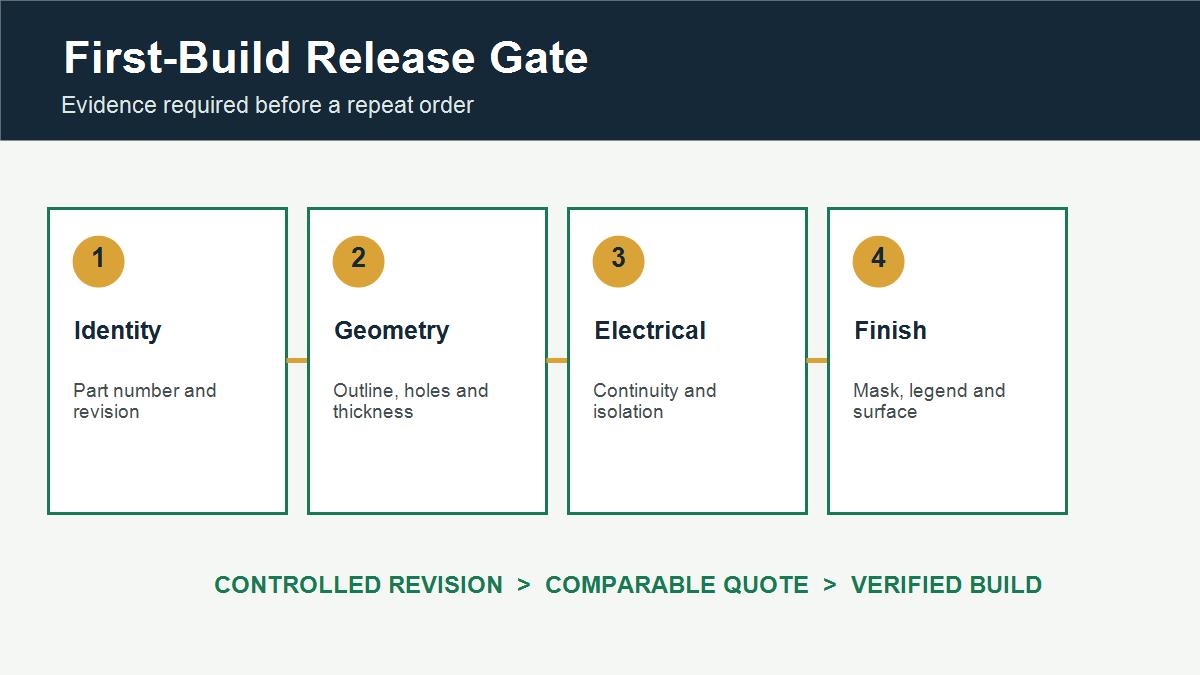
- Part number, revision, date code and quantity.
- Finished outline, thickness, hole sizes and critical positions.
- Layer construction or coupon evidence when required.
- Electrical continuity and isolation evidence.
- Solder mask, legend, surface finish and edge condition.
- Fit with connectors, enclosure and assembly tooling.
- Any special requirement named on the fabrication drawing.
Which Problems Should Stop a Repeat Order?
Stop and investigate if the shipment does not match the released revision, if a critical dimension or electrical requirement fails, if undocumented CAM edits appear, or if the supplier cannot trace the delivered boards to the approved construction. Separate cosmetic observations from functional nonconformities, but document both with photos, measurements and board identifiers.
Do not “fix” the next order with an email note alone. Update the drawing or source data, record corrective action, and create a clean release package.
China PCB Order Checklist
- Assign one part number and revision.
- Export and visually inspect Gerber or ODB++.
- Verify PTH, NPTH and slots in the drill data.
- Issue a fabrication drawing with dimensions and notes.
- Confirm layer count, copper, material and thickness.
- Define finish, mask, legend and special processes.
- State impedance and approved stackup requirements.
- Specify quantity, panel, test, reports and packing.
- Request quotes on the same assumptions.
- Resolve every CAM question in writing.
- Inspect the first build against critical characteristics.
- Archive the approved package for repeat orders.
When Is PCBTRY a Practical Fit for Your Order?
PCBTRY is a practical RFQ option when you need custom bare PCB fabrication and can provide controlled manufacturing data for engineering review. Prototype and production needs should be quoted against the actual stackup, materials, tolerances, finish and test requirements rather than a generic board description.
For an engineering review and quotation, send your Gerber or ODB++ package, NC drill files, fabrication drawing, stackup or impedance notes, quantity, panel preference and target delivery date through the PCBTRY contact page. If the design is still at prototype stage, review the China prototype PCB guide before release.
Frequently Asked Questions
Can I order a PCB using only Gerber files?
Simple boards may be quoted from Gerber and drill data, but a fabrication drawing or RFQ sheet is still needed to control thickness, material, finish, tolerances, test and revision.
Do I need a BOM for a bare PCB order?
No. A BOM is mainly for component sourcing and assembly. A bare PCB order needs fabrication artwork, drill data and board specifications.
Should I send native CAD files?
Send the manufacturing output requested by the factory. Native CAD may help resolve a question, but it should not replace a reviewed fabrication release.
Why did two suppliers quote different prices?
They may have assumed different material, copper, panel yield, test, tooling, shipping or lead time. Normalize those fields before comparing.
Can the factory change my trace width?
Only through an approved engineering process. Controlled-impedance adjustments may be appropriate, but the final geometry and stackup must meet the released electrical requirement.
What is a CAM question?
It is a manufacturing-data clarification raised before production, often involving conflicting notes, drill types, clearances, stackup or panelization.
How many prototype boards should I order?
Choose enough boards to support assembly, functional test, destructive analysis if needed, spares and at least one retained reference. The correct count depends on project risk.
Is electrical test automatically included?
Do not assume it. Ask which method, coverage and evidence are included in the quote.
What should I save for a repeat order?
Archive the approved fabrication package, supplier stackup, engineering answers, purchase order, inspection evidence and any corrective actions.
When should I request a first-article report?
Request it when critical dimensions, special processes, controlled impedance, new suppliers or regulated documentation make objective release evidence important.



0 Comments